

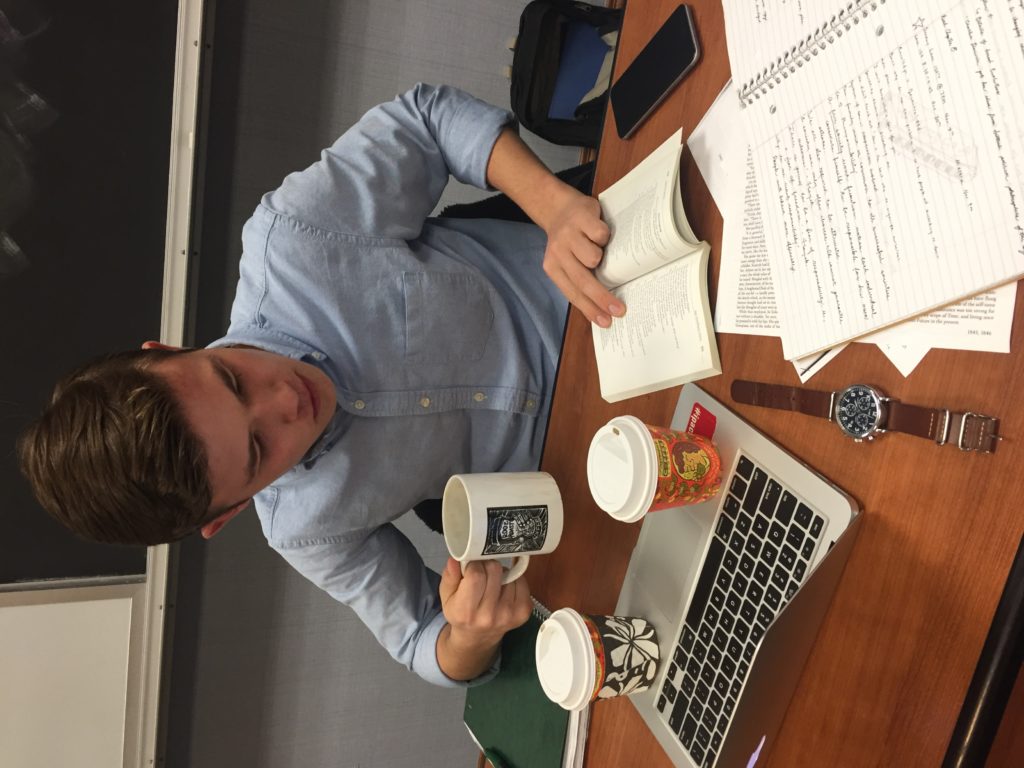
It’s 1:30 a.m. You’re drowning in pages-long finals reviews. You promised you wouldn’t drink any more coffee, but your biochemistry midterm is tomorrow, and your eyes glaze over every time you look at the page. You reach over and press the brew button on your coffee maker.
The U.S. Army and Department of Defense have developed an algorithm, the Wall Street Journal reported last month, which calculates the amount of caffeine a person would need to have the same level of alertness as if he had slept more than seven hours, the minimum number generally considered to be a healthy amount. The algorithm prescribes 200 milligrams of caffeine when one wakes up, followed by another 200 milligrams after four hours. For someone who plans to go several days without sleep, the guidelines suggest consuming 200 milligrams at midnight, 4 a.m., and 8 a.m.
At Hillsdale College, students are not immune to the caffeine trends. Students and faculty may use coffee solely for the caffeine boost, for taste, or both.
Junior Tim Runstadler Jr. began drinking coffee when he was in middle school, at a Boy Scout camp. Since then, he has been a faithful coffee drinker, but primarily for the taste. Holding a mug with six shots of espresso, Runstadler tried to recall the last day he hadn’t drunk coffee.
“I can’t remember a day I haven’t drank coffee in a very long time,” Runstadler said. “It sounds like a very crappy day.”
When asked about the algorithm, Runstadler, a potential candidate for the Marine program on campus, said, “it seems healthier to eat more and get energy from that.”
Sophomore Rebecca Joyce started drinking caffeine in Pepsi at age 2, due to an undeveloped central nervous system which created a sort of wired effect whenever she had a temper tantrum or burst of emotion, normal at that age. Since then, she has needed to take caffeine in large amounts to remain calm.
“I am known to drink four shots of espresso,” Joyce said. “But we’ve all been there thinking that taking that shot of caffeine will help you write that paper when it actually just sets your heart racing.”
Sophomore Kirby Thigpen said that the idea of creating an algorithm is “not a long-term solution for getting little sleep for soldiers.”
She doesn’t experience the same positive effects when drinking coffee on only a few hours of sleep.
“When I have less sleep and drink coffee, at first I feel OK but I do start to get really jittery and shaky after a while, and then I can’t get anything done,” she said. “Whenever I have more sleep, I tend to get more done when I drink coffee.”
The Army is not the only one to take advantage of the utilitarian aspect of caffeine.
Professor of English Justin Jackson considers himself to be more of a “coffee as fuel guy than coffee as taste guy.” If he had to estimate how much he drinks on a daily basis, he would say around 500 to 700 mg of caffeine.
This may be why he takes a caffeine-fueled nap every so often to boost his energy on days he finds it takes three to four times longer than usual to read something.
According to studies conducted by researchers at Loughborough University in the UK and in Japan, taking a cup of coffee and then a 20-minute nap directly after can be much more effective than just taking a nap or drinking coffee. After taking the cup of coffee, sleeping for 20 minutes allows the brain to clear itself of adenosine and also allows the caffeine to take its full effect.
Jackson highly recommends this practice to his students, especially those who take his afternoon classes, since drowsiness seems to set in after lunchtime.
“If students are feeling tired after lunch, why are you poring over a passage for an hour, not getting it, when you could just refresh your brain in 20 minutes and then you’ll get through that passage in 20 minutes?” Jackson said.
Jackson normally drinks a cup of coffee in the early afternoon, around 1 p.m.
“It seems to me you have three options: one, drink coffee, it will help you become alert. Two, go take a nap, it will reset your brain. Three, go drink coffee and take a nap,” Jackson said. “I prefer the third.”
Assistant Professor of Politics Adam Carrington started drinking coffee just a month ago, due to the arrival of his new infant daughter.
“I had a pretty good run. I got through undergrad, graduate school, and my first four years here, and then my daughter happened,” Carrington said. “Since she likes to get up at 5 a.m., she’s the biggest reason. I’m a slave to her and so now I’m a slave to coffee. They are twin masters.”
But Carrington felt that caffeine should be used sparingly and only under special circumstances.
“It can be a way of bridging through difficult times like Hell Week, finals week, midterms. It can be a little bit of a boost here and there,” Carrington said. “But if it’s running your life, especially at 18 to 20, that’s a problem, and I would say from our end, as faculty and staff, we should be encouraging you all to take care of yourselves.”
However, pulling all-nighters and practically living on coffee prevents students from fully participating in what Hillsdale aims to do, according to Carrington.
“If you end up doing that all the time, I think it’s going to hurt your health,” said Carrington. “In the end it’s going to hurt your education and what we are trying to do here. We want you all to be healthy, knowledgeable, good, functioning citizens and human beings. If you have to be hooked up to an IV, how healthy are you being?”
Professor of biology Silas Johnson noted the military’s history of experimenting with substances, including amphetamines. Johnson said most drug use, including caffeine, is not necessary for normal adults.
“I think for most normal healthy adults it’s not a necessity to consume any stimulants or depressant compounds,” Johnson said. “But it is very human to do so.”
