
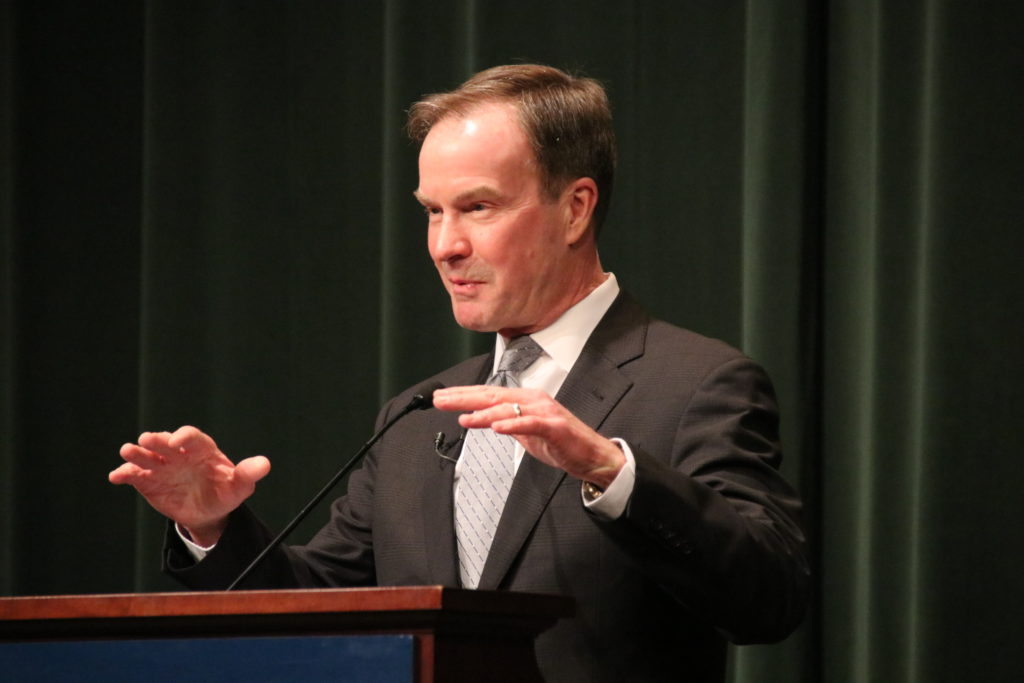
The first person in Michigan history to serve in the executive, legislative, and judicial branches spoke about two heroines at Hillsdale College on Wednesday afternoon.
Attorney General Bill Schuette, who is in the running to become the 49th governor of Michigan, told the story of two women whose courage and talent brought to justice convicted serial child molester Larry Nassar. Schuette spoke in Phillips Auditorium to a group comprised mostly of donors. In his speech, he described the stories of Angela Povilaitis, the attorney who prosecuted Nassar, and Rachael Denhollander, a former gymnast who first exposed Nassar’s crimes.
“Rachael’s voice stopped Larry Nassar,” Schuette said. “Her courage made it possible for more than 250 women to come forward, and stand up, and use their voices, and condemn a man who abused them during the most tender of years.”
Schuette assigned Povilaitis to prosecute Larry Nassar, a former osteopathic physician at Michigan State University. He has promised a thorough investigation into how Nassar committed sexual assault for decades in a state university.
“When I assigned Angie Povilaitis to be the lead prosecutor in the Larry Nassar case, I knew her skills as a prosecutor made her the right choice,” Schuette said.
Schuette said he told the story of Povilaitis and Denhollander because sometimes bureaucracies fail and injustices occur.
“When institutions fail, the solutions must come from individuals,” he said.
Junior Tess Skehan introduced the attorney general.
“The way he discussed the role of women in terms of helping one another in the state was very impressive,” she said. “I’m excited to see what his campaign holds.”
Schuette, a Republican, announced his campaign for governor on Sept. 12.
His bid for governor is the next step for a politician who has consistently held federal and state office for about 30 years. He served as Michigan’s 10th District representative from 1985 to 1991, when he accepted a position as director of the Michigan Department of Agriculture until 1995.
He then served in the Michigan Senate from 1995 until 2002. He was a judge for the Michigan 4th District Court of Appeals from 2003 to 2009. The people of Michigan elected him as attorney general in 2010.
He’s a native of Midland, Michigan, the same town where his parents raised him and he raised his children. His life in Midland inspired his first book, “Big Lessons from a Small Town.” The book does not endorse political positions. Instead, he recounts his story, starting as a waiter and rising to become the leading GOP candidate for Michigan governor.
The most recent polls from RealClearPolitics show Schuette leading his GOP primary opponents by more than 20 points. Schuette will face leading Republican opponents Lt. Gov. Brian Calley and state Sen. Patrick Colbeck in the Aug. 7 primary. In a head-to-head matchup against Gretchen Whitmer, former senate minority leader and the leading Democratic candidate for governor, Schuette would lose by 7 points, according to a Detroit News poll.
After Schuette’s speech about the women who exposed and prosecuted Nassar, the audience asked policy-oriented questions about his campaign for governor.
Schuette touted his adherence to the rule of law in Michigan as it applied to prosecuting sexual assault cases and the Flint water crisis. An audience member asked how he would apply the rule of law to immigration in Michigan.
“I’m a rule of law guy,” he said. “Those states that are ignoring the federal law are wrong. If you don’t like the law, then you change it, but you don’t flagrantly violate it.”
He did not give his stance on controversial federal issues, like the border wall or Deferred Action for Childhood Arrivals. Schuette refused to answer questions about the federal government, specifically those relating to President Donald Trump. Instead of worrying about drama in national politics, he said he is concerned about “jobs and paychecks” in Michigan.
Another audience member asked how Schuette would address opioid abuse if elected governor.
“You have to do two things. You have to have greater treatment facilities for people to help them get well,” Schuette said. “We need better education about the dangers of opioid abuse.”
He said “unscrupulous doctors who overprescribe” have contributed to the problem. He also said Michigan has to solve the issue through treatment, adding that “you can’t arrest your way out of this.”
“He highlighted how he upholds the rule of law and conservative policies, such as a lower tax rate and prosecuting corrupt officials,” said senior Jonathan Moy, who works on Schuette’s campaign. “He has set his goals high, and I think he’s accomplished them.”
