
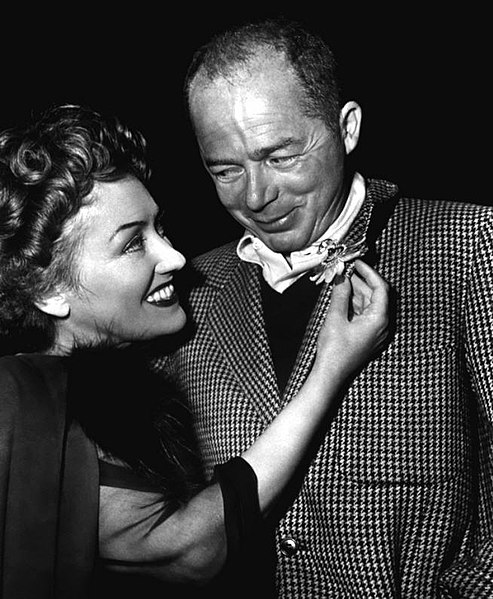
“A director must be a policeman, a midwife, a psychoanalyst, a sycophant, and a bastard.” This is how Billy Wilder described his role in 1960, the year of “The Apartment,” for which he won three Academy Awards as not only director, but also producer and screenwriter.
Anthony Lane from The New Yorker wrote of Wilder’s legacy, “Over and over, Wilder shows us mankind behaving badly, or using one another as props and pawns, or racing into follies from which there is no escape, and still, like sheep to the shearer, we come back for more.”
Wilder’s unique, stylistic twist on the genre of film noir and unconventional themes made his films unprecedented in the cinematic world. Pushing the boundaries of acceptable subject material for film by exploring themes of adultery, alcoholism, and crime, Wilder produced some of the best films of Hollywood’s Golden Era.
Wilder wrote a moving script for “The Lost Weekend,” which came out in 1945 and follows one man’s struggle with alcoholism. The alcoholic, Don, pleads for a drink, saying, “Let me have my little vicious circle. You know, the circle is the perfect geometric figure. No end, no beginning.” Don’s last words in the film are, “Out there in that big concrete jungle, I wonder how many others there are like me? Poor bedeviled guys on fire with thirst. Such comical figures, to the rest of the world, as they stagger towards another binge, another bender, another spree.”
“Sunset Boulevard” tells the story of a retired movie star desperately trying to make her comeback, and a bankrupt screenwriter whose work won’t sell. When the two become lovers, the screenwriter’s eventual infidelity leads to the movie star’s jealousy, insanity, and tragic end.
Starring Hollywood’s icon Marilyn Monroe, “Some Like It Hot” premiered in 1959. The strong themes of sexual comedy, raucous humor, and cross-dressing completely violated the Motion Picture Production Code, which had been for almost 30 years. “Some Like It Hot” led to the eventual rejection of the code in 1968 and the creation of the MPAA film rating system, which is still used today. In 2009 the American Film Institute named the film the best American comedy ever made.
“Double Indemnity” is perhaps Wilder’s darkest film. An insurance salesman becomes involved in a murder when he falls in love with a woman intent on killing her husband and living off of the fraudulent accidental death claim. As the two plot the murder, the moral corruption of these characters grows more disturbing. After they succeed in killing him, the salesman’s depravity leads him to another violent act.
The film is marked by a mood of pessimism, fatalism, and menace. Wilder uses a unique lighting system to darken the film, casting shadows across faces, dark corners of rooms, and alleyways to accentuate the mystery, crime, and depravity of the film. He also uses a film noir style called Venetian blind lighting, where the lines of a window blind cast deep shadows on a character’s face.
Not only did Wilder write and direct movies, but he collaborated with world-class Hollywood stars in order to produce phenomenal performances. In fact, Wilder directed fourteen different actors in Oscar-nominating performances. When working with actors, Wilder’s method was to consider the limitations of the actor and bend the script to those limitations, rather than force the actors to perform beyond their ability.
Wilder coaxed Hollywood stars Gloria Swanson and Erich von Stroheim out of retirement to perform in “Sunset Boulevard.” Swanson would go on to win the Golden Globe Award for best actress.
Billy Wilder’s legacy is evident from the mark his movies have made on the cinematic world. With their bold, raucous themes and extraordinary actors, his films leave the viewer with both a shudder and a smile.
