
President Donald Trump has an opportunity to make an unprecedented deal and create a legacy. That opportunity is North Korea.
Last week, the White House announced a stunning event: Trump will meet with Supreme Leader of North Korea Kim Jong Un. No sitting president has ever met with the North Korean state. This bold step will open the door for the possibility of peace on the Korean Peninsula. Nothing is guaranteed, but these talks could lead to a denuclearized North Korea.
For most of his term, Trump pursued a hardline policy against North Korea, memorably dubbing Kim Jong Un “Little Rocket Man.” Trump threatened “fire and fury” against the nation if it continued its nuclear threats, and pursued his aggressive stance through the 2018 Pyeongchang Olympics.
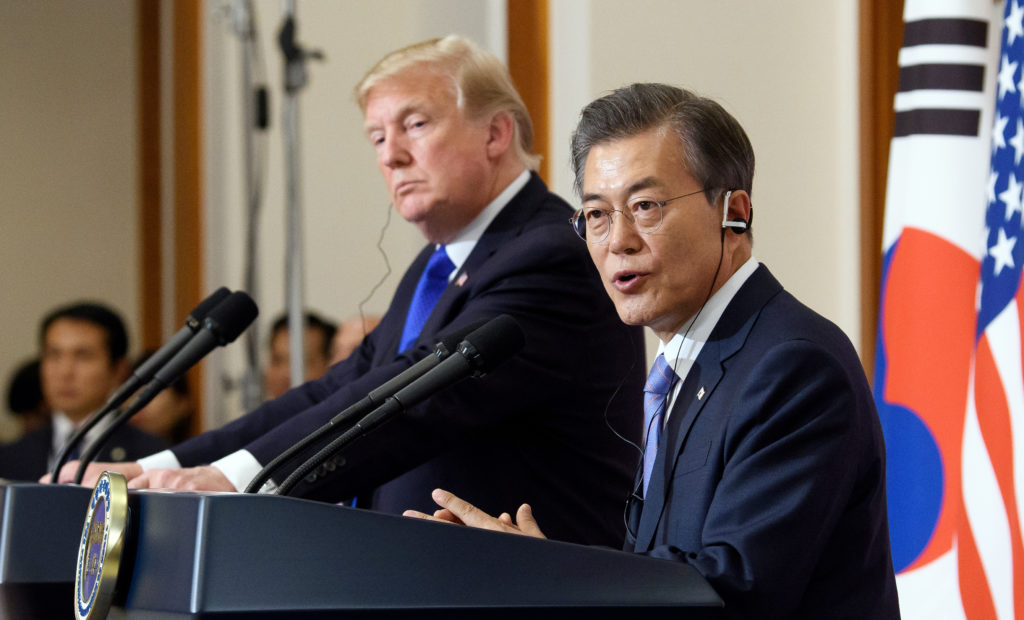
But now the landscape has shifted. South Korean President Moon Jae In has been working behind the scenes for months to orchestrate détente between North Korea and South Korea. And in an unprecedented move, Trump suddenly agreed to participate in talks. Trump feels that his months of threats against Kim Jong Un has forced them to consider denuclearizing. If he’s right and his self-proclaimed negotiation skills hold up, this could be the greatest achievement in American relations with East Asia since Richard Nixon’s visit to China.
A denuclearized North Korea is perhaps the administration’s top foreign policy priority. After all, no other nation poses a real nuclear threat to the U.S. mainland. And no other leader besides Kim Jong Un would be self-destructive enough to follow through on such a threat. An agreement with North Korea would take both South Korea and the U.S. out of the shadow of the bomb. Achievements like that are what create presidential legacies.
So why the sudden shift in tactics? Nixon himself may provide the answer. The president famously subscribed to the so-called “madman theory.” He aimed to give off the impression that if he were pushed too far, he could snap and unleash nuclear war. The aim was to scare foreign powers into doing whatever it took to keep the supposed “madman” happy. The Machiavellian tactic, combined with the strategy of brinkmanship, kept the Russians and Vietnamese on their toes, fearing an unpredictable U.S. response.
While Trump may not have explicitly pursued the appearance of a “madman,” he is at least employing his much-touted negotiations skills. To get something from a foreign power they have to believe that the alternative is far worse. Think of this as the classic “bad-cop” routine. North Koreans have repeatedly violated past agreements, knowing that they would be safe inside their Hermit Kingdom. But if they know that the punishment for faithlessness is “fire and fury” — or nuclear war — then they may be more willing to follow the agreement.
Sure, there is a risk of ending up with a bad deal. But that’s the case with any negotiation. There’s little risk in simply coming to the table, while the upside could provide peace to the region. Some media outlets have claimed this will give Kim Jong Un what he wants by legitimizing his regime. Yet, many of the same outlets decried Trump’s threats last year.
They have to face the facts: North Korea is a true threat, and the United States must protect itself and pursue peace, which means Trump must use threats and brinkmanship when needed and diplomacy elsewhere.
If Trump understands one thing, it’s negotiation. He knows how to use harsh rhetoric to get what he wants, and he knows how to compromise when necessary. Time will tell if the North Korea talks will end in peace. But by opening up the avenue for diplomacy, the administration showed its willingness to take unprecedented steps toward peace and stability.
And that’s what legacies are made of.
Noah Weinrich is a senior studying politics.
