
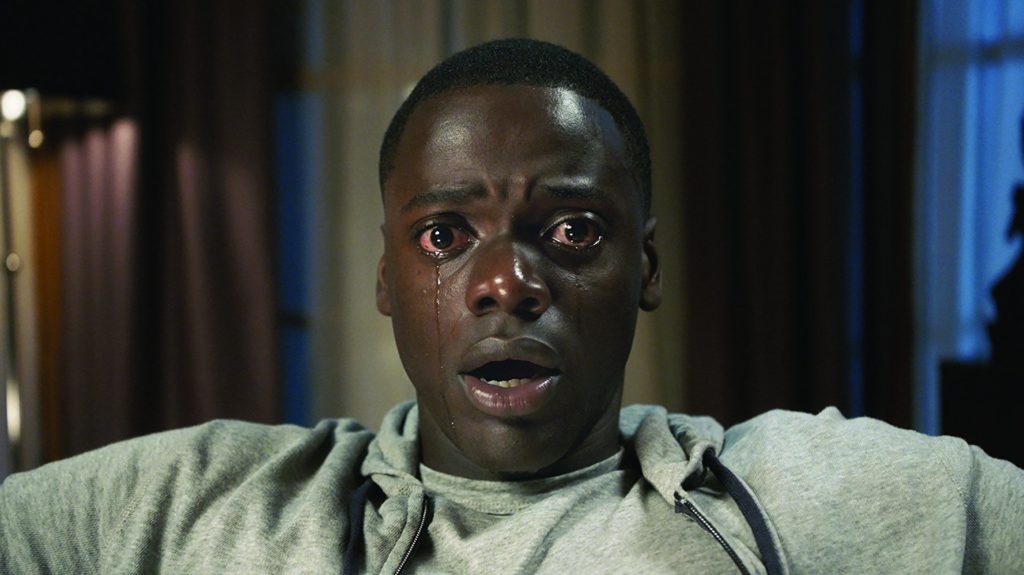
Director Jordan Peele’s debut film, “Get Out,” a thriller-comedy with elements of psychological horror, challenges and expands the traditional American definition of racism, leaving audiences much to contemplate but little to act upon.
“Get Out” is nominated for Best Picture at the Oscars, and although Peele deserves recognition for the movie’s original commentary on race in America combined with a refreshing reinterpretation of the thriller genre, the historical scope of candidates like “Dunkirk” and “The Darkest Hour” dwarfs the thriller-comedy.
In its attempt to show white Americans as oblivious, privileged, and subtly bigoted, “Get Out” obscures actual racism. But what the movie lacked in a social commentary, it made up for with its patiently drawn-out plot line.
Most thrillers can’t seem to make it 15 minutes past the opening scene before the villain’s revealed, the protagonists start dying, and the writers abandon all semblance of plot in exchange for a predictable sequence of unearned jump scares. Not “Get Out.”
Although it’s pretty clear from the beginning that white people are bad and black people are good, it isn’t revealed who’s in on the conspiracy or what it is until three-quarters of the way through. The movie’s patience leaves viewers in a state of anxiety and uncertainty, the best emotions for a thriller.
And while it doesn’t parallel the most serious forms of oppression in modern America, “Get Out” does give a unique interpretation of liberal or left-wing racism.
For a Fox News-watching, white, deplorable American, the message of “Get Out” feels clear: Whiteness bad, blackness good. And it’s hard not to feel this when (spoiler alert) the white people in “Get Out” hunt black people, alter their brains, and turn them into slaves. It’s a heavy-handed narrative, though not one without justification.
In the film, Rose Armitage (Allison Williams) brings home her boyfriend, a black man, to meet her family. Armitage’s family acts affectionately toward Chris Washington (Daniel Kaluuya), while making subtle references to his race but never addressing it outright.
In the first conversation between Armitage’s father and Washington, the father says, “By the way, I would have voted for Obama for a third term if I could.”
With awkward comments like this, the movie addresses the fascination that white American liberals have with praising the culture, traditions, and faculties of black Americans, all the while disrespecting white culture as oppressive, irrational, and overly religious.
Those who defend the racially charged message of “Get Out” argue that it presents racism through the lense of a horror film, making the message more palatable for people not inclined to believe the narrative. But the racial bias is so thinly veiled, and with so little tact, that it turns away white Americans who may have connected with its premises if they were presented on less hostile terms.
The original take shows the shift racism has undergone in American culture. The image of racists as white men wearing hooded white robes is all but dead in the United States. Peele doesn’t attack Neo-Nazis, either. The new racist is the white liberal, what some movie reviewers have referred to as the “negrophile.”
And this agenda leads to uncomfortable, even cringeworthy, moments in the movie, especially when 60-plus-year-old white people make insensitive comments.
At one point, a white man is praising Washington’s superior “frame and genetic make-up,” eventually concluding that “black is in fashion.”
In an interview with NPR, Peele said he wanted the audience to feel the irritation that comes from the “sort of lame reaching out to make a connection.” This reaching out is rarely to understand black culture, making it banal and disrespectful.
“So it was important to me to, first of all, put the entire audience on the same page of what it feels like to be aware of these little subtle interactions and the sort of underlying racism that is sort of just being even slightly distracted or to be made aware of your own race in a normal conversation,” Peele said.
Liberal racism will never be this obvious, but maybe the film’s writers thought Americans needed an overbearing presentation of it to realize the absurdity of these sorts of statements. But there’s a danger to this, too: By presenting racism as a series of microaggressions, in which elderly people from different generations unwittingly make uncomfortable comments, “Get Out” could neglect the harsher realities of poverty, crime, and discrimination about life as an African American, realities hardly imaginable to most middle-class Americans.
Racism isn’t a plot that can be uncovered. Rather, marginalization of the black community is propagated by a series of decades-long government policies, including state-sanctioned abortion, anti-family welfare policies, and a racially motivated War on Drugs that has unjustly incarcerated generations of black men.
There’s no evil lair in the basement of a rich, white family, where elites gather to oppress poor, black people. The oppression is in front of our eyes.
