
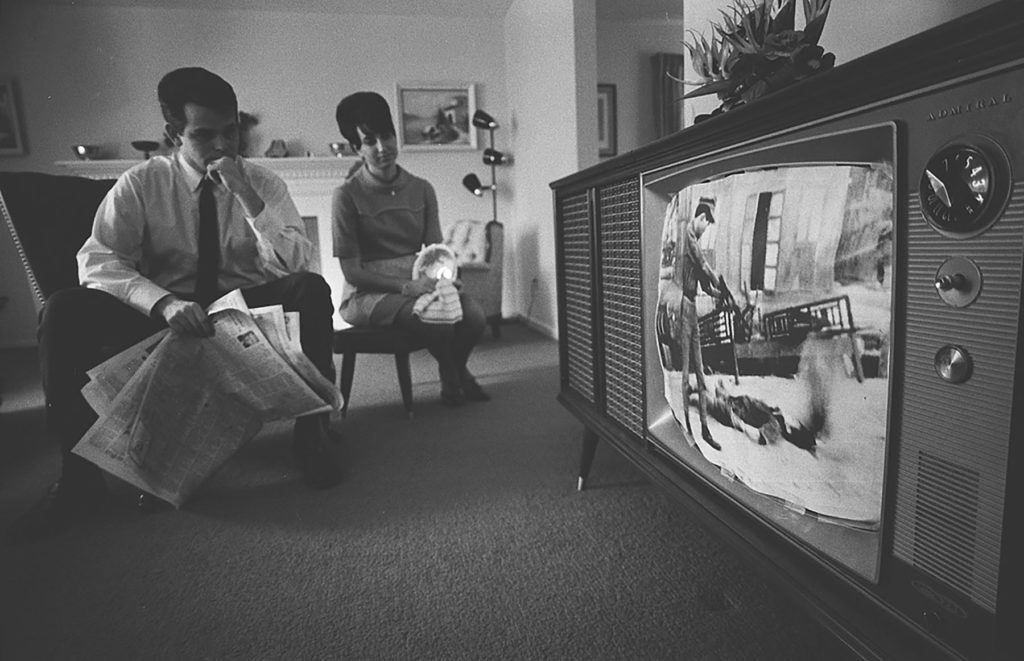
War, revolution, riots, assassins, rights, men on the moon – this was the 1960s.
This was the era in which Vietnam rattled with gunfire and burned with napalm as American soldiers battled the communist Viet Kong, while on the shores of the U.S., young men publicly incinerated their draft cards.
Martin Luther King Jr. declared the dream he had for his children and the children of America — to “not be judged by the color of their skin, but by the content of their character” — atop the steps of the Lincoln Memorial.
In 1961, President John F. Kennedy promised to put an American on the moon before the end of the decade. Two years later, in Dallas, Texas, he was shot fatally in the head and neck.
In 1969, over all the noise and the riots, Neil Armstrong stepped into the dark solitude of space, his boot imprinting into lunar dust.
Now, in 2018, we take a look back.
“It is the duty of every citizen to know his country’s history,” Director of the Center for Constructive Alternatives Matt Bell said. “Much can be learned from studying historical periods of turmoil and change.”
On Jan. 28, the 1960s Center for Constructive Alternatives will begin, bringing perspective and insight to the 167 students registered on why this revolutionary decade is closer to the present day than younger generations might expect.
Darryl Hart, distinguished associate professor of history at Hillsdale College, grew up during the 1960s.
“It’s hard for me to think that for someone like me the 1960s is about as far in the past as FDR was. It’s still fresh in my mind,” he said.
Despite the distance, Hart said this era is an important time.
“I guess I would like students to gain a sense of freshness of how important the ’60s were, and to gain a taste of it in as many flavors as possible,” said Hart, who will sit on the CCA’s faculty round-table on Jan. 31. “It’s a fascinating time in U.S. history.”
Throughout the 1960s, people marched in the streets for the causes such as civil rights. A broad political group known as the New Left began to form, which advocated for concepts such as abortion rights, drug reform, environmentalism, and the revitalization of Marxism.
Although not wholly similar to the civil rights movements, modern-day social justice activism, from fourth-wave feminists to members of Black Lives Matter, can be traced back to the 1960s.
“All of those I think have roots,” said Peter Blum, director of sociology and social thought at Hillsdale and fellow member of the faculty round-table.
“It was in the 1960s, I think, that people really began to talk in some of the ways we’re now used to talking about: some very general areas of controversy, and areas having to do with social change, technological change, the effects of contemporary society on a lot of traditional emphases that we tend to value around here,” Blum said.
Such traditional emphases would include America’s conservative notions of sex with the rise of the Sexual Revolution, which would make contraceptives and abortion easier on the American social palate.
Hart reminisced about the impact of the Sexual Revolution on movie audiences.
“My parents didn’t really want me to go to movies,” he said. “I bent the rules there and I went to movies that they didn’t approve of. I, like most Americans, came to think that one-night stands and hook up cultures were fairly normal, although I do still disapprove of it.”
The popularization of casual sex in media would be further developed by the erotic film industry of the 1970s, during which X-rated films such as “Last Tango in Paris” were produced. However, millennials might be better acquainted with mainstream internet porn, the entertainment media’s hyperbolic portrayal of promiscuity among teenagers, and the widely consumed (and harshly criticized) erotic novel, “50 Shades of Grey.”
“I guess you could argue conservatism was, in some ways, organizing itself or had to respond to the crises created by the ’60s,” Hart said.
Blum agreed.
“We wouldn’t have conservatism, as it exists now, without the New Left.”
