
A girl of about eight who wore a hot pink cardigan — with bangs dyed to match — leaned back, lifted her iPhone, and snapped a photo of Cindy Sherman’s “Untitled #92,” a photograph of a frightened young woman in a school uniform, hair cropped short, face blanched, pupils contracted to pin points.
“That’s beautiful,” her mom said. Later, her mom sighed: “They all look so sad.”
For an off-campus day trip, Hillsdale College’s art department bused 47 students and family of faculty to Chicago Saturday to explore the vast, well-curated, and slightly overwhelming Art Institute of Chicago. (Maps are available for download — perhaps the docents are sick of giving directions to lost tourists).
Some students took the chronological approach to art museums, beginning in antiquity, but one student group, including senior Leah Hickman, juniors Abe Norman and Madeline Richards, sophomore Hannah Socolofsky, and German foreign exchange student Nina Bernard decided to go backward, beginning with modern and contemporary art.
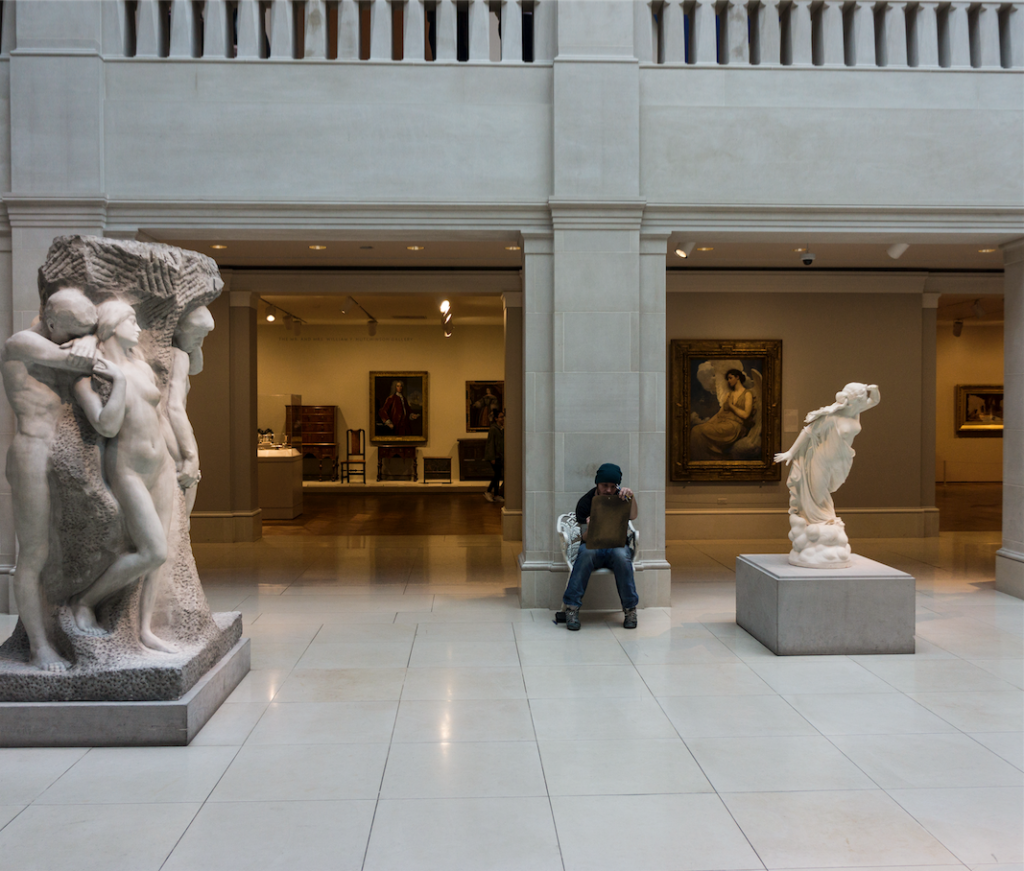
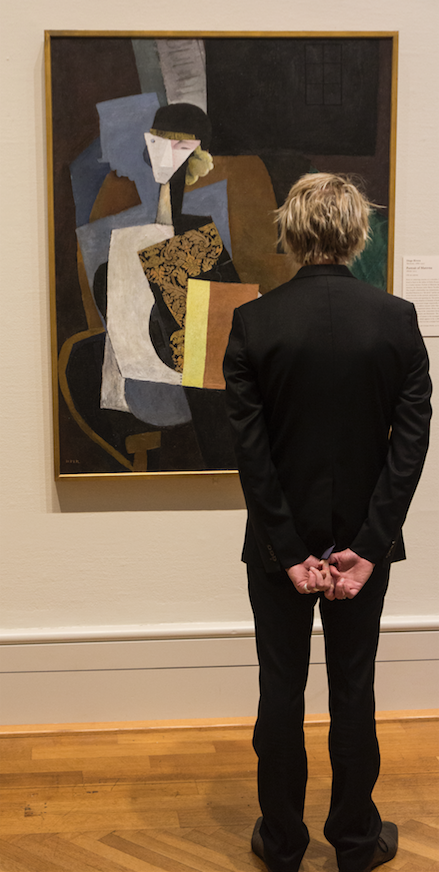
Touring the museum in a group, Norman began snapping pictures of how different people stood while appreciating art. He said he liked hearing everybody’s opinion and how they experienced each piece, the differences and similarities, and how that reflects their personalities.
Student 1: “I’m trying to understand this painting.”
Student 2: “Obviously, he’s trying to make you think.”
Student 1: “Why is the word blue on the orange paint, and the word red on the yellow? I can’t find a pattern.”
Student 2: “Does life even have a discernable pattern?”
Student 1: “Yeah, life and death seem kind of like patterns.”
Student 2: “But wait, Abe, you can’t understand life without death.”
American-born Jasper Johns’s “False Start” used words to name colors, not label them. Maybe it’s the same idea as this ironic conversation about existence. You can’t understand one color without the others, and you can’t understand life without death.
At least that’s the corny version.
The museum’s cafeteria: jazz music playing in the background, people sitting in sleek chairs eating their overpriced gourmet lunches at pristine white tabletops under abstract, colorful mobiles, and a married couple sipping champagne with their lunch a table over.
“After lunch, every piece would be amazing,” Norman said.
Maddie Richards could spend hours in front of Monet’s “Water Lilies” — and the impressionist exhibit was certainly impressive. But she said she enjoyed seeing the mix of styles and forms and materials used in the modern and contemporary exhibits.
“I appreciate that in a different way than Monet and Singer Sargent, where connection to the piece, brush strokes, and sensual colors are more important,” Richards said. “Some provoked feeling and thought, some I had to read the plaque, but that depends on your experience of the art to begin with.”
For her, abstract art makes her think, requires more effort: “It’s thought provoking and chaotic.” Nina Bernard, a German foreign exchange student studying English and art, couldn’t wait to see the Native American art that she is studying in class, mostly because Native American art doesn’t figure heavily in European art museums.
A crowd of people surrounded an old woman larger than life, painted in grayscale, wearing a white veil: “Arrangement No. 1 in Black and Grey,” or more lovingly known as “Whistler’s Mother,” who flew in from the Musée d’Orsay in Paris.
Richards sat on the bench directly facing Whistler’s mother, remarking the large, flat masses of color and the thin application of paint — so different from the textured, vibrant impressionist color palette.
After ceding the bench to other Whistler aficionados and navigating the crowd, the group found itself in the much larger crowd of people milling through the rooms dedicated to impressionism: famous artists like Claude Monet, George Seurat, and Pierre-Auguste Renoir, but also lesser-known painters like Paul Sérusier, Berthe Morisot, and Harald Sohlberg.
Sokolofsky, grasping at imaginary paintbrushes: “I can imagine him in an artistic frenzy, I can see him clutching his paintbrushes … you can see the energy that goes in and the vitality that goes out.”
“He was truly revolutionary,” Richards said. “He did it with vigor and vitality, and people can just appreciate his skill.”
The bench-side musings turned toward life speculations. Sokolofsky credited the impressionistic texture and color techniques with stimulating her imagination and esteemed the impressionist painters and their works for their role in her cultivation of wonder.
Richards recalled an adage from a high school teacher: “If you want a beautiful life, you need to find at least three things a day that are beautiful. It’s really changed me: I’ve become more optimistic and grateful, and just appreciate things like this.”
Sokolofsky turned back from Richards to the painting: “Nature pieces force you to stop and say, ‘That’s lovely.’”
She waved to the lilies.
