
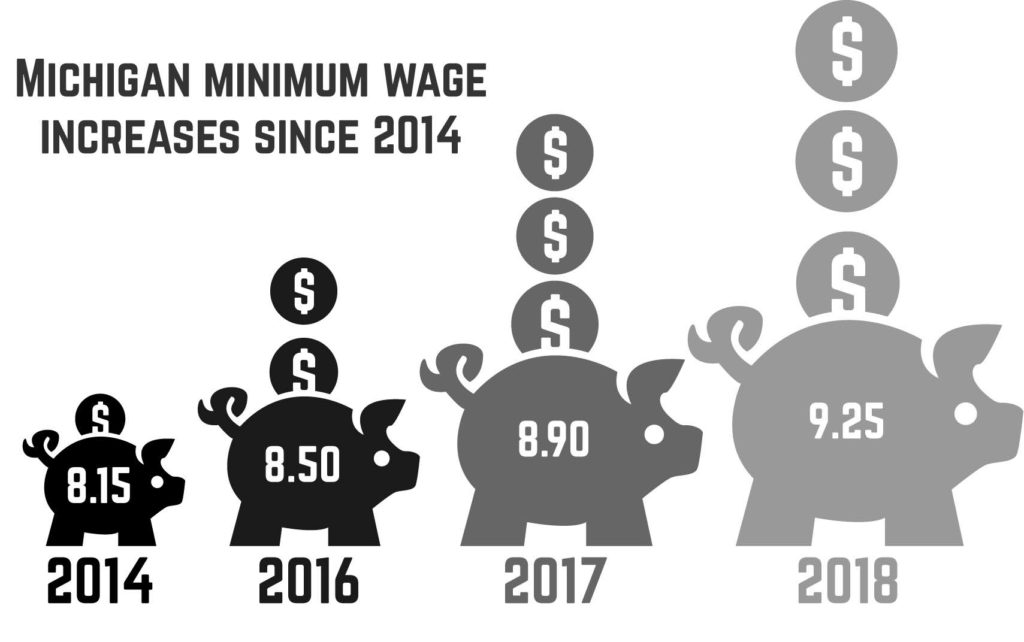
Student workers are getting a boost in pay this semester, after Michigan’s minimum wage increased from $8.50 to $8.90 per hour Jan. 1.
“It means they’re getting paid more,” Chief Administrative Officer Rich Péwé said.
After Michigan Gov. Rick Snyder signed the Workforce Opportunity Wage Act into law in May 2014, the college’s departments have budgeted for the changes, as the minimum wage gradually raises to $9.25 by Jan. 1, 2018. The increases led to a temporary halt on the semesterly wage made previously available to students and decreases in hours for some.
Many departments, such as Mossey Library, rely upon student employees to function. Knowing when the minimum wage is increasing allows them to submit their budgets to the college with the raises factored in, a luxury missed in 2014 when the law passed after the departments had already submitted their budgets, rendering it too late to factor in the increase.
“We had to make cuts,” Public Service Librarian Linda Moore said. “We need our student workers.”
But for departments independent of the college’s financing such as the college bookstore, which runs off what it makes, the minimum wage increase means it has to make cuts to keep expenditures low. The bookstore had to cut some student hours, as it did last year, said Cindy Willing, the bookstore’s director. It may even eliminate a student employee in the future, once the seniors graduate, Willing said.
“I don’t want to,” Willing said. “I love having students in the store. They’re good workers.”
Junior Erin Wonders is a cashier in the bookstore and said her and her colleague’s hours were cut in the less busy mornings and late afternoons. Although Wonders said she likes the extra money from the minimum wage, it makes it difficult for employers to reward their workers.
“I think it’s hard that if you get promoted and then the minimum wage gets increased, it’s hard for employers to continue that [difference in pay] for doing the same thing you were doing before,” Wonders said.
That shows in the college’s decision last year to suspend 10-cent semesterly wage increases until further notice. Although some students can get paid extra for working unfavorable hours, holding supervisor roles, or using unique skills, most student employees are being the same minimum wage, regardless of longevity.
“We’re holding off until we stabilize and look at that again over time until the market is where it needs to be,” Péwé said.
Other students expressed concerns about the effect of the minimum wage increase on prices.
“I’m really unfavorable,” said junior Holly Irmer, a library reference worker. “It doesn’t matter that I get paid more. I have to pay more for things.”
Irmer said this became evident to her when she returned to Michigan from winter break when she worked at Shoe Sensation in Nebraska, making a $9 minimum wage.
“Here, I can buy milk for $1.29,” she said. “I couldn’t find anything cheaper than $2.30 at home.”
As for salaried employees, a U.S. Department of Labor rule under the Fair Labor and Standards Act looked to double the overtime threshold, increasing those eligible for overtime pay from $23,660 to $47,476 a year, starting Dec. 1. Péwé said some employees of the college would have been affected by the law, but an injunction by a federal judge has prevented the law from being enacted while the courts determine if the federal department’s rule is valid.
“We were prepared, but it didn’t go into effect,” Péwé said.
