
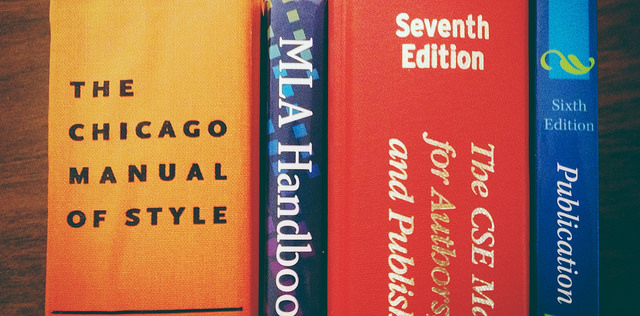
Hillsdale College’s English department is switching from the Modern Language Association style guidelines to those of the Chicago Manual of Style next semester.
Associate Professor of English Dutton Kearney said the department made the switch because the eighth edition of MLA released in April essentially removes standardization from its formatting principles. There is now no set format for in-text citations, and the MLA handbook asks only that students be consistent with whatever system they choose to invent, he said.
“The eighth edition has the lofty goal of being more flexible and responsive, but it goes about it entirely wrongly,” Kearney said. “Everything that we used to teach as required has now become optional.”
According to Purdue University’s online writing lab, the eighth edition of the MLA handbook “focuses on the writer’s strategy and individual decisions. The writer’s goal should be to provide a document and list of sources that is easy for readers to use so that the reading experience is informative and enjoyable.”
English professors met to discuss the new edition and decided it was time for the department to make the change. Provost David Whalen said the school has used the MLA guidelines since before he arrived at the college in fall 1994.
“This eighth edition of MLA is a pretty major overhaul,” Professor of English Justin Jackson said. “The thought was if we have to relearn a style, do we really want to go with MLA? Chicago, or some form of this, is what most academia or most university presses use.”
Hillsdale’s departmental agreements require professors to enforce “correct and complete documentation of research sources.”
The changes to MLA, then, would also make grading papers more difficult because of the standard’s new subjectivity, Professor of English Dwight Lindley said.
“The new rule is almost that there aren’t rules,” Lindley said.
Additionally, Lindley said learning Chicago style will give students an advantage once they graduate. Although MLA is associated with literature, most academic journals use Chicago.
The change, however, is a long time coming, Jackson said. In 2009, the seventh edition of the MLA handbook removed the requirement of footnotes in papers. That raised a flag that the standards were drifting away from the scholarly approach Hillsdale wants, Jackson said.
“Chicago offers a far more thorough way of citing research,” Jackson said. “No one here hated MLA. They just changed so radically that we would have had to relearn it. So it was time to switch.”
Students taking English classes may have to be more diligent in using Chicago style, Jackson said. That’s especially true for freshmen, since many high schools teach MLA style. Nevertheless, Jackson said the switch shouldn’t present too much of a challenge.
“MLA is a much simpler documentation style, so it’s much simpler to learn,” Jackson said. “Chicago is far more scholarly and superior.”
The English department will not be the only use Chicago style. The history department requires Chicago or Kate L. Turabian’s A Manual for Writers of Term Papers, Theses, and Dissertations. Other departments, like the philosophy department, allow students to decide which format to use, said Tom Burke, philosophy and religion chairman and humanities dean.
Although Kearney said the most important aspect of an essay is its content, requiring proper formatting teaches students to express their thoughts in a professional manner.
“Like the MLA, the English department is focused on making communication and analysis more important than formatting,” Kearney said. “But if a student takes care to format a document properly, it’s because its content is important to him or her.”
