
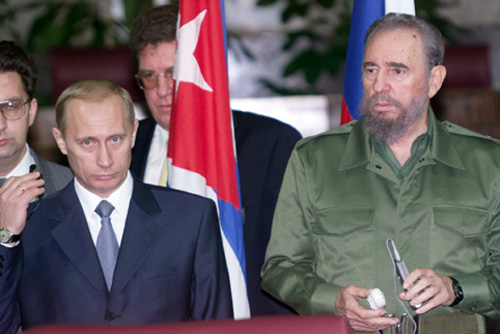
Fidel Castro, the fiery revolutionary who defied American presidents for half a century as Cuba’s supreme leader and brought the world to the brink of nuclear war, is dead at age 90. His brother and successor Raul announced the death via Cuban state media Friday.
“The tyrant is dead,” chanted jubilant crowds of Cuban Americans in Miami’s Little Havana. Clanging pots and the waving of Cuban flags shaped a celebration decades in the making. Many cheered the death of the man who may have been the most important Latin American leader of the 20th century.
In 1959, many cheered not his death, but his success, as Castro and his ragtag rebel army entered Havana victorious. Soon, however, they began to flee as Castro’s communist reign took everything, from their possessions and heritage to their loved ones and freedoms. This paradox defines the experience of the Cuban people with Fidel Castro and his brutal dictatorship.
Fidel Alejandro Castro Ruz was born August 13, 1926, in Biran, Cuba to a Spaniard plantation owner and his maid, who married only after Castro’s birth. He was known as an unruly and boisterous student who often fought with peers and never hesitated to criticize teachers he did not respect.
Later in Havana as a law student, he immersed himself in radical politics and took part in the violent exchanges between groups supporting and opposing the strongman presidency of Fulgencio Batista. His first taste of revolutionary violence came when he joined the unsuccessful expedition of 1947 to oust General Rafael Trujillo, a military dictator of the Dominican Republic.
Returning home, he joined anti-Batista circles and ran for congress in 1952. Castro had a real chance of winning until Batista staged a bloodless coup that overthrew the constitutional government. As a self-described “man of action,” Castro turned away from the ballot and embraced the bullet. After a failed attack in 1953, on the Moncada army barracks in Santiago, Cuba’s second largest city, Castro went to prison, but not before delivering a dramatic courtroom speech in which he famously declared: “History will absolve me.”
Granted amnesty and exiled to Mexico, Castro and his brother Raul gathered a small group, including an Argentine doctor named Ernesto “Che” Guevara and made plans to invade Cuba. By 1959, they had amassed a peasant army that forced Batista from power.
Castro, then 32, paraded his way through Cuba to Havana, promising democratic elections and a more “humanistic government.” Not long after, Castro showed Cubans a more radical side of himself by executing hundreds of Batista loyalists. He also revealed his obsession with, and deep hatred for the United States and what he saw as its domination of Cuba since the Spanish-American War of 1898. “The Americans will pay dearly for their actions,” he wrote. “When this war is over, a much longer and greater war will begin for me, the war I am going to wage against them. I realize this is my true destiny.”
True to his word, he embraced Communism and established close ties with the Soviet Union. He urged the Soviets to place ballistic missiles in Cuba, just 90 miles from Florida – a threat that led to the Cuban Missile Crisis of 1962. He never got his missiles but he remained a persistent problem for American presidents, sparking economic embargoes, refugee crises, CIA assassination plots – and even plans to destroy his popularity by making his beard fall out.
Castro’s understanding of propaganda and image, especially on television, enabled him to retain the loyalty of his people even under the harshest economic periods. His trademark olive-green military fatigues and mastery of words in thousands of speeches, often lasting hours, suffused many Cubans with a hatred of the United States.
Millions, however, were forced to flee Castro’s brutal 49 year dictatorship. During his nearly five decades of of rule, Castro built a repressive regime that violated basic human rights and punished all forms of dissent. Human rights groups have struggled to count all of Castro’s victims. The Cuba Archive Project has documented thousands of deaths by firing squad, including those of children. Nearly 80,000 have died in attempts to escape the island and join the virtually 2 million Cuban exiles and immigrants living in the United States.
Even friends of Castro, including Huber Matos who fought as a general in Castro’s army, left their beloved island with a sense of betrayal. Shortly after arriving in Miami and joining legions of Castro opponents there, Matos told Worldview magazine, “I differed from Fidel Castro because the original objective of our revolution was ‘Freedom or Death.’ Once Castro had power, he began to kill freedom.”
Mr. Lee is a junior studying politics and journalism.
