
Brace yourself, theatergoers: This is a lot more “Mother Courage” than “The Drowsy Chaperone.”
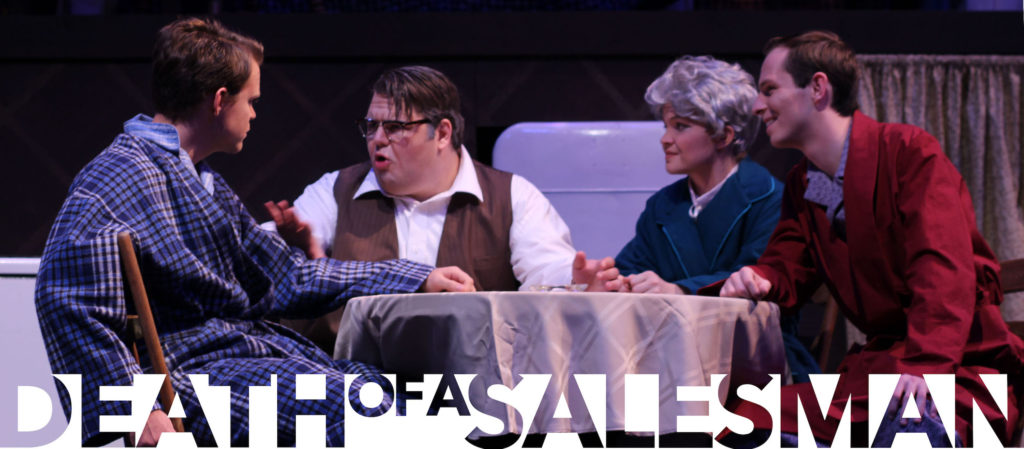
The Tower Players enraptured their audience in Markel Auditorium last night with their opening performance of Arthur Miller’s 1949 masterpiece “Death of a Salesman.” The play, which runs through Sunday, is one of the greatest and best-known works of American theater.
“We’re trying to tell a story, and we’re charged with the challenging task of this being such a familiar story,” director Michael Beyer said. “We’re trying to bring it the justice that it deserves, because it stands remarkably well on its own.”
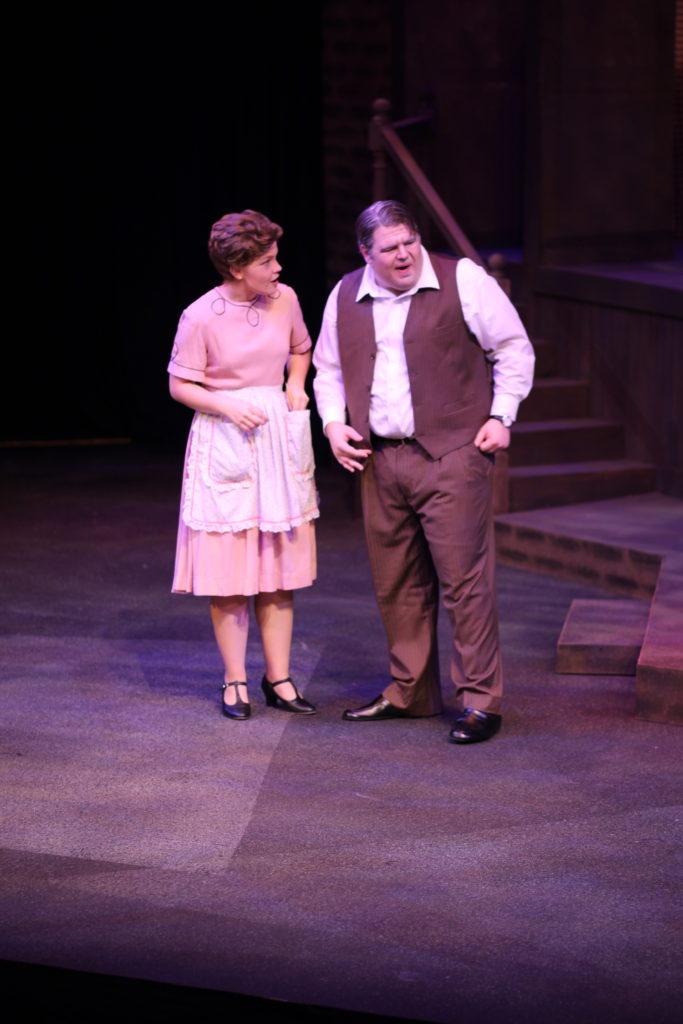
The play centers around junior Nikolai Dignoti as the titular Willy Loman — by all accounts the walking, talking picture of the American Dream.
Willy has a modest but respectable middle-class career as a traveling salesman. He has a decent home in the city, where he raised two well-adjusted All-American sons with his wife, Linda (junior Rebecca Carlson).
But from the outset of the play, all is not right with Willy. He has grown easily distracted with age and stress, to the point where he struggles to drive his car without crashing. He feels underappreciated at work and wonders what he worked for all his life.
“Work a lifetime to pay off a house,” he says in the opening scene. “You finally own it, and there’s nobody to live in it.”
Through a sequence of flashbacks, dreams, and memories, the play maps out Willy’s life — with all its successes, happinesses, mistakes, and missed opportunities — and ends with his sad, distracted death.
Pulling off a play like this is a monumental challenge, but Beyer said the cast, which stars, among others, sophomore Dylan Strehle and junior Mark Naida as Willy’s sons Happy and Biff, rose to the challenge from the beginning.
“You have to maintain a positive energy, so that it doesn’t weigh you down to the point where you find yourself in a rut,” Beyer said. “Everyone that is in the play gave 110 percent of their excitement and never let the daunting stuff get to them. They went through it all with a smile.”
Still, embodying characters like Miller’s is no picnic. Dignoti said the show’s more uplifting scenes were key to staying positive.
“I have a few favorites: some of the first flashbacks, because they’re some of Willy’s happiest memories,” he said. “There’s a card-playing scene that’s also a lot of fun, which is also in the first act. The second act is very, very heavy; I enjoy doing it once it’s over, but it’s also very hard to do.”
Getting into the roles required physical sacrifices, too. Dignoti’s customary shoulder-length hair and beard don’t scream “20th century professional.” So he and Beyer both went for an emotionally painful haircut this week.
“I made the promise to Nikolai that I’d hold his hand through the process,” Beyer said with a laugh. “We’ll be mailing those ponytails off to a company called Children with Hair Loss.”
To help the actors get into the characters, Beyer brought in some outside help. Associate Professor of English Dutton Kearney and Professor of English Justin Jackson led a discussion with the cast on the play’s themes and the characters’ motivations.
“I think a lot of times we approach it as this critique of American society or American capitalism, which is fine, and I don’t think there’s anything completely wrong with that reading,” Jackson said. “But I think Miller has great psychological insight in the play … It’s very much a play about fathers and sons, and not just that, but just psychologically what it even means to be in a family unit.”
Jackson said he was floored by the degree to which the cast digested the deeper themes of the work.
“My gosh, I would ask them questions where I thought I could bait them into some stupid answer, some sort of Cliff’s Notes pattern, and they rejected it,” he said. “They are very, very good readers of the play.”
Ultimately, Beyer said, success will depend on the actors balancing the play’s deep sadness with the humanity of the characters.
“The title takes care of itself, in a way, in knowing that death is an inevitable theme,” he said. “Willy has a fate, just like we all have a fate. We don’t have to necessarily focus on that for that to be part of the play. I’m hoping to bring out more of the smiles.”
