
Nestled on the street corners of every self-respecting American city, coffee shops adorned with the famed coffee brand’s green and white siren welcome hordes of customers where, seated by Starbucks fireplaces and soaking in faint strains of jazz, they enjoy not just coffee, but a cultural experience.
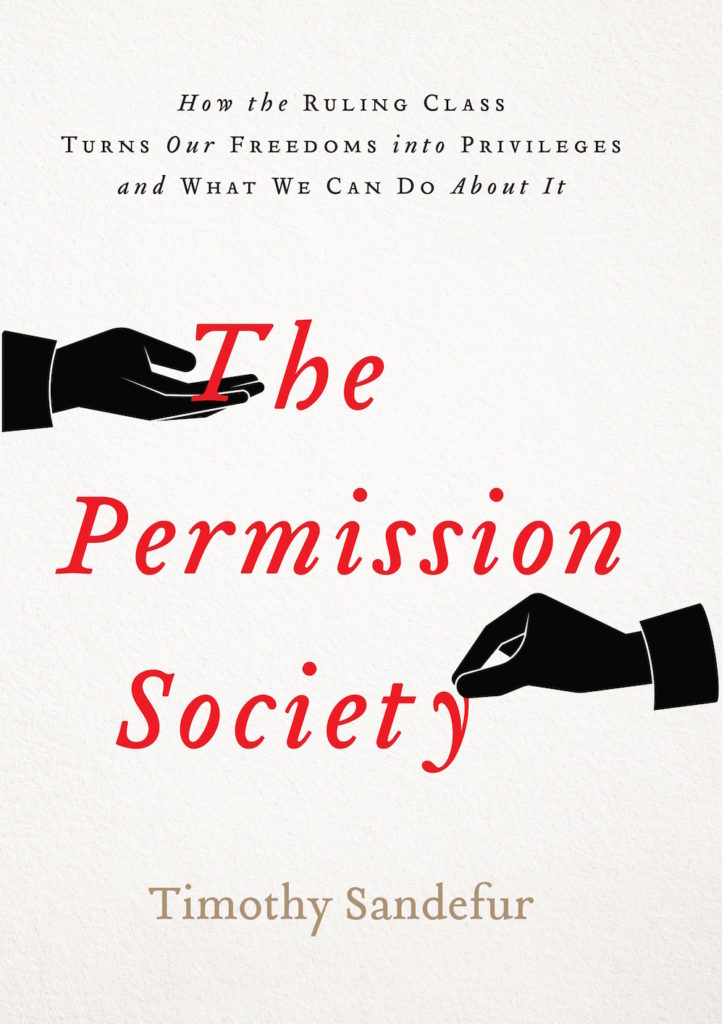
Yet the coffee giant’s popular drinks and welcoming hearth would not exist under today’s permit requirements in some states. Certain kinds of government permits were required, according to Hillsdale alumnus Tim Sandefur’s new book “The Permission Society,” published September 2016. A political economy major at Hillsdale, Sandefur ’98 said his studies prepared him for law school and a career defending the Constitution in court and in books like “The Permission Society.”
Sandefur’s writing career began in 2005, when he was asked if he knew anyone who could write a book on property rights.
“I’d never written a book before and I wasn’t sure how to do that,” Sandefur said, “But I remembered that line from the Ghostbusters where they said, ‘When someone asks you if you’re a god, you say yes!’ So I said I’ll do it.”
Two months later, Sandefur published his first book, “Cornerstone of Liberty: Property Rights in 21st Century America” and started on his second, “Right to Earn a Living.”
Sandefur said the books are a natural outgrowth from his work as an attorney.
“As you’re doing law, you write briefs on a variety of cases and they all had sort of a common theme,” Sandefur said. “So you can take them and sort of blend the cases together and make a book out of that without too much effort.”
Sandefur said the idea for “The Permission Society” came when he litigated cases challenging the constitutionality of Certificate of Need laws, which require new businesses to obtain permission from competitors before opening their doors.
During the litigation process, Sandefur said he found examples of how companies used the Certificate of Need laws to prevent new companies from starting up, merely because the existing companies were afraid of competition. Sandefur said his work was the first research of its kind give the perspective of businesses who were affected by Certificate of Need laws.
Other kinds of government permit laws, Sandefur writes, require people to prove that there is a “public need” for a business before establishing one. Starbuck’s, for example, would have to prove the public needed another coffee shop. An impossible task.
Fortunately for Starbucks, and for other companies, public need permits did not exist in the 1980s, and according to Sandefur, they shouldn’t exist today either.
“These laws,” Sandefur writes, “expand the power of the state, stifle innovation and entrepreneurship, and do violence to the basic principle of equality on which our nation’s institutions rest. Our constitution promises more – and Americans deserve better.”
Sandefur’s career in public interest law started even before he could walk.
“There’s a legend in my family,” Sandefur laughed, “that my mother looked down in my cradle and said, ‘Oh T. Mason Sandefur, he sounds like a lawyer.’”
But it was during his junior year at Hillsdale College, Sandefur said, when he realized he wanted to work in public interest law. The lecture was on economics and the law, and one of the co-founders for the Institute for Justice spoke, describing a case challenging a California law that forced hairbraiders to obtain licenses from the state.
“By the end of the speech I was sold,” Sandefur said. Litigating cases where he could defend people against the government was exactly what he wanted to do.
After graduating from Hillsdale, Sandefur attended Chapman law school, clerked with the Institute for Justice and the Pacific Legal Foundation where he became a principal attorney. He only recently transitioned to vice president for litigation at the Goldwater Institute.
Sandefur’s skills as an attorney stood out to Deborah La Fetra, Pacific Legal Foundation principal attorney and special assistant to the Director of Litigation.
La Fetra said she became a mentor to Sandefur, working with him on cases before he became principal attorney himself. As the two worked together, La Fetra also became familiar with Sandefur’s humorous side.
“He has an encyclopedic knowledge of all things ‘Simpsons’ and ‘Star Trek,’” La Fetra said. “He can find a relevant ‘Simpsons’ quote for anything, usually asterisked with the footnote ‘Little “Simpsons” quote there’ or, in shorthand, ‘LSQT.’”
La Fetra said she even gave him a custom-made coffee mug with “*LSQT” on it.
Another colleague, Adi Dynar, a staff attorney at the Goldwater Institute’s Scharf-Norton Center for Constitutional Litigation, said Sandefur impacted his life as well.
Dynar said one of his favorite cases with Sandefur involved a hairbraiding license case like the one that first inspired Sandefur.
“When he and I work on cases like that, it’s very rewarding on a personal level,” Dynar said. “We are helping people lead happy lives, and we are helping people get through unnecessary government regulation. I think Tim is an awesome boss, an awesome mentor, and a really dear friend.”
