
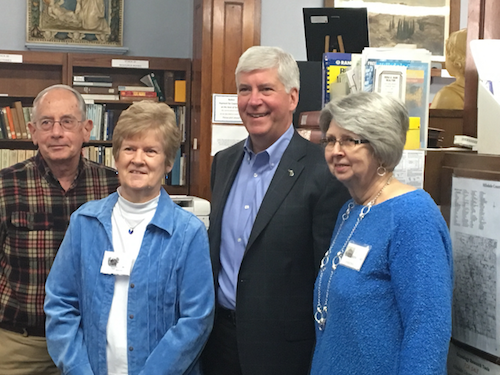
Philip H. DeVoe/Collegian
After labelling Hillsdale an at-risk community as part of his Rising Tide initiative in 2015, Michigan Gov. Rick Snyder met with city and college officials Oct. 26 at the Mitchell Research Center to discuss issues holding Hillsdale back from greater economic prosperity and stability.
“It’s great to see the community together; the key is getting people to work together, and we had so many different elements of the community here today,” Snyder told The Collegian.
In the roundtable, lead by Dominic Romano of the Michigan Economic Development Corporation, members discussed four issues Hillsdale leaders identified as being the major ways to help the city. These included bringing people and businesses to Hillsdale, improving and expanding the workforce, solving the problem of unavailable housing, and improving public health and safety.
Chris Sumnar began by discussing how Hillsdale can accomplish coordinated placemaking, meaning building Hillsdale as a place for outsiders to visit and, eventually, stay. He identified the strengths of Hillsdale as Hillsdale College, the Hillsdale Hospital, the recreation and school system, and downtown architecture.
“Some challenges…are communication between local government and college, finding entrepreneurs who want to take risks on our downtown, and finding folks who want to retire here,” Sumnar said.
Hillsdale College Chief Staff Officer Mike Harner said one struggle the college faces is finding hotels for parents visiting the college. He said he believes the development of new hotels and space for long-term visiting would help build and improve the downtown infrastructure.
Snyder told The Collegian that he believes Hillsdale College is an important asset in helping the city become more attractive to outside entrepreneurs and visitors. He said that since faculty and staff live in the community, it is an engine supportive of the economy and housing markets.
“The college is a wonderful learning institution,” Snyder said. “It has a great, world-renowned reputation that will help identify Hillsdale.”
Another city asset discussed at the meeting is the recently-installed fiber optic cable system throughout Hillsdale, which is a potential incentive for entrepreneurs to open businesses in the area.
“This fiber could be leveraged into new economic opportunities — you can do business all over the world if you have good connections on the internet. You’ve got a good start on that, so, now, how can we grow that,” Snyder said.
Snyder said he hoped Hillsdale College would help with expanding Hillsdale’s workforce through programs in conjunction with the city. He described cybersecurity as an example of a high-paying field with a need for workers, and suggested Hillsdale College work with the community to train workers.
Hillsdale City Manager David Mackie said he believes the lack of housing is one of the major problems facing the city’s economic development. He explained how he and his family, two adults and three children, struggled to find somewhere to live upon moving to Hillsdale, a difficulty shared by potential business owners.
“The first questions businesses ask when they consider moving here has to do with where their staff and employees will live,” Mackie said. “We have a limited stock of move-in ready homes and a high landlord rental rate. Housing is very critical to our community right now as it affects business development.”
Mackie said city officials are working to fix this problem by marketing a recently-built subdivision, building a 40-room senior center, and performing demolitions on derelict houses.
On the issue of poverty, Chief Financial Officer for Hillsdale College and City Councilman Patrick Flannery said that there is a perception that some members of the community aren’t motivated to work. He said local churches help those in need in the community as best as they can, offering guidance on parenting on finding employment.
“There’s a difficulty in convincing parents of these children that they need to work, because there seems to be an opposition to working or an incentive not to work,” Flannery said. “It’s frustrating to see.”
He said churches in the community are helping parents by giving them food and praying for them, and stressed the importance of educating parents on their responsibility to work, having them return to or enter the workforce as the ultimate goal of such education.
On the topic of public health, Hillsdale Police Chief Scott Hephner said that the opioid addiction is one of the biggest issues of public health affecting Hillsdale. He explained that the main cause of heroin addiction is an addiction to painkilling medication prescribed by doctors.
“We should not be targeting our resources at addicts who are at that addiction point. If we look at it from a prevention standpoint, it becomes a question of how we stop it before the addiction starts,” Hephner said.
Snyder suggested automated prescription systems as a way to prevent this addiction, which happens when painkilling medication is overdosed to patients. Since heroin is cheaper but produces a similar high, addicts often make the switch once the heroin becomes available, like it is in Hillsdale.
“Some doctors don’t like to adapt to this new technology, and we need to overcome that,” Snyder said about the automated prescription systems. “If all prescriptions were online, we could analyze that data to look for problem areas and trends.”
The roundtable was Snyder’s final stop on his visit to the 10 communities involved in the initiative, a program designed to help them reach economic stability and self-sufficiency to foster business development.
“It’s not that ‘we’re from the state and here to help,’” Snyder said in his opening remarks at the roundtable. “It’s a proactive involvement, to say ‘we’re here to be a partner.’”
Snyder said he hoped the roundtable would expose issues with which the community struggles as well as assets which show its potential. Key to the process, Snyder said, is the second meeting, where he will return and see how the communities are progressing.
“It’s not about listening, it’s about helping these communities,” Snyder said. “My goal is to say at some point that these communities have graduated, become self-sustained, and don’t need state assistance.”
Snyder said he believed the meeting went well, and that he is excited to return and see how Hillsdale has done with overcoming some obstacles and utilizing assets. He has yet to revisit any of the ten Rising Tide communities, and hopes his return visit finds Hillsdale closer to self-sufficiency.
“I want to go back and see what we’ve gotten done,” Snyder said. “It’s a wonderful community, and, now, how do we strengthen it on a sustained basis?”
