
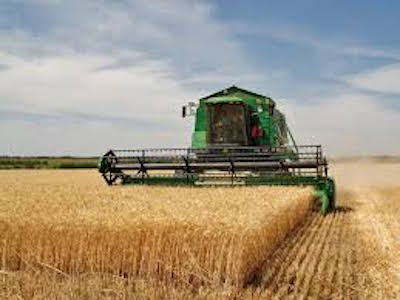
Record crop production in southern Michigan this year is driving up competition for commodity farmers, some of whom are not going to be able to sell all of their crops.
“The prices are terrible,” Hillsdale County farmer Bill Hayward said. “A lot of farmers are not going to make it.”
Several farmers are reporting a trend of abundant yields across Hillsdale County and Branch County this year, but with an increase in supply comes a decrease in demand, and, thus, lower prices for farmers.
Hayward said that during a drought in 2012, prices went up as high as $13 to $15 per bushel, whereas now the prices are around $8 to $9 per bushel. Corn and wheat prices are showing similar disparities. Such low prices are not covering expenses for several farmers, which has been the case for the past two years and possibly will be next year too.
Good weather seems to have been one of the main causes of such abundant yields this year. According to Branch County farmer Bill Pridgeon, the heat was especially helpful. Normally, local weather does not reach into the 90s, but this past summer saw several 90 degree days. Farmers need a number of these so-called heat degree-days for a good harvest, and, as a result of this and the rain, Pridgeon said the crops in his field right now would be a “historical yield” for his farm.
In contrast to the region-wide heat, rain varied by area, with northerly drought around the Hillsdale and Jonesville areas until August, and a lot of westerly and southerly rain toward Coldwater and the state border throughout the summer. It was like a “tale of two cities,” according to Pridgeon, whose farm west of Reading received 18 inches of rain, while farms on the east side of Reading received only five inches.
For farmers who got their crops in the field on time this year, the excellent combination of heat and rain helped crops ripen more quickly than usual. After the heat degree-days and August rain, Hayward said his garden grew “like mad,” and his soybeans are better than he has ever seen.
Professor of English Christopher Busch raises Jack Be Little pumpkins, and he said they are already past ripe, while normal ripening time is not until Halloween.
Despite the general success of commodity farmers this year, the drought farther north hurt a lot of produce farmers. AJ Schiel, a local produce farmer, said commodity farming is different from produce farming because produce is often less able to withstand heat and small produce fields like Schiel’s do not always have a consistent supply of irrigation. Hayward also commented on this difference between produce and commodity farming, saying that more drought-resistant technology has been developed for commodity crops — like his wheat, corn, and soybeans — than for produce.
Hayward says that every night on TV, the economic situation looks worse and worse for commodity farmers.
“The American farmer has gotten to be very good at his job,” he said. “Which is precisely why so many are struggling economically this year.”
