
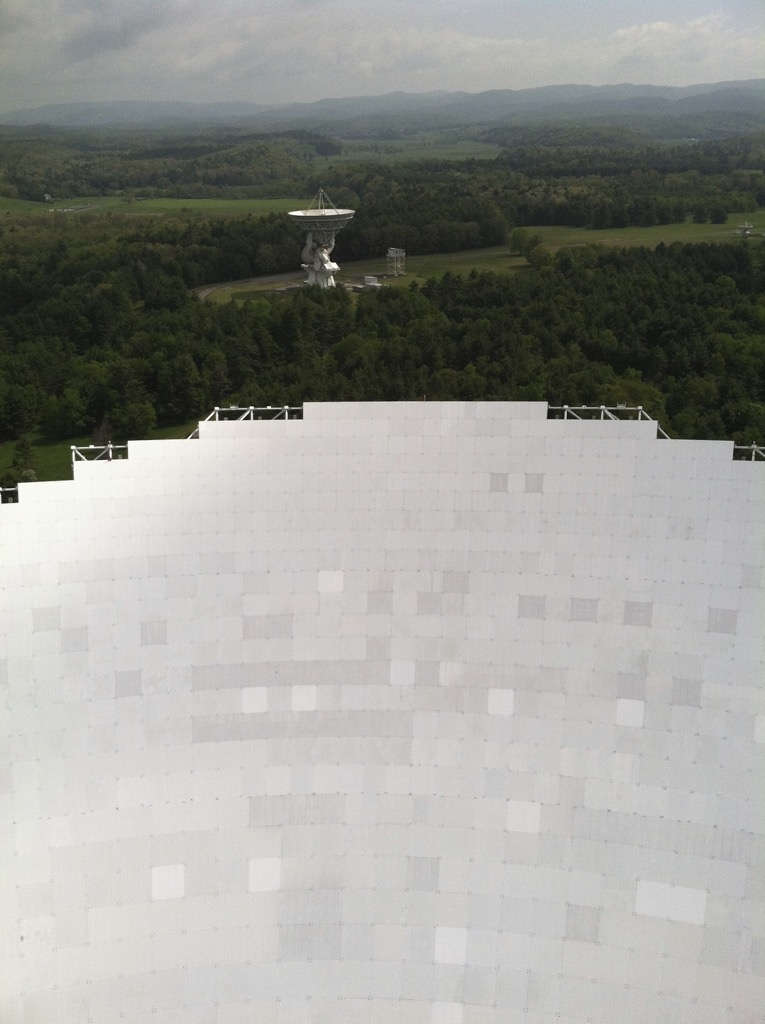
Students will visit the Green Bank Telescope in West Virginia, which can be controled from Hillsdale College, during the summer.
Timothy Dolch | Courtesy
Physics students will have the opportunity to climb a 485-foot-tall radio telescope in May, after spending the past year using computers to control it in Hillsdale. The group will accompany Assistant Professor of Physics Timothy Dolch on a trip to the Green Bank Observatory in West Virginia.
Located four-and-a-half hours away from Washington, D.C., the GBO is host to an array of radio telescopes, a museum, and a visitor center. While the general public can visit and go on tours, the students attending the conference this summer will be making observations from the control room of the Green Bank Telescope.
As a member of NANOGrav, the North American Nanohertz Observatory for Gravitational Waves, Dolch can bring students into direct contact with the GBO. He said the NANOGrav workshop will run from May 23-27, and physics and math major junior Daniel Halmrast will participate. Physics and politics major senior Cody Jessup said he also may attend the trip. The students recently went to a NANOGrav conference in California, where they gained experience studying the data from the radio telescopes.
“It’s another student workshop like the one we did in California, but this one is geared more towards doing observations as opposed to analyzing the data,” Dolch said.
This trip will put the students in the shadow of the device they’ve been controlling from the Strosacker Science Center’s basement for the past year. The radio telescope receives signals from neutron stars, and scientists look for changes in these signals to determine if a gravitational wave was present.
“You can use it in the rain, in the winter. Sometimes we have to stop because we have to dump snow out of the dish,” Dolch said. “It’s just a weird way of doing astronomy, if you’re used to optical astronomy.”
The Green Bank Telescope is nearly as tall as the mountains around it. Dolch said the giant dish sits in a valley with about 20 other telescopes. The radio telescope rests within the United States National Radio Quiet Zone, an area in West Virginia, Virginia, and Maryland, where wireless communications and radio waves are banned to minimize interference.
“When you’re down there and you’re looking at the telescope from the control room, it doesn’t hit you, even when you’re there, quite how big it is until you walk out there,” Dolch said.
Although Jessup said he isn’t confident he will attend the trip, Halmrast said he hoped to continue work with gravitational waves using radio telescopes next summer. NANOGrav has focused its efforts on annual gravitational waves, but Halmrast said he plans to work with waves that have eight-hour-long periods. Halmrast said if he detects gravitational waves with higher frequencies and scientists make similar discoveries in the longer waves, then they will have a “proof of concept.”
“It’s actually pretty competitive trying to get telescope time,” he said.
Following his work with the Green Bank Telescope at the conference, Halmrast said he hopes to create a proposal to work with a team of astronomers in Australia.
