
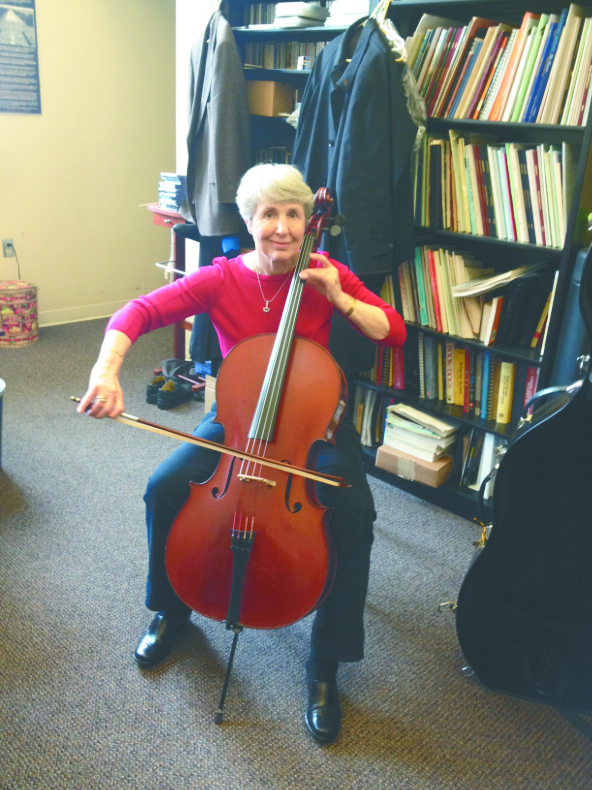
Mary Ann Marks | Courtesy
Mary Ann Marks ’64 walked out of the room without turning around. After 54 years playing on the cello — “an old friend,” according to her husband Bob Marks — Mary Ann was ready to say goodbye.
When Mary Ann decided to give up her cello, her first thought was to sell it. The $40,000 instrument proved difficult to sell, however, so Mary Ann considered donating it instead. Bob suggested her alma mater.
“The people here were so open to it and they made us feel so good about it,” Mary Ann said. “Holleman said he’d be thrilled to have it, so I knew it was the right decision.”
The cello will join the ranks of the $90,000 Eberle violin and the $150,000 Bosendorfer piano already available for students’ playing use on special occasions.
“I just want someone to play it,” Mary Ann said. “It’s a wonderful instrument that has gone up in value, and someone should be playing it.”
Though the details are unconfirmed, the cello will most likely serve the same function as the Eberle. Concerto Competition winners and students playing senior recitals are some of the most likely candidates to play the new instrument.
“Students will use it if they have something special to perform, or a difficult piece that requires that kind of color quality,” Professor of Music Melissa Knecht said. “The Eberle teaches students how to find more colors when they’re playing and improves the quality in their sound. It’s a great teaching tool and motivates students to be better.”
The cello was originally a gift from Mary Ann’s parents during her junior year of college. She travelled to Chicago to test a few and picked this one out.
“It was red. It has a pretty red tone to it. I liked the sound of it. It was full and rich,” Mary Ann said. “But I don’t play it as well as I used to. Every time I play I sound terrible, and I didn’t want to sound that way. This cello is too good to just sit in my house and collect dust.”
Mary Ann finds practicing increasingly more difficult.
“I don’t have the dexterity with my fingers and the cello keeps getting heavier and heavier,” she said.
But for 36 years after graduating from Hillsdale, she played in the Plymouth Symphony Orchestra. She loves performing much more than she loves practicing, and she particularly loves concerts — both performing in them and listening to them.
“I love to hear an orchestra,” Mary Ann said. “There are so many things going on. It’s a work of art to have everybody on the same page. I’ll always be a music lover. I love going to concerts much better than practicing. I go and I clap real hard. Music was not my vocation, but I always want it to be a part of my life.”
Mary Ann began playing in fifth grade, but she was following in the footsteps of her sister, am even more dedicated musician.
“My sister plays violin and viola. I’d wake up every morning in high school and she’d be playing the Mendelssohn violin concerto,” Mary Ann said. Her sister’s daughter, Lisa Tarzia, now teaches violin at the college.
Mary Ann pursued a career in teaching elementary school rather than music, despite graduating with both a major and minor in music from Hillsdale and after serving a music fraternity. Those who know her will miss hearing her play.
“I like to listen to her play,” Bob said. “When our neighbors found out she was going to donate this to Hillsdale, they tried to talk her out of it. One neighbor came over the other day because he wanted her to play one more time. It’s the end of an era.”
Mary Ann and Bob described a lady who played in the Plymouth Symphony orchestra. Though the lady attended every rehearsal and performance, she sat in the last chair, the place the least-experienced performer usually sits. Mary Ann never wanted to be the person in that chair; she said she didn’t want to be known as someone not very good. So she stopped playing instead.
Now, she will enable younger students to develop their musicianship instead using her valuable instrument.
“I just want people to play it,” she said. And at Hillsdale, they certainly will.
