
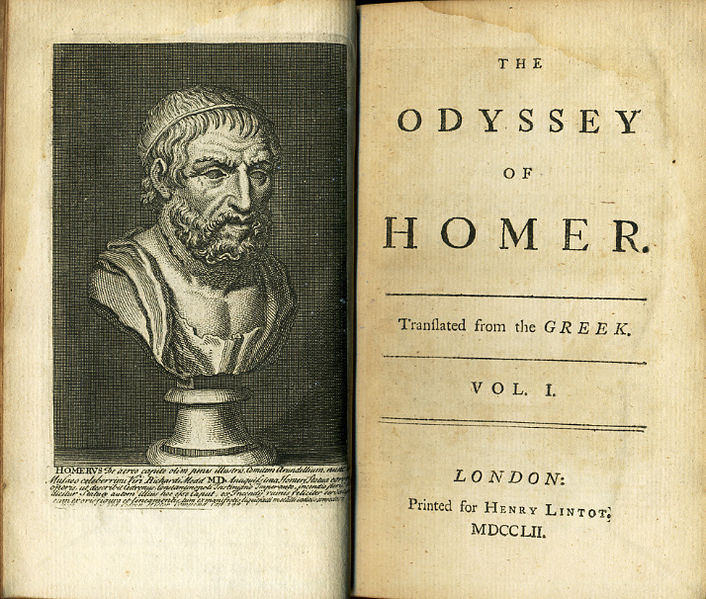
Homer’s “The Odyssey” is a traditional selection read in Great Books in the Western Tradition: Ancient to Medieval, one of the core curriculum courses in Hillsdale College’s great books program, which was ranked No. 3 in the nation by Best College Reviews.
Wikimedia Commons | Collegian
According to an online college review journal, Hillsdale College has made an odyssey into the nation’s top-ranking literature programs.
Hillsdale was ranked No. 3 on a list of the 25 Best Great Books Programs in the country, published in July by Best College Reviews. The review recommended Hillsdale’s literature program as part of a curriculum that requires all students to take great books courses as part of a liberal arts education, preparing them for work in many disciplines.
“Imagine being taught by the greatest masters of the mind that walked on this Earth,” Best College Reviews said on its website. “If you can imagine such a place, you’ve imagined a great books or liberal arts education.”
Best College Reviews judged colleges according to a strict definition of the liberal arts. To qualify, colleges have to offer at least 30 credit hours of “great books-style education” in small classes where students engage in Socratic dialogue while discussing classic texts.
Hillsdale’s curriculum requires all students to take two great books courses regardless of their major. These classes give students a foundation in fundamental questions, said Dwight Lindley, professor of English at Hillsdale College.
“We study great books to form our understanding of the kinds of things humans are interested in,” Lindley said. “They help us think well about the things we’re going to think about anyway: What does it mean to be human? What is community? What is love? A great books education has the virtue of forming our way of thinking about those questions with the most impressive thinkers we have access to.”
But Lindley said not all great books programs are created equal.
Other featured liberal arts colleges, including first-ranking Biola University’s Torrey Honors Institute in California and runner-up New St. Andrews College in Idaho, focus almost exclusively on the classics in their curricula, according to Best College Reviews’ website. St. John’s College, which finished fourth, is famous for its unstructured, tutorial-based education centered on the great books.
“St. John’s has a more text-centric approach,” Lindley said. “Hillsdale’s great books model is more historicized. One of the defining features of our model is that we also teach history courses that place texts within a broader narrative.”
Best College Reviews noted this wide scope of study at Hillsdale.
Lindley, who graduated from Hillsdale in 2004, said he has seen Hillsdale’s professors shift toward a more traditional canon of selected texts in the English department, as well as in politics and philosophy, in the past 15 years.
Rebekah Slonim, a senior English major, said studying a selected set of great books helps students appreciate good literature while also improving their writing skills.
“Students get to read works that are worth reading,” Slonim said. “The list is somewhat ambiguous — How do we know something is as good as ‘The Odyssey’? — but it’s a great way to learn to analyze literature.”
While tutoring students at the Douglas H. Hawkins Writing Center, she said she noticed students often are intimidated by the great books courses at first.
“Learning how to analyze literature with great books can be scary,” Slonim said. “Students are just learning to write, and they say, ‘I have to analyze “The Odyssey”?’ It’s hard, but once you’ve done that, you can do anything.”
Students in all majors benefit from reading and analyzing great literature, Lindley said.
“I teach literature as analogous to scientific study,” Lindley said. “Though some people see literature as mostly subjective, they’re really just two different kinds of analysis. We use the evidence in front of us to reach a probable conclusion about the things we all care about. People learn better that way. Humans connect to humans — not just ideas.”
Slonim said the great books courses provide a foundation for further studies.
“Hopefully studying great books opens their minds — and their imaginations — to what’s in them,” Slonim said.
