
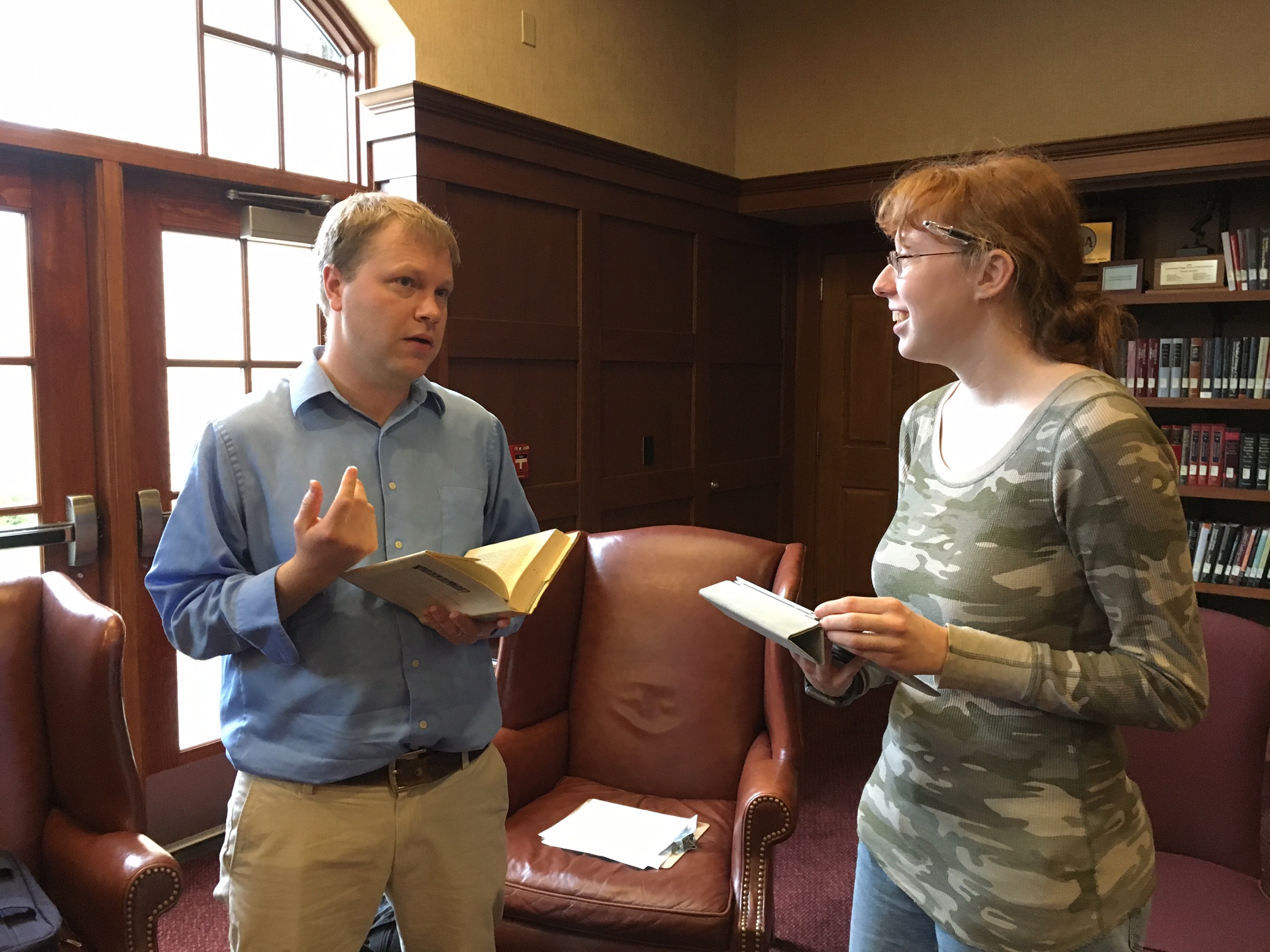
Talk of starships and robots filled the formal lounge as Professor of History Bradley Birzer and Assistant Professor of Physics Timothy Dolch led a discussion about the history and development of science fiction and fantasy literature with approximately 20 students last Thursday.
Their discussion, hosted by the Collegiate Scholars as a part of the Conversation, examined science fiction and fantasy from an interdisciplinary perspective, looking at the history, politics, and science behind the genres.
Though the roots of science fiction in America began in the early 1900s, with cheaply-produced pulp magazines containing short stories, Dolch said the same literary components found in science fiction novels can be found in much earlier works.
“You know, most literature throughout history has supernatural elements or fantastic elements or elements that are really extrapolating to the edge of everything,” he said. “In fact, Isaac Asimov, he called Homer’s ‘Odyssey’ the first science fiction novel because it’s got a lot of mythology, but it’s also kind of looking to the borders of the Mediterranean and imagining what’s there.”
Although science fiction became more politicized as it gained prominence in mainstream media, Birzer said the genre was initially apolitical, with authors exploring a wide variety of ideologies in their fictional settings. In recent years, the science fiction community has come to debate the purpose of the genre — whether it should be grounded in reality and the laws of nature, or in myth and heroism of the imagination.
Additionally, the Conversation covered the chicken-and-egg relationship between scientific advancements and the genre of science fiction. Some scientists incorporated their ideas into works of science fiction, while others drew inspiration from science fiction in their research pursuits.
“Things like black holes, neutron stars, pulsars, were not immediately obvious,” Dolch said. “People had to unpack the theory to derive these exotic phenomena. In a way, science fiction is just an exercise in that kind of imagination too, so I think there’s a huge overlap. I think science wouldn’t be what it is today if it weren’t for science fiction.”
Sophomore Ilsa Epling, vice president of the Science Fiction and Fantasy Club, said the Conversation gave her a greater appreciation for the origins and impact of science fiction.
“It was very insightful,” she said. “A lot of people do want to just write the genre off as nerds, but if you look at it, it really does have a huge cultural impact.”
