
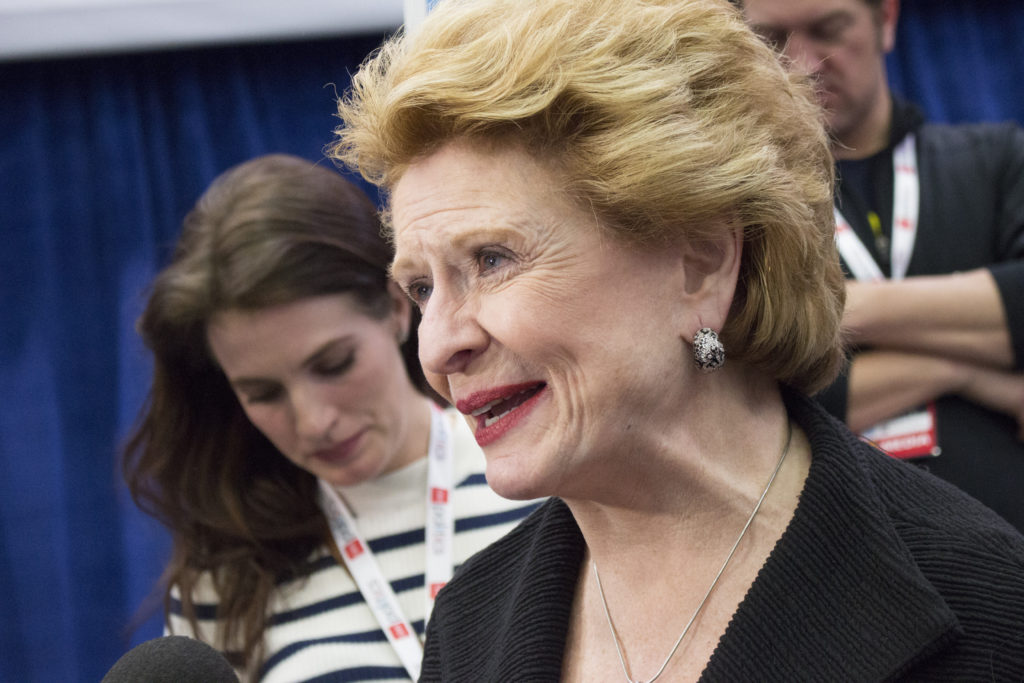
Sen. Debbie Stabenow, D-Mich., speaks with reporters in a press scrum following Sunday’s Democratic presidential debate.
Nicole Ault | Collegian
Flint, Mich. — If sympathetic publicity counts, Flint, Michigan, may have been the real winner of the CNN-sponsored Democratic presidential debate Sunday, March 6.
News networks focused national discussion on Flint in the days ahead of the debate. Former Secretary of State Hillary Clinton challenged Sen. Bernie Sanders, I-Vt., to a debate in Flint after the news broke that high levels of lead had contaminated the city’s water. CNN invited members of the press via email to join them in distributing water bottles throughout the city from 8 a.m. to mid-afternoon on Saturday.
“In response to the community’s need, CNN has partnered with Convoy of Hope,” said CNN Vice President of Communications Matt Dornic in the email. “The network has committed to a five-week donation of 500,000 bottles of water that will be distributed at four locations throughout the city.”
On the day of the debate, the Flint-focused atmosphere continued into the media center, located in the University of Michigan — Flint’s campus recreation center, separate from the debate hall. Local Flint businesses sold concessions around the perimeter of the large room, and posters in the bathroom stalls raised awareness of the crisis.
Just outside the doors to the media center, protesters from the Fight for $15 beating drums and waving blue cardboard water drops also drew awareness to the water crisis.
“We work, we sweat — write 15 on our checks!” protesters shouted.
They also waved blown-up images of of Michigan Gov. Rick Snyder’s head, with devil horns and red eyes, particularly emphasizing the tension that persists in the city.
Perhaps the most consequential attention to Flint occurred during the broadcast of the debate itself. Flint residents made a substantial appearance — a few had been chosen to ask questions of the candidates, and the Flint City Wide Choir sang the national anthem before the debate began.
CNN anchor Anderson Cooper prefaced the debate by emphasizing that Flint would be in focus.
“Tonight, the Democratic candidates are here to answer questions about what they would do for Flint, as well as about other issues facing their country right now,” he said, according to the CNN transcript.
Sanders and Clinton emphasized the Flint crisis from the beginning and called for Snyder’s resignation.
“Over the last several weeks, I had the opportunity to meet with a number of residents of Flint at a town meeting in Flint, and I have to tell you what I heard, and what I saw literally shattered me,” Sanders said in his opening statement, according to the transcript.
Clinton began by saying she was “very grateful that my request that we hold this debate be held here so we can continue to shine a very bright spotlight on what has happened in this city.”
Throughout the debate, the candidates used Flint as a springboard for discussing national issues, including unemployment and infrastructure problems.
After the debate, discussion of Flint continued in the media center as Michigan politicians and DNC Chairwoman Debbie Wasserman Schultz, D-Fla., made an appearance for press interviews.
“I aspire for college students to care about things like crumbling infrastructure and the plight of the people of Flint because in order to make sure that we can create the jobs we need and make sure there’s reinvestments in cities like Flint, we have to make sure that we have infrastructure that can support and sustain the businesses that these cities want to attract,” Schultz said.
Sen. Debbie Stabenow, D-Mich., said she wants to keep national attention focused on Flint.
“I think that being here in Flint is a showcase of a difference in philosophies between the two parties. It’s very, very clear,” Stabenow said. “What we see now is the full Republican philosophy on display — that you save a little bit of money, and you’re willing to sacrifice the health and safety of citizens in order to be able to do that.”
Others made similar points.
“The fact that this debate was in Flint and a big part of the debate was about Flint gives the people that I represent, my hometown, a lot of reassurance that there’s help coming,” said Rep. Dan Kildee, D-Mich. “It really shows the difference between our party and the other party.”
Sen. Gary Peters, D-Mich., noted how the Democratic debate spent much more time on the Flint crisis in comparison to the Republican Party’s debate on Thursday, three day before.
“Here we are in Flint highlighting an issue that is so important to the people of Michigan,” Peters said. “And the discussion here wasn’t just about Flint, it was also highlighting the need to make sure that people understand that the issues that are impacting Flint could impact other communities all across the country.”
During the debate, Sanders questioned what would happen when the national media leave Michigan.
“I think the fear — and the legitimate fear — of the people of Flint is that at a certain point the TV cameras and CNN will disappear,” he said.
But Kildee said he thinks the debate will have lasting benefits.
“To me, this was a debate that served us well as a nation, served us well as a party, and for the home, many of the people I represent in Flint, Michigan,” he said. “Hopefully, it’ll serve them well, too.”
