
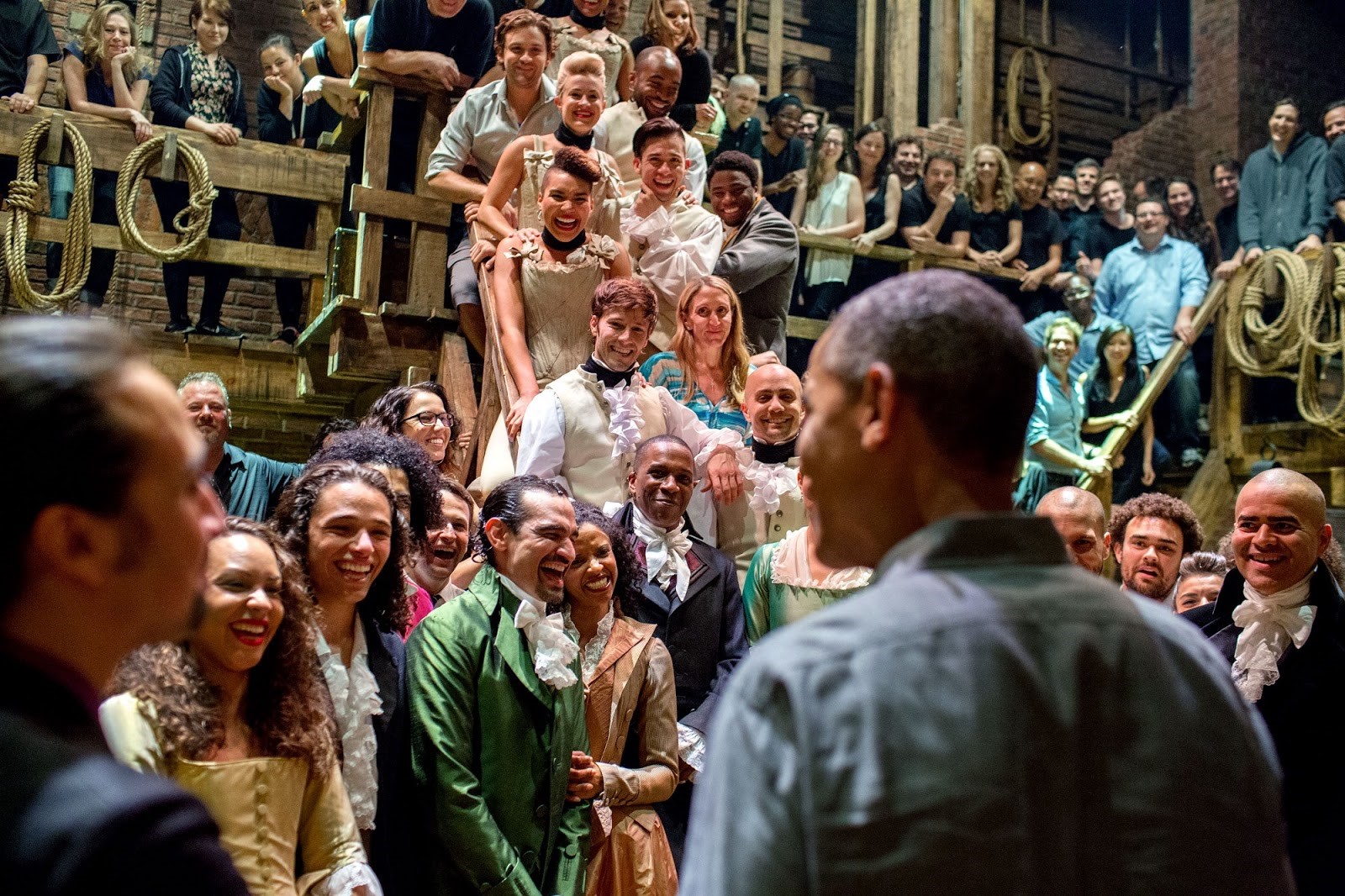
When Lin-Manuel Miranda debuted his “Hamilton Mixtape” at the White House in 2009, his clever lyrics and musicality carried the performance, while his subject inspired amused but politely restrained laughter.
This year Miranda rapped his Grammy acceptance speech for the cast recording of “Hamilton: An American Musical” to roaring, even tearful applause. Miranda’s work has made American history a popular obsession. Teachers rejoice at the new interest their students have developed in the subject. But does Miranda’s hip-hop Broadway spectacle, littered with inaccuracy as it is, really promote history?
The show’s superficial departures from historical fact — anachronisms of language and medium, an ethnically diverse cast, etc. — do what all narrative history must do: collect the actions and dispositions of individuals of the past, with some degree of selectivity and adaptation, for the sake of communicating them faithfully to individuals of the present.
While Alexander Hamilton and Thomas Jefferson might not have gone head-to-head in actual rap battles during cabinet meetings, they did compete against each other with an energy and animosity that Miranda and his cast portray with appropriately caustic attitude. The audience doesn’t know what’s hit them: Suddenly they feel emotionally invested in niceties of 18th-century foreign policy.
Now, Miranda does feed his audience significant factual inaccuracies. The love triangle between Hamilton and two of the Schuyler sisters is purely dramatic invention, and so compromises the faithfulness of the narrative to reality. But although Angelica Schuyler Church was already married by the time she met Hamilton, the intentional fiction of their brief flirtation illustrates a primary function of history as a scholarly pursuit. Two songs, “Helpless” and “Satisfied,” narrate the same events but tell two different stories. Elizabeth Schuyler, Hamilton’s bride-to-be, recounts the night with all the blush and flutter of flowering romance; from Angelica, they hear of a moment of passion, power, and sacrifice. Such consideration and reconsideration of facts according to various perspectives is precisely the business of history. In departing from the strict facts of history, Miranda represents history at work.
Miranda’s choice of medium opens the door to a species of compromise more detrimental to Hamilton’s historicity. There is no comprehensive list of facts which, added all together, make up history; so history as a study requires selection and therefore exclusion of facts, which inevitably expresses the historian’s predispositions. Choosing material is one level of bias, shaping a narrative is another, and idealizing that narrative is yet another.
Theatre thrives on tropes that idealize the narrative. In “Cabinet Battle #1,” for example, Miranda creates a microcosm of the archetypal conflict between Jefferson and Hamilton. Miranda emphasizes the opposition by invoking multiple points of disagreement. The character Jefferson defends the sovereignty of the several states, which is both accurate and relevant; that is exactly how the historical Jefferson argued his point. Miranda adds, however, a eulogy to the southern agrarian ideal, which gives the character Hamilton the opportunity in his response to excoriate Jefferson for owning slaves.
So the historical Hamilton’s argument for his financial plan is replaced by an ad hominem attack, and the attitudes and values of the Sectional Crisis are imposed on a debate that took place decades prior.
Rhetorically and theatrically, it plays well: the tension is high, and the subtle foreshadowing is exquisite — but it bears the mark of bad history, a prejudicial association of later answers with earlier questions. Even so, the theatrical treatment of the question may become useful as a historical artifact in itself in years to come, as future historians view “Hamilton” as the present generation’s consideration of the relationship among all the questions facing the early republic.
All Miranda’s departures from orthodox historiography serve a purpose for history as well as theatre. Miranda does not mean for his audience to fall in love with Alexander Hamilton, except perhaps as a side-effect: he means for them to fall in love with history itself, and with the legacy of America’s founding. “Hamilton” is not the first musical to recount American history, nor to contextualize it for modern audiences — what makes it special is its guarantee that it will not be the last. “Hamilton” has successfully established popular theatre as a gateway drug to hard history, and America is hooked.
