
Feet flitted across the black box floor Wednesday evening as dance instructor Alison Plemmons taught the art of Scottish Highland dance to 16 Hillsdale students.
The craft is a traditional Scottish dance which was developed as early as 1054 A.D. when Malcolm Canmore, a Celtic prince, killed another chieftain, according to the Scottish Official Highland Dancing Association.
“Taking his victim’s claymore and crossing it with his own on the ground, so making the sign of the cross, Malcolm Canmore danced over and around the naked blades with the ecstasy of victory,” the association’s website read.
The Sword Dance is still popular during competitions today, but Plemmons leaves the swords at home and primarily works on teaching her students at Hillsdale the Highland Fling. She said she can’t remember the exact year she started at Hillsdale, but guessed she began about a decade ago.
But that was hardly the beginning of her Highland dance career. Her mother was born and raised in Scotland, and started teaching 2-year-old Plemmons the craft. Plemmons performed for the first time at age 3, dancing in front of 1,000 people.
“And that was that,” Plemmons said.
She never stopped dancing. By age 11, she represented the Midwest region in the national highland championships, and at age 14, she won her first of four consecutive championships.
From there, she started teaching the art she loved and eventually passed the membership exam from the British Association of Teachers of Dancing. Now, she teaches young aspiring professional dancers during the evenings at the Mittig School of Highland Dancing in Novi, Michigan, when not instructing the students of Hillsdale.
“It’s a celebration of my heritage, and I want to spread my heritage and my love of Highland dance to anybody who wants to learn,” Plemmons said.
Even though Hillsdale students typically take the class recreationally — not to become masters of the art — Plemmons said she benefits just as much from teaching them as she does from teaching her more serious dancers.
“It’s actually refreshing,” Plemmons said. “It’s all in my perspective. I get out of it what I want, and I choose to learn from them.”
Plemmons said she spends the classes introducing basic technique and definitions of movements, which she then connects to form the dance. She also brings in the Scot
tish social dancing for a “different flair” of the Scottish heritage.
Over the years, she has gotten a wide variety of students, many with no dance experience.
“I think they take it because it’s new and different and they don’t know what to expect,” Plemmons said.
She said the class is very helpful for flexibility and coordination because of how much “crossing over the body technique” goes into the dance.
“You are using both sides of the body at the same time, which activates your brain and your coordination,” Plemmons said. “You need to move your right arm and left foot. The coordination is the struggle for most students.”
Plemmons said that even though Hillsdale students aren’t starting young, she knows that committed students could learn enough to compete or put on shows. In the past, when she was connected with the music department, she has had groups of students perform.
Senior Lucia Rothhaas is currently in the class. She said the backstory as to how she ended up in the class is a bit embarrassing.
“I thought Irish stepdancing and Highland dancing were the same thing,” Rothhaas said. “I grew up watching Riverdancing and practicing it on my kitchen floor.”
She wasn’t taking a physical education class or any classes “for fun,” so when a friend mentioned she was taking it, Rothhaas decided she could do Irish dancing too. Rothhaas said she has no previous dance experience, but loves dancing.
“It’s kind of rigorous and we only have one class per week to work on form and how to position our feet, and I have no background in that,” Rothhaas said.
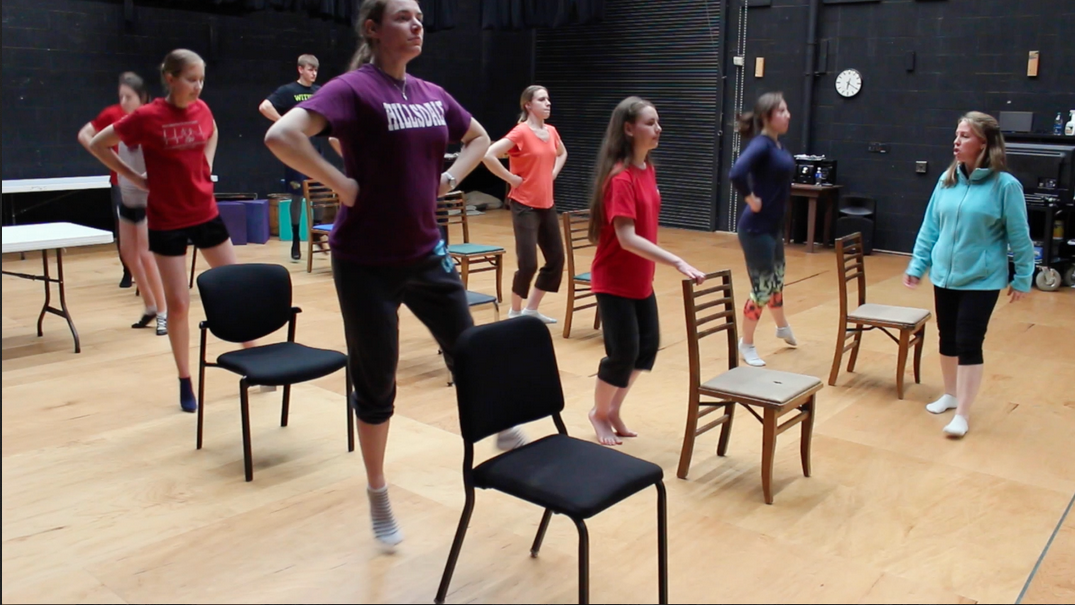
Right now, Plemmons only teaches a beginner class, but she has some students who have taken the class all four years at Hillsdale because they love it.
Senior Hannah Wolff took Scottish Country dance before coming to Hillsdale and wanted to continue learning new types of dance, so Scottish Highland dancing seemed like a natural choice. She also knew the club associated with the class hosted ceilidhs, or informal Scottish country dances, during the school year. She’s taken the class since she was a freshman.
“It seemed like a great way to stay active, fulfill my PE credit, and have fun,” Wolff said in an email. “It’s nice to take a break from academics and yet exercise another part of my brain: some of the dances are more complicated and definitely require mental exertion.”
Wolff said the four-step Highland Fling is like running a mile.
“Not only does it require incredible strength to jump for that long, but you must do so while keeping proper posture, pointing feet, executing turnout, and the dozens of other things Alison is constantly reminding us of,” Wolff said.
Wolff also had great praise for Plemmons.
“She keeps me coming back,” Wolff said. “She is extremely down-to-earth, funny, and encouraging. She always gives us a pep talk when we’re stressed during hell week, and she also holds us to a high standard for dancing. Alison is great to be around.”
She added that in the future she plans to keep dancing and bringing more people into the world of Scottish Dance.
Plemmons shared the same sentiment.
“I just want people to know that I love Highland dancing and I am willing to work with and teach anybody who is willing to learn,” Plemmons said. “It’s not about being the absolute best, but enjoying the experience and learning.”
