
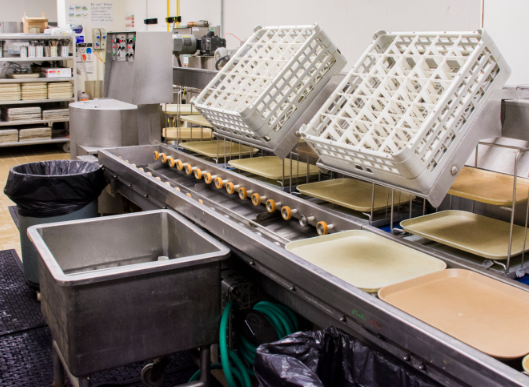
During a normal weekday lunch, Saga, Inc. serves over 500 guests in a 20 minute period. A group of this size consumes as great an amount of food as the amount of dishes it produces. These food scraps, plates, cups, utensils, and bowls eventually find their way to a conveyor belt, magically disappearing, returning to the cafeteria cleaned and ready for reuse.
Kevin Kirwan, general manager of Saga, explained that an operation this big requires a plan which maximizes space, reduces waste, and cuts costs.
“This cafeteria has a lot more efficiency built into it, compared to the previous one,” Kirwan said.
In 2007, Hillsdale College built a brand new cafeteria, The Knorr Dining Room, located in the newly-built Grewcock Student Union. Kirwan designed the cafeteria layout with new appliances to maintain his goal of conserving food and preventing waste.
One of Kirwan’s waste preventing appliances is the Hydro-Extractor, a close-coupled waste pulping system. An appliance that reduces the volume of waste deposited into landfills by removing 95 percent of liquids
Once on the conveyor belt, the dishes and utensils make their way toward an angled stainless steel trough. The plates are then scraped clean. The excess waste is then combined with a stream of water within the trough. This mixture creates a pulp-able slurry, comprising of 95 percent liquids and five percent solids.
The slurry then makes its way to the Hydro-Extractor, which removes the majority of liquid, and returns it to the trough for reuse.
Somat, the producers of the Hydra-Extractor explained that this sustainable appliance provides a solution for food businesses that want to initially reduce waste, but more importantly reduce costs.
According to Somat’s website, “These pulpers provide an economic and efficient answer to reducing waste volume at the collection source. It reduces labor costs, improves sanitation, and conserves water.”
“The reason why we purchased this appliance and why it is apart of our system is so that we could reduce our waste footprint in landfills,” Kirwan said. “It takes six or seven 55-gallon trash containers, full of food, and mulches it up and turns it into only one bag of trash.”
Senior Abigail Schultz previously worked in Saga’s dishroom. During her first day on the job she was surprised to see the efficiency of the process.
“When I first got the job I expected myself to be washing dishes by hand, but the process was very streamlined. At times it would get really stressful when dished started to build up,” Schultz said.
Kirwan addressed the congestion of the dish line during lunch hours, pointing to the large influx of students during such a short period of time.
“It is the sheer volume of getting the plates off of the conveyor belt. The student’s conception is that the backup has to do with food waste. That is not the case”, Kirwan said. “There are basically three people pulling 2,000 pieces of dishes a piece during a lunch period.”
“It is not a glamorous job, but it is necessary in Saga’s food chain” Schultz said. “All the people working back there do a fantastic job making each lunch successful and sanitary. A little more appreciation from students could go a long way.”
Kirwan admitted that the current system is not without flaws, but it was designed to be versatile and able to adjust to changes in technology.
“When we opened up in 2008, we realized that another five to ten years down the road, cooking equipment would change.”
