
For those of us who will not be drowning our sorrows in cheap bottles of Chardonnay or whispering sweet nothings to the less-than-amused house cat, today means a box of chocolates and a romantic dinner with that special someone. But why go through the hassle of buying wilting carnations at Kroger or booking a table for two at Applebee’s? Why not skip to what everyone really wants: sex. As an old iPhone ad said, there’s an app for that.
“Bang with Friends” is a new Facebook application that allows users to discover anonymously whom among their friends is down for a one-night stand, taking the Facebook “poke” feature to a whole new level. But the creators of this app see themselves as heroic trailblazers in the dating game.
“By being honest and forward, we’re taking the no bullshit approach [to sex],” said one of the creators in an interview with The Daily Beast. How bold of them.
But it’s not breaking news that a promiscuous understanding of sex has infiltrated American culture.
The problem is not that we’re sleazy (I’ll save the morality talk for Mom and Dad), but that we’re becoming disconnected in our sleaziness. What ever happened to the good old-fashioned night at the bar where you had one too many whiskey sours, asked the cute bartender for her number, and got embarrassingly told off, while your friends mercilessly mocked you for weeks? There’s an idea for a slogan: “Bang with Friends: Taking All the Fun out of Getting Rejected.”
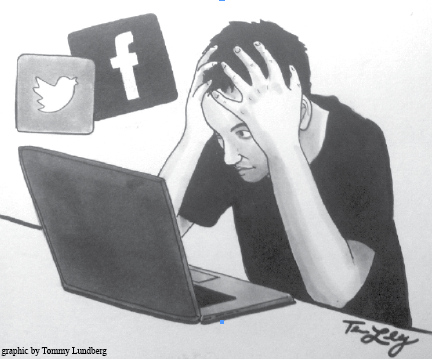
Facebook and other websites are facilitating the social retardation of America. A problem arises when you have 1,000 friends on Facebook, but only really know 50 of them closely. We experience the problem when we find more pleasure in spending hours in front of our Macbooks chatting about the latest “Big Bang Theory” episode instead of socializing face-to-face. This disconnect is disconcerting, and it has staggering effects, particularly for younger generations.
In 2011, California State University Psychology Professor Larry Rosen distributed electronic surveys to 1,000 teens and observed an additional 300 adolescents while they studied. The results of these tests demonstrated that those who used Facebook frequently exhibited depression, anxiety, narcissism, and other antisocial behaviors. They also got lower grades and developed sleeping and stomach problems.
How did outlets designed to enhance social interaction do precisely the opposite? Studies show that a measly 7 percent of human communication is based on written or spoken words, while the rest comes from nonverbal cues. So, those of us who instant message our friends about how much we bawled our eyes out during Anne Hathaway’s rendition of “I Dreamed a Dream” are not able to express completely what we desire to communicate and therefore experience social detachment.
This problem was predictable. In his 1992 book “Crossing the Postmodern Divide,” Albert Borgmann warned that information technologies would create a sort of social “hyperreality,” in which we become drawn into the IT universe and lose interest in actual reality.
Hubert Dreyfus pointed out in 2001 that online interactions lack risk, without which we cannot form a sense of commitment or identity. We were too busy updating our statuses to heed these warnings.
Realizing the irony in the term “social media” is becoming easier. Though Facebook was created with good intentions as a useful tool, it is warping into an instrument of frivolity and shallowness. Perhaps we can go back to using Facebook responsibly, but perhaps not.
But, for now, try taking a break from Facebook this Valentine’s Day. It’s not too late to make those Applebee’s reservations.
