
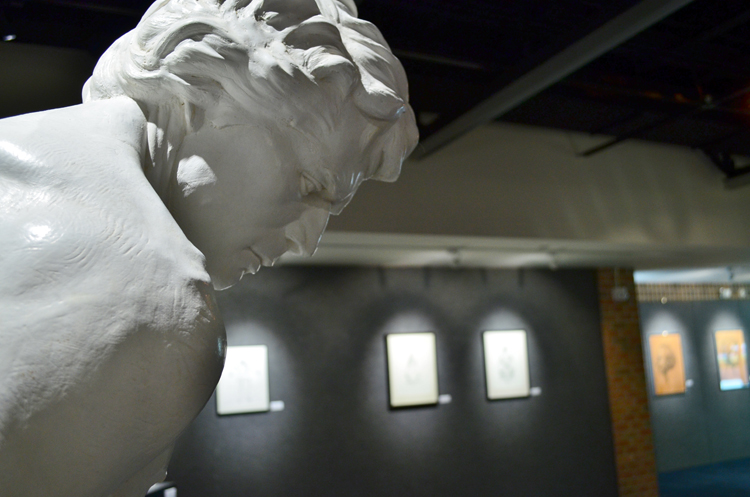
Artist Chris Untalan’s exhibit, showcasing classically inspired nudes and portraits, opened last Sunday in the Daughtrey Gallery at the Sage Center for the Arts. The exhibit is part of the Hills- dale College Professional Artist Series, and will continue through Sept. 23.
Many of Untalan’s pieces are accompanied by reflective titles, such as “Burden of Conscience” and “Philippians 2:6-8.”
Professor of Art Sam Knecht noted that Untalan’s subjects rarely make eye contact with the viewer.
“In many cases, his subjects are looking inward rather than outward,” he said. “I think there’s something rather somber about his work that seems to invite contemplation.”
Associate Professor of Art and professional sculptor An- thony Frudakis said the pieces were thought-provoking and non-traditional.
“The models that he’s chosen are all non-idealistic; it points to a kind of respect of and rever- ence for life in man as he is, without an aesthetic overlay,” he said.
While these imperfect sub- jects have made some conser- vative viewers uncomfortable, most agree that Untalan’s work
shows remarkable talent. Senior Alexandra Allen, who
is minoring in art, said that while she didn’t find Untalan’s work particularly aesthetically pleas- ing, her experience in sculpting has only increased her apprecia- tion for Untalan’s sculptures.
“Nude figures, and especially overweight nude figures, really show off how much skill you have,” she said. “Trying to make really convincing roundness, just by taking off clay and putting on clay, is really hard.”
Untalan’s skill in reproducing the human form, and his atten- tion to detail, are reminiscent of the classic Greco-Roman and Renaissance styles of art. Pro- fessor Frudakis said that Untalan had “an excellent understanding of anatomy and a wonderful sensitivity to texture — a sort of full and life-filled form.”
Untalan said that he sees the human form as “the most direct means to communicate abstract concepts.”
“I’m trying to communicate to the viewer this idea that I have, and I’m using the object to do that — and at the same time I’m communicating with the object,” he said. “And I think that any good work of art, be it two-dimensional or three- dimensional, should have that sort of presence. It’s almost like it’s alive.”
