
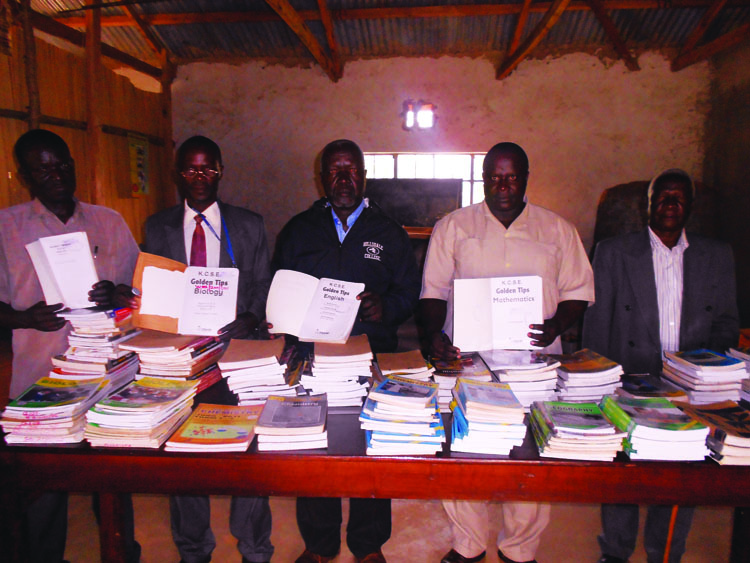
 In the Rarieda District of Kenya, Africa, there is a school called Wang’arot Secondary School. When students at this school read their textbooks, they think of Hillsdale College.
Juniors Rose Okeyo and Samantha Gilman purchased 226 textbooks — about 10 books per subject, per grade — for Wang’arot school. This order only filled half the need, Okeyo said.
In addition, the girls sent $1,100 to sponsor two Kenyan children for last fall semester. The two boys were Kennedy Odhiambo Ogallo and Novine Odiwuor Otonde. Ogallo is a third year student at Wang’arot Secondary School, while Otonde is a second year student at Siger Secondary School.
Okeyo said she felt particularly directed to help these two boys because of hardships in their family life. Ogallo is an orphan, Otonde’s mom a widow.
“I have talked to them,” Okeyo said. “I’ve seen them grow up.”
Despite growing up in these broken situations, both boys hold high academic goals. Ogallo wants to be a computer engineer; Otonde wants to be a lawyer.
“They’re doing really well in school,” Okeyo said. “[Ogallo] is always the top of his class, and [Otonde] is in the top fifth percent.”
Wang’arot Secondary School was built in 2008. Okeyo visited Wang’arot in January and said she saw marked progress.
“It’s still young,” Okeyo said. “More students enroll in the school now because parents are more confident that there are more resources.”
She said last year there were 66 students at Wang’arot. As of January there are 79.
“If you don’t have textbooks, you can’t learn, you can’t do your homework,” she said.
Wang’arot is located in a poor area of the country. Families there can not afford to send their children to the established schools, Okeyo said.
Community members founded Wang’arot to give these poorer students a chance to learn.
Okeyo’s father, Cleophas Okeyo, is the Board of Governors Chairman at Wang’arot.
Rose Okeyo sees that even people who don’t have the resources to obtain books have a hunger to learn.
“Before I came to the US, I saw a boy walking home with ripped pants,” Rose Okeyo said. “[Yet] I knew he had a passion for learning.”
Rose Okeyo said after that, and after watching her father’s participation in the school, she wanted to get involved, too.
“Jesus said to him to whom much is given, much is required,” Gilman said. “Giving with love is a way to preach the gospel. It is not only a duty but a joy to give.”
Rose Okeyo said the students at Wang’arot wrote thank-you notes to her and Gilman.
“They are very grateful,” she said. “They wanted us to tell all of campus.”
Gilman has not been able to visit the school in person yet.
She said whenever Rose Okeyo visits the school in Kenya, the students ask, “When is Samantha coming?”
“They always want to meet me,” Gilman said, smiling.
Rose Okeyo and Gilman have a bigger goal than filling the textbook needs of Wang’arot. They hope to turn their program, named Tujelimu, into a non-profit organization.
The name Tujelimu is a combination of two Kenyan words — tujenge, which means “let’s build,” and elimu, which means “education.” Together the name translates to “let’s promote education.”
“I want to go to schools and encourage students and sponsor those who need help,” Rose Okeyo said. “This project is a lifelong commitment for both of us despite our different career paths. We really desire to sponsor more students because their futures are uncertain since their parents can’t afford to send them to school.”
She said their goal is to raise the education level in that area of Kenya.
“The kids near Wang’arot are just as smart as other kids, we just need to give them a chance,” Okeyo said.
Okeyo was fortunate enough to attend one of the established schools.
“It is my joy to help these kids who don’t have that opportunity,” she said.
“We want to see [Tujelimu] blossom and spread as much as possible,” Gilman said. “I hope it’s the start of something big.”
Okeyo said Tujelimu’s website should be up and running in the next six months to a year. The website will allow visitors to learn about the mission of Tujelimu and donate to its cause.
“We can actually use what we have in America to directly help these students in Kenya,” Gilman said.
They first had this idea two years ago when both were freshmen. After their fundraiser dinner at Mauk Residence Hall last April 16, they opened a joint bank account to start collecting money for their mission.
“I love the way I’ve seen God work through all of this,” Gilman said. “If I hadn’t met Rose, we would not have been able to start this. It’s awesome that even at a young age you can have a profound impact. Youth is no obstacle. I’m only 20, but God has opened doors to allow me to tangibly help people get an education. It shows you shouldn’t wait to make a difference.”
There are no Tujelimu fundraisers planned for this year; however, Gilman said they might host a book drive, especially since professors and students usually have a lot of extra books.
From now on, though, Tujelimu will rely on individual donations, word of mouth, and its website, Gilman said.
“We are in this for life,” Gilman said.
ejohnston@hillsdale.edu
