
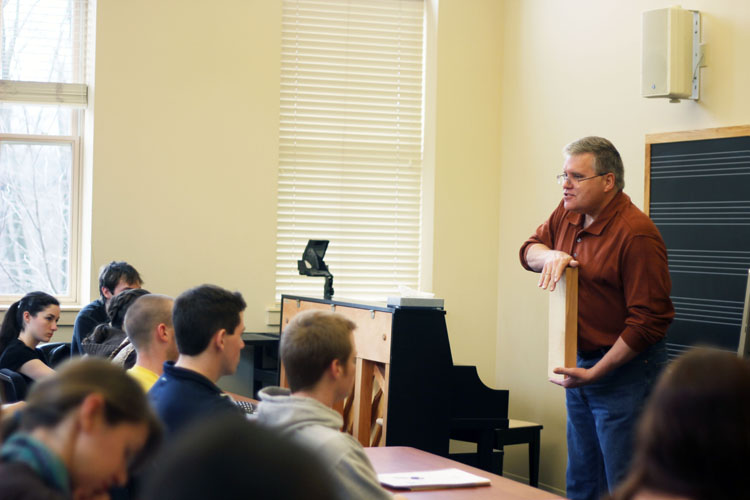
Scott Tribby, luthier extraordinaire, captivated students with his Monday tutorial for instrument maintenance and repair.
Over 30 students packed into the Howard Music Hall classroom to hear Tribby, who makes and repairs violins, talk about how to identify common problems with violins, violas, and cellos.
Before he started talking about repairs, he passed an old violin around for students to observe and mentally note the problems they saw. Later, he picked it up and pointed out its problems: warped wood, crooked sound post, bent bridge, loose seams, cracks, and much more.
Some repairs, he said, require expertise, but some can be done at home.
For instance, the bridge, an intricate slice of wood that lifts the strings away from the instrument, is often pulled forward by the tension from tuning the strings. It can be put back in place, but if it is left alone, it will warp.
“Is anyone afraid to move your bridge?” He asked the class with a smile. The students were silent.
“Admit it,” Tribby said.
Laughter erupted in the tiny classroom, and students watched Tribby brace his violin against his thigh to demonstrate the safe way to correct the bridge angle.
He also showed students how to readjust the sound post, the dowel-shaped piece of wood that fits snugly between the front and back of the instrument. It can become out of place or crooked, but the only way to tell is to peep through the narrow “f” holes cut into the top of the instrument. This repair is delicate.
“If you do want to do it,” said Tribby, “Try it on somebody else’s violin.”
When Tribby began rapping on the seams of the violin he had passed around class, the rich thump became a hollow snap, and he stopped. The seam was loose. But Tribby told the class, “Yes, you can fix it.” Get the glue damp and secure the chin rest over it until it dries.
This is because of the nature of violin glue, also known as hyde glue.
“It is the best glue in the world and it is the cheapest glue.” Tribby said.
He held up a small jar of light brown kernels and passed it around the class. The kernels of animal protein become glue when mixed with water, he explained.
“All the parts of a cow that you don’t eat go into this,” he said. “It’s disgusting.”
Jell-O, it turns out, is the exact same stuff. To prove it, Tribby handed out two blocks of wood securely fastened together with bright orange Jell-O.
Tribby continued to discuss the troubles of string instruments, from mysterious buzzing to bow problems and how to fix them. Afterward, a swarm of students waited to have him look at their instruments and help them find the problems.
Freshman LaRae Ferguson was waiting to have her violin looked at.
“I didn’t know that there were so many things we could fix ourselves, which is nice,” she said. “We tend to think of the violin as abstract. It is good to remember it is a piece of wood you can work with.”
“I wish that when I was younger I knew how to look for things,” Dana Duncan, violin instructor at Hillsdale College, said. She has taken student instruments to him for years, and said his violins are “world-class.”
David Peshlakai, cello instructor at Hillsdale College, expressed his confidence in Tribby.
“He is the luthier I go to for most of my work,” he said. Like Duncan, he also takes student instruments to Tribby for repairs.
Peshlakai was also enthusiastic that students were learning about maintenance of their instruments.
“A little bit of care and maintenance can prevent catastrophes down the road,” he said. “Everyone needs to know about taking care of their instruments.”
sgilman@hillsdale.edu
