
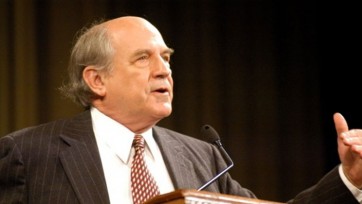
On Wednesday, Charles Murray of the American Enterprise Institute visited campus to speak about one of his books, “Coming Apart,” and the effects modern politics have had on America’s social classes. A few things struck me during Murray’s lecture.
First, Dr. Murray struck me as not fully honest in response to Associate Dean of Men Jeffery Rogers’ question about “The Bell Curve,” a book by Murray and co-author and psychologist Richard J. Herrnstein in 1994 about the relationship between human intelligence and class structure. The book was controversial, particularly because of Chapter 13, in which the authors claimed racial differences have a profound impact on intelligence.
Rogers asked Murray about this particular chapter, to which Murray claimed critics don’t quote it and don’t treat it fairly. For example, noted econometricians Arthur Goldberger and Charles Manski gave “The Bell Curve” a careful and fair analysis, including substantial quotation from Chapter 13 on race. They show that the statistical work of Murray and Herrnstein was not competently done, and the conclusions drawn were unwarranted.
As for Rogers’ contention that Murray should have known “The Bell Curve” would be weaponized, I first heard of the book before it was published, at an informal gathering where economist Walter Block gloated that it would mean we could stop wasting money trying to educate black people.
Second, although I didn’t read “The Bell Curve” (largely because of Goldberger-Manski and similar reviews), I did read “Coming Apart.” While I generally agree with Murray’s contention concerning the importance of constructive behaviors and civic culture, I found his statistical analyses unconvincing, and the inferences and conclusions he drew unwarranted. I do agree that good behaviors generate success, but I think his thesis of social bifurcation is wrong, as is his IQ theory. He doesn’t demonstrate them, at least. There is a serious literature on the importance of learned “non-cognitive skills” (character), which runs counter to Murray’s IQ thesis.
Third, a recurrent theme in his Hillsdale talk is that conservatism has fundamentally changed from focus on limited government to nationalism. I think that’s false. Today’s “nationalism” has a different meaning than “nationalism” of, say, Italy or Germany in the 1930s. Ever since the end of the Cold War, our leftist intelligentsia has proclaimed the obsolescence of the nation-state, to be replaced by unaccountable international bureaucrats in a system of global governance. In this context, nationalism is about preserving and restoring limited constitutional government.
Finally, what I liked most about Murray’s talk was that he was able to deliver it here, freely, without fear of being physically assaulted by radical leftists. It’s a pity Murray is more concerned with President Donald Trump than with leftists who vowed to fundamentally transform America and are now promising to finish the revolution.
Professor Charles N. Steele, Ph.D. is an Associate Professor of Economics at Hillsdale College.
