
Courtesy | X
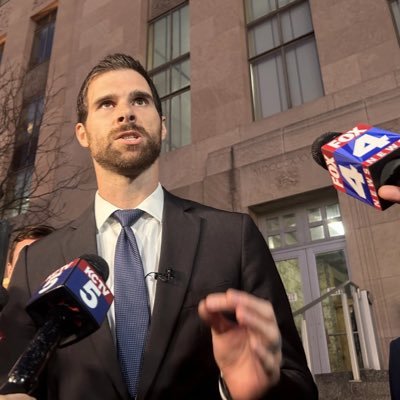
States have the legal means to fight back against social media censorship, U.S. District Judge Josh Divine told students at a lecture Oct. 8.
The former Missouri solicitor general said controversies involving online content moderation arose after Donald Trump won the 2016 presidential election. Tech companies that had previously limited moderation to spam and bots took a more aggressive approach, he said.
“A year before the 2020 election, an executive at Facebook circulates an internal memo, saying, ‘We have the power to alter the outcome of the 2020 election, and in fact, I am very tempted to use that power, to pull any lever, to prevent Donald Trump from being reelected,’” Divine said.
The memo, written by Facebook’s hardware chief Andrew Boz Bosworth, credited Trump with using social media algorithms to his advantage. Bosworth said companies like Facebook could influence the outcome of elections through their control of social media platforms. Divine said this power was soon turned on conservatives.
“Shortly after this, the Biden administration comes in and starts pressuring tech companies, including Facebook, to take down content that the Biden administration didn’t like,” Divine said.
Twitter then kicked Trump off its platform, Divine said, so Republican-led states responded quickly. Divine walked through the process.
“You want to regulate content? You can do that. We’re going to create an exception, though,’” Divine said. “You don’t get to regulate content for viewpoint discrimination purposes, so you can’t take down somebody’s post in Texas because you don’t like the political viewpoint that it professes.”
Missouri responded by passing laws focused on the social media platform’s algorithm after the Supreme Court decided Moody v. Netchoice (2024). Divine used his role as solicitor general to defend those laws, he said.
“Missouri’s approach says, OK, fine. The Supreme Court said ‘we can’t control this. This is Facebook’s,’” Divine said. “So what we’re going to say is, Facebook, you still get to do that, but you can’t have a monopoly on the algorithms. We’re not going to let you go here and delete the New York Post from your site entirely, and we’re going to require that you let other third parties onto your site to have their own competing algorithms.”
Courts have to wrestle with the market power of large social media companies who often act more like the government than private corporations, Divine said.
“Think about Facebook, Instagram, WhatsApp,” Divine said. “The thing that’s attractive about these things is that everybody’s on them. The Facebook suite of apps has 3 billion people on it, and so it’s not like there are any real substitutes. You can’t just leave Instagram and go to something that is a substitute for good. It’s not like shifting from Uber to Lyft. It’s more like shifting from driving to walking.”
Students packed the classroom to hear Divine talk. More than 60 students attended the lecture, according to junior Pierce Leaman, the club’s director of membership.
“Freshman turnout has been phenomenal this semester, and I give credit for that to our tremendous board and their commitment to bringing in great speakers who invite interest in the law for our students,” Leaman said.
Freshman Teddy Randall said he appreciated the career advice during the Q&A following Divine’s talk.
“I really appreciate the way that Hillsdale brings in speakers like Judge Divine, where they’ve had this real world experience and they’re able to bring it to us in a college that could sometimes be considered a bubble,” Randall said. “They give us guidance and wisdom for how we can hopefully pursue a career and one day be like them. As a freshman, I’ve just found it really nice just to be able to go to these different talks. I’ve been to four or five now.”
Divine’s advice was helpful for freshmen, even those outside of pre-law.
“Even though I’m not necessarily pursuing law, I took out of it the greater point that you don’t necessarily get into a profession by going in the straight line in the beaten path,” freshman Victor Michlik said. “He really emphasized the fact that he wouldn’t have expected where he would end up in this career. He started with trying to go down the conventional route of law, but he realized that the people who get to actually have real fun are the people who take risks in their college years and in their career.”
Leaman said the career advice was valuable for those unsure of their post-grad plans.
“I think the most important career advice in his talk was his encouragement to have adaptability if your immediate post-college or law school plans do not materialize,” Leaman said. “He had cited the example that for all his efforts after law school, he was unable to return to his home state of Colorado, and as such had to pivot to a career in Missouri, an unfamiliar state. That was particularly relevant to me and many other students at the talk, many of whom will likely have to pivot in our immediate career plans as opportunities come and go.”
