
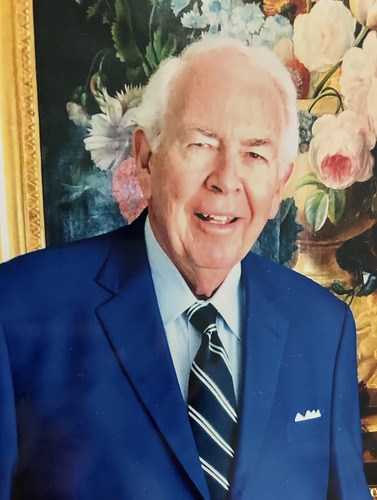
Courtesy | Cleveland.com
Longtime board of trustees member Lawrence “Larry” Selhorst died Aug. 8 at age 93 after being involved with Hillsdale College and the conservative movement for more than 35 years.
“Larry was an old hand on the board when I came to the college,” College President Larry Arnn told The Collegian in an email. “I found him wise and careful. He gave me lots of good advice and was a steady support. He was that way for his whole service on the board, which precedes me for some years. We miss him and are grateful to him for his service.”
Board member and chairman emeritus Bill Brodbeck ’66 said Selhorst was invested in the board’s work in furthering the college’s mission. Selhorst became a trustee in 1991.
“He was a fine man and did very well on the board,” Brodbeck said. “He treated it as a serious thing, which each of us is obliged to do.”
Born in Coldwater, Ohio, on Jan. 4, 1933, Selhorst attended John Carroll University before starting his career in the steel industry. He founded American Spring Wire Corporation in 1968 and served as chairman of the Meridia Health Systems in Cleveland; Meridia’s Suburban Community Hospital; and Russell, Burdsall, and Ward Corporation.
Selhorst was a devout Roman Catholic and a skilled golfer. He is survived by his wife, Martha Selhorst; his brother, John; his children, Sandra, Kathryn, and Timothy; and his many grandchildren and great-grandchildren.
Chief Administrative Officer Rich Péwé said Selhorst was granted emeritus status when he left the board in 2015, though he still attended meetings until about five years ago. Hillsdale’s financial independence from federal and state taxpayer money drew Selhorst to the college, according to Péwé.
“I spent a good deal of time around him,” Péwé said in an email to The Collegian. “He was a steady man with a great personality. Always calm, cool, and relaxed no matter the situation. He always had funny stories and was extremely generous with his advice.”
In addition to his entrepreneurship in the manufacturing industry, Selhorst was a prominent voice in the early conservative movement that rallied around William F. Buckley Jr. and National Review magazine.
Jack Fowler, contributing editor and former publisher of National Review, said Selhorst was one of the first members of the advisory board of National Review Institute, a nonprofit think tank that supports National Review’s mission.
Fowler said he became very fond of Selhorst over the course of several cruises the National Review would host.
“Tall, good-looking, cheerful, smart man, not smarmy, not a know-it-all — there was something about him,” Fowler said. “He had a real presence and a real dignity. Martha, his wife, was just an elegant, beautiful, lovely lady. They were the kind of couple that I think when most people saw them, they would wish that they could be like them.”
Fowler remembered a conversation he had with Selhorst in late 2015 as publisher, where Selhorst called him to comment on National Review’s negative stance toward Donald Trump at the time.
“National Review — this is 10 years ago — had an infamous issue against Trump,” Fowler said. “What Larry was getting at was — he was not prescient, he was observant — the lay of the land culturally and politically called for someone like Donald Trump.”
Fowler said Selhorst was not “Trumpy,” but was disappointed that National Review could not see the problems of the “aggrandized Left.”
“I thought at the time, ‘If Larry Selhorst is thinking this, that says something fundamentally is changing,’” Fowler said. “He was a weather vane. He knew what way the winds were blowing.”
Selhorst’s friend Bruce Schooley said he met the Selhorsts on a National Review cruise about 25 years ago.
“They were both leaders in their own way. They’re both very proactive actualizers,” Schooley said. “It was fun to be around them because they were examples of how you actually move balls down the field, and they were both highly intelligent and extremely articulate.”
Schooley said Selhorst knew everything that was going on in the conservative moment and was willing to invest his time and money in it.
“He had an entrepreneurial spirit, which is why he was so good for the movement because he kept thinking of things that the National Review or other people in the movement should do that were more proactive and practical,” Schooley said. “It wasn’t all just kind of lofty principles. He was interested in figuring out ways in which it can actually become real in people’s lives.”
Schooley said when he went through cancer treatment at the same time as Selhorst’s son, Selhorst supported both of them through that.
“It was encouraging because his son survived and I survived,” Schooley said. “We just loved having them as friends and loved our time with them, and we’ll miss the fact that he’s gone.”
