
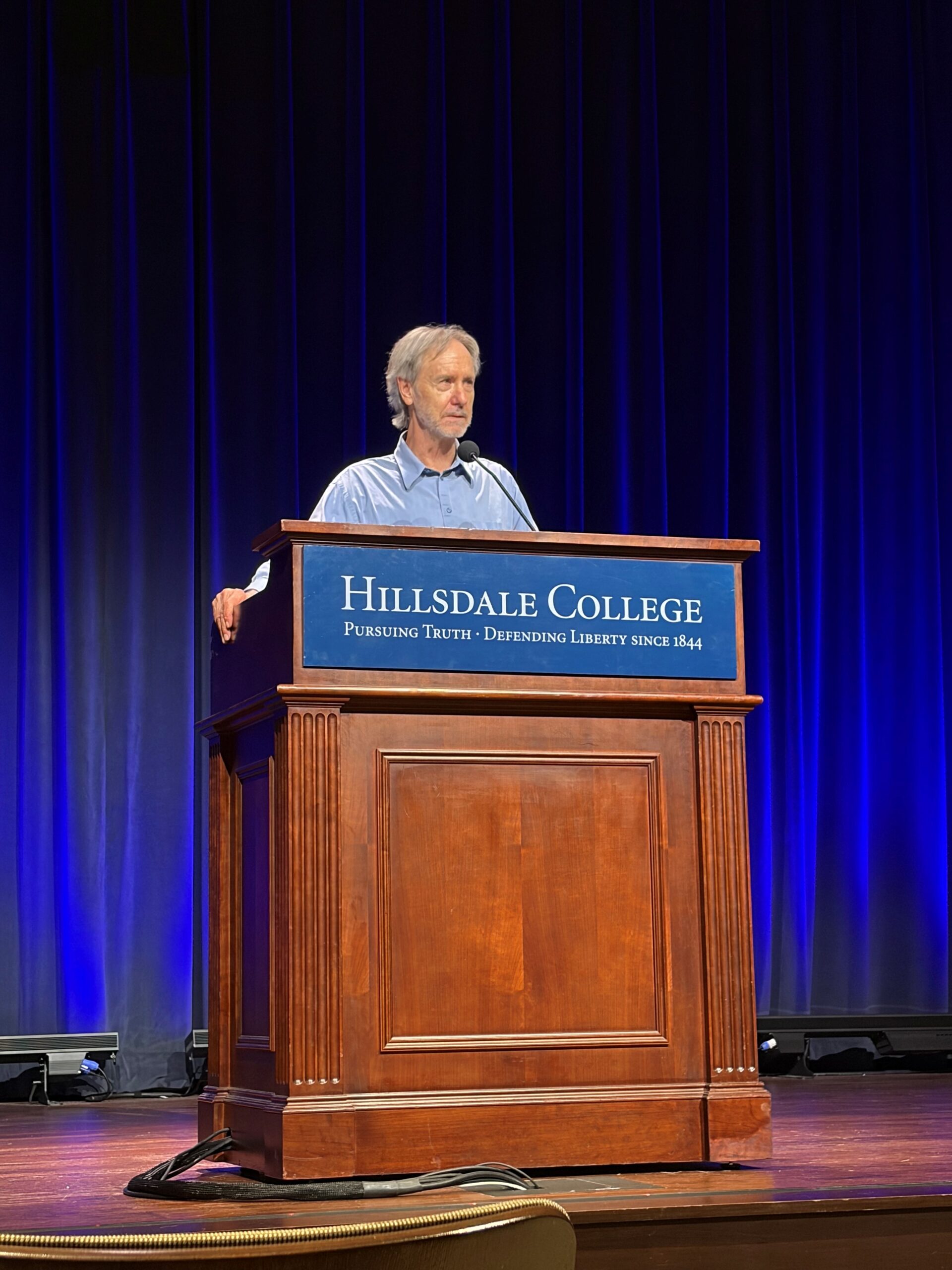
Ron Rash speaks on campus Sept. 8. Courtesy | Adam Robbins
New York Times bestselling author Ron Rash lectured students in Plaster Auditorium on the research and philosophy behind his fiction, revealing that he met with an expert on eagle falconry as research for one of his works.
Through reading excerpts of his work, a lecture, and a Q&A for undergraduate writers on Sept. 8 and 9, Rash encouraged writers to focus on one vivid image when creating a story and to research culture and nature to bring regional history to the reader.
“Writing is an attempt to get to the core of what it means to be a human and reveal the essence of the character,” Rash said.
Rash draws from the literary traditions of Flannery O’Connor and William Faulkner. Like them, Rash’s works explore the complex darkness of humanity.
“In the eight years I have been directing the program, I have never had so much positive feedback from others about a visiting writer,” Dutton Kearney, associate professor of English and director of the visiting writer’s program said. “Ron Rash has an uncanny and genuine ability to make others feel seen and heard.”
Rash is the author of several novels and collections of short stories and poems. His novel, “Serena” was recognized as a 2008 New York Times bestselling novel as well as a finalist for the 2009 PEN/Faulkner award for fiction.
“‘Serena’ is a book that will outlast both of us. I think it’s a modern classic,” Kearney said.
Rash teaches at Western Carolina University as the John Parris Distinguished Professor in Appalachian Cultural Studies.
Both nights on campus Rash read excerpts from his writing which entranced the audience.
“Plaster Auditorium became completely silent as we were transported into the narratives, both about water,” Kearney said. “In each of these moments, there was a transformation that took us all out of that tragic moment to think about something higher than tragedy — the experience of time outside of time, be it in future lore, or in theological transcendence.”
On the second evening of his visit, Rash read an excerpt of his work describing a young girl drowning which displayed the grisly reality of tragedy but offered hope of peace at the end. He unraveled the complex process of constructing his deeply emotional scenes and gave the audience a look at the craftsmanship that makes literature matter to the reader.
During an informal Q&A, Rash discussed the process of finding inspiration with undergraduate students in the Heritage Room and advised them on the purpose of good literature.
As a young writer, Rash told students he would meticulously plot his stories out, but soon realized that if the end was not surprising to the author, then it would not shock the reader. It was through this method that he wrote his stories to live in ways that even shocked him, Rash said.
As an author trying to uncover the deepest parts of the human experience, Rash finds that humanity truly comes out when something does not go right. These moments are the details that make a story, Rash said.
“One of the most pernicious things a young writer can be told is to only write what you know,” Rash said.
Rash’s research often leads him to meet people with obscure careers or lifestyles. While writing the novel “Serena,” Rash met with an expert on eagle falconry to learn some of the techniques hunters use. Rash said he often approaches research situations with an eager desire to learn. Sources love talking about what they do and will usually be glad to share about it, Rash said.
Although many of the excerpts Rash read were heartbreaking, he said the darkness was the best way to dig deeper into what it means to be human. The Appalachian landscape, hard and isolating, lends to this type of writing, but also provides a rich culture and natural beauty nurtured within the unforgiving terrain, Rash said.
“Ron Rash was an absolute delight over dinner and made us all weep during his readings. I loved that,” Assistant Professor of English Christina Lambert said. “In the spirit of Flannery O’Connor, he reminded us that you have to say dark things in literature if you want to say the truth.”
