
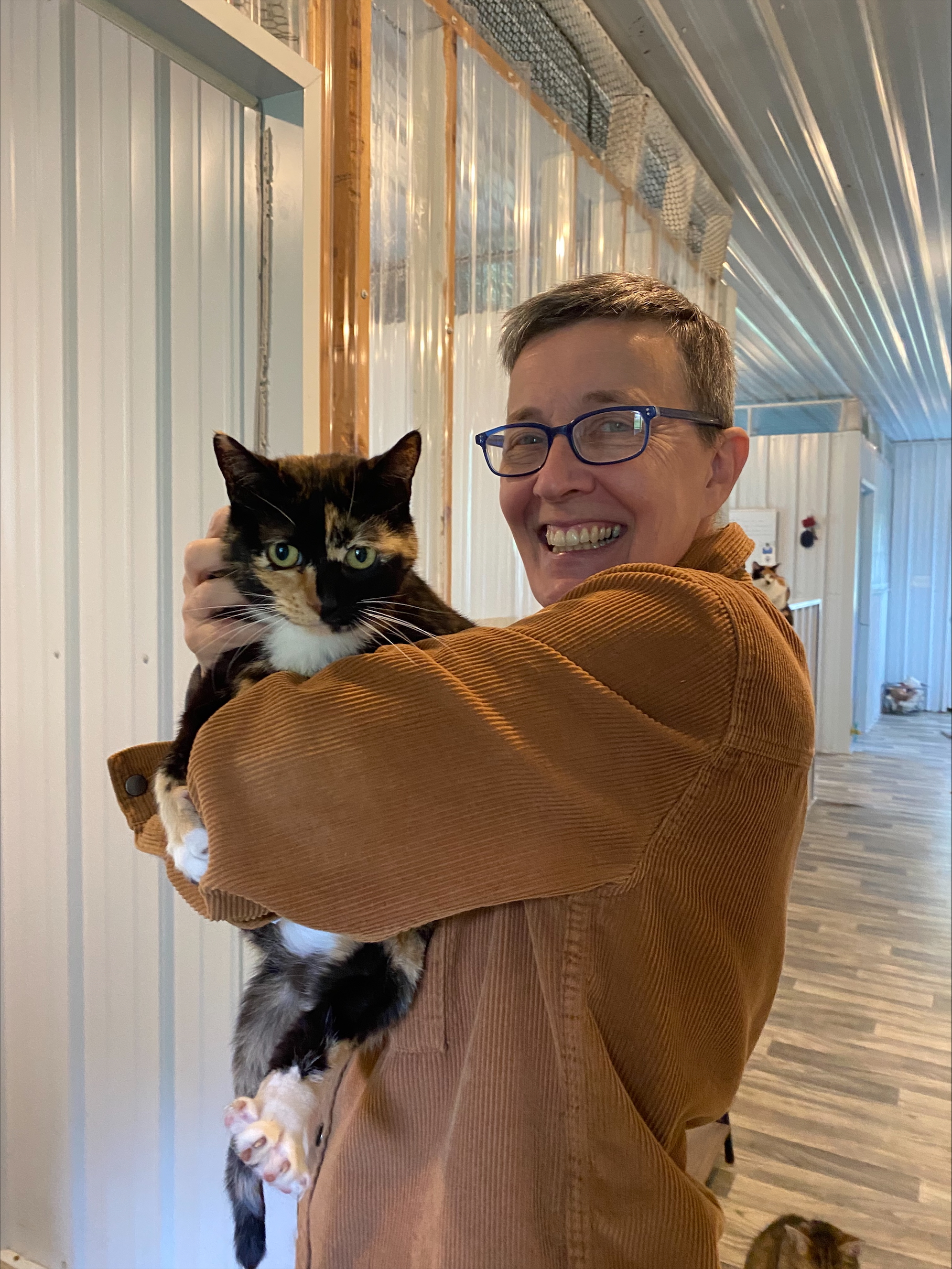
Kátia Sherman holds Luna, a rescued cat. Megan Li | Collegian
When Kátia Sherman bought her house after accepting a job at Hillsdale College eight years ago, she found an enormous colony of stray cats roaming around.
“In one summer, a colony of 20 can turn into a colony of 130, so I neutered and spayed all of them and provided outdoor housing, food, and stuff for them,” said Sherman, an associate professor of Spanish. “A lot of them became so friendly that I was like, ‘I need to start adopting these things.’”
When Sherman ran out of space in her home in 2020, she dug into her retirement account to build the Feline and Friends Shelter. But, according to Sherman, there were so many stray cats coming in that she ran out of funding. She surrendered her license as an animal shelter a year ago, stopped taking animals outside of extreme circumstances, and deleted the shelter’s internet presence. Now, Sherman said although the shelter is no longer an official and working institution the cats continue to come.
“I blame it on my own inexperience — big heart, but not a lot of know-how,” Sherman said. “I took in a lot of cats that were not adoptable cats.”
Sherman said every stray cat who came to the shelter was brought to her by students, neighbors, and strangers who heard about her shelter through word of mouth.
“The population of cats, outdoor cats, feral cats, proliferates as fast as you or I can count, and sometimes you have an outbreak of disease out on the streets,” Sherman said. “It’s a very difficult place to try to do this, because the need is so great, the willingness is so small, and it’s all about money.”
The shelter took in between one and five cats a week, and kittens were likely to leave the shelter fastest, according to Sherman. Other cats were not.
“If you have a black cat that is an adult and has a special need, like Molly, who is absolutely the most loving cat we have in the shelter, people just won’t adopt them,” Sherman said. “Once you begin to observe them, you see how tremendously hard their lives are.”
Senior Emma Wiermann had volunteered at Feline and Friends since the first semester of her freshman year.
“We’re giving them pets and affection and teaching them to be socialized to humans,” Wiermann said. “But I’d say it’s cool that they’re doing me a service because they’re giving me the furry anxiety repressives that I need — a good way to cope with the busyness of school.”
Sherman said she sees more stray cats in Hillsdale than she has seen anywhere else.
“I grew up in the dumps,” Sherman said. “I’ve never seen anything like this.”
Sherman said it is the instinct of cats to reproduce, and the city does not have the funds to counter that with a public spay clinic.
“It needs fundraising, and then it needs controlled publicity,” Sherman said. “When I retire, that’s what I’m going to do if I stay in Hillsdale, because the need is obvious. It screams at you.”
Director of the Great Hillsdale Humane Society Megan Gordon said the Humane Society hosts a spay and neuter clinic about once a month, born from a program called Fix the Future in collaboration with the BISSELL Pet Foundation.
“We can normally take around 20 to 30 cats and there they get fixed, microchipped, basic vaccines, and it is $25,” Gordon said.
Sergeant John Gates, who heads the Hillsdale County Sheriff’s Office Animal Control Division, said the division handles dogs and livestock, not cats.
“The biggest thing is that cats are considered feral animals, and there is a lack of resources,” Gates said.
Sherman said there are people in the county trapping and killing cats.
“As the intelligent species, we owe them better,” Sherman said. “This is a very religious little town. There is a church on every corner. But I get frustrated sometimes because I feel that Christian teaching of caring for your neighbor doesn’t extend to the next species.”
Gates said education and responsible pet ownership can provide the most help in alleviating the problem. He has not heard specific cases of animal cruelty, but he would not be surprised.
“Absolutely, our office will enforce it,” Gates said. “It’s a violation of state law.”
Wiermann said the community can push for changes in laws concerning animal cruelty.
“Obviously, don’t be a terrible person,” Wiermann said. “They’re God’s creations, just like we are — obviously not the same, but still worthy of love and respect.”
Sherman said cat owners should try to care for or, at least, spay a cat before deciding to give up on it.
“Don’t buy that new pair of jeans that month and get the cat spayed,” Sherman said. “It’s little things that we can do, little sacrifices that we can make on our end that will change the life of another being that shares this planet, in this life with us. It’s edifying, it’s gratifying. It will make you feel better.”
Send tips to the City News team: collegiancitynews@gmail.com
