
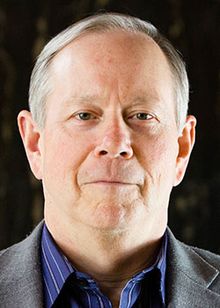
Bill Gertz is the national security correspondent for the Washington Times and a New York Times bestselling author. His latest book is “Deceiving the Sky: Inside Communist China’s Drive for Global Supremacy.” At the recent CCA Feb. 3, he lectured on “AI as a Means of Totalitarian Control in China.” Courtesy | Washington Times
What do you think is the biggest threat China poses to the U.S. right now?
It is the number one existential threat to the United States. In my view, everything else is a sideshow: Russia, Ukraine, Middle East, Latin America, whatever. I view China as the ultimate threat because they have, after 40 years of engagement with the United States, after the Cultural Revolution, the policy under Deng Xiaoping was to bide their time and hide their capabilities. Then in 2012, Xi Jinping came to power, and he is a true believer in Marxism, Leninism. They have a little bit of a different interpretation of it, but he’s driving the train into making China the next superpower. In order for China to do that, it has to diminish, weaken, and ultimately destroy the United States, in order for China to achieve its position as the sole superpower. We’re challenged by this massive reality across the spectrum — political, military, intelligence, cyber — all domains are being threatened by China. Through my reporting, I’ve been trying to awaken people to that fact.
What can the U.S. do about it?
It’s Cold War 2.0, and we learned from the first Cold War that as long as there’s this expansionist, nuclear-armed dictatorship in China, we need to address that threat the way we address the threat from the Soviet Union, which was ideologically. It’s going to take a restatement or a reassertion of American values and democracy. We have to lead from the top. We’ve got to ultimately defeat the Chinese Communist Party ideologically.
What should the average person understand about China?
Understanding the danger from China is understanding the role of Marxism and Leninism within the Chinese system. Even some within the second Trump administration, they don’t fully comprehend what we’re up against in terms of that we’re dealing with an ideologically motivated adversary that is not going to be amenable to transactional kinds of relations with the United States. It’s going to require a much greater understanding that these are people who have a vision, and that vision is based on an 18th-century ideology of Marxism, which says that, first, there’s no God, it’s atheistic, and that leads to massive human rights violations. And second, it has a historical vision that history is moving from a feudal society up until an ideal worker’s paradise that will never be reached, and in the interim, they’ve applied totalitarian controls, and that the reason they’re doing this is not because it’s a nationalistic Chinese thing. It’s a Marxist, Leninist motivation that is driving them, and the main obstacle to them achieving their Marxist, Leninist goal is the United States as a free, open and democratic system, and that is the biggest threat to China, and that’s why we need to better understand the nature of the China threat.
How did you get into national security reporting?
I’m an old Cold Warrior, and I covered the Cold War going back to the ’80s. I had some experience working for a publication and a group called the Freedom Leadership Foundation, which basically looked at human rights in the Soviet Union. We supported dissidents, and we battled the Soviet Union back in the day, and then it collapsed. I was hired in 1985 by the Washington Times, and they had just brought on a new editor who was a former Newsweek correspondent, and he put me on the foreign desk, and that’s where I started.