
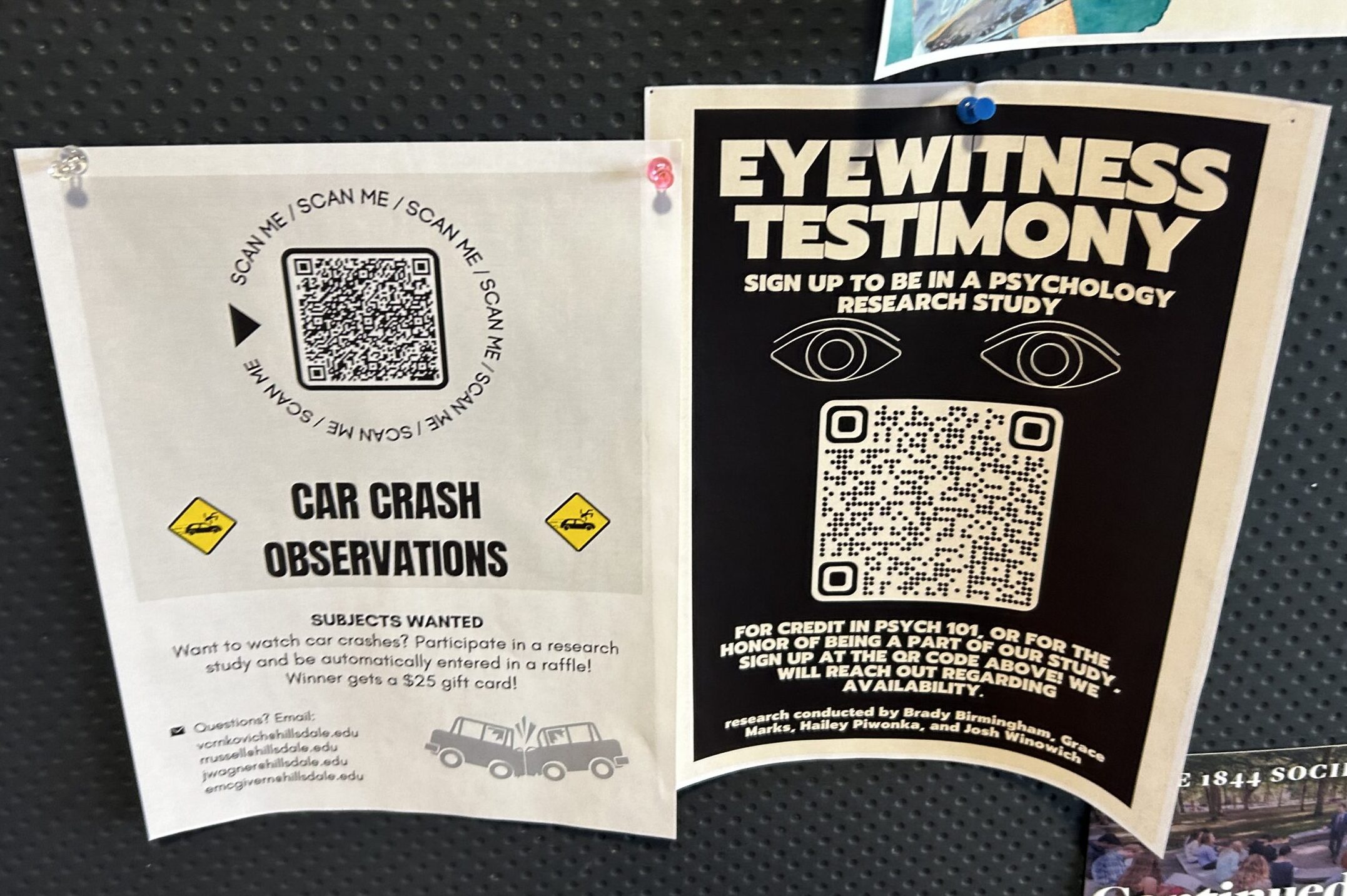
Students replicated famous psychology studies on campus. Lauren Bixler | Collegian
Psychology students conducting research on campus this semester have invited students to provide eyewitness testimony in a given scenario or observations on car crash videos. Students conduct these studies during the spring semester for Assistant Professor of Psychology Jared Parker’s Research Methods & Methodology class.
“We teach students the different methods that psychologists use to investigate psychological questions,” Parker said. “We also teach them relevant concepts in the philosophy of science and how to think about scientific research.”
Students learn the fundamentals of research by conducting replications of famous studies with a smaller data set. Two of the research projects are recreations of Elizabeth Loftus’ studies, which specialized in memory research.
“Elizabeth Loftus was interested in how memory can become distorted and how witness testimony and memory can be changed based on how you ask the questions,” Parker said.
The implications of these studies can immensely shape the practice and execution of psychology, according to Parker.
Grace Marks, one of Parker’s students, said studying different authors and psychologists has shaped her approach to research statistics.
“Some of the authors we have been reading are a little disillusioned with the way modern psychology is, and Parker has been giving us a very nuanced take on how to interpret statistics so we don’t put too much stock in them,” Marks said.
Parker said there are two parts to psychology — the therapeutic side and scientific side — which must work together to provide psychotherapists with the scientific arsenal to better understand the nuances of what their patients go through.
Parker said that although most students seem to be on the psychotherapy track, participating in research now can be helpful for them later on.
“I think the main utility of research is it gives them an insight into what it’s like to participate in these studies, and that insight can be useful later on in their careers as they examine research that other people have done,” Parker said. “If you want to be a good psychotherapist you should stay up to date on research that other people have done.”
Sophomore Brady Birmingham shared what he learned from conducting a research study.
“I have learned how difficult it is to control extraneous variables in a study. It takes a lot of work to try and ensure that each one of the participants has a very similar if not identical experience when taking the study,” Birmingham said. “I better understand why psychology has such difficulty creating studies that are reliable and replicable.”
Marks stressed the benefit of conducting research.
“We have learned things that might make us more cautious about some of the assumptions we are encouraged to jump to in modern psychology,” Marks said.
