
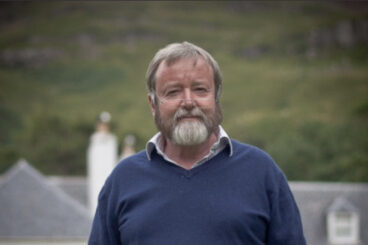
Iain McGilchrist spoke about the relationship between the sciences and the humanities. Courtesy | Hillsdale College
We need to integrate the humanities with the sciences in order to have a holistic understanding of the human person, according to psychiatrist and neuroscience researcher Iain McGilchrist.
The psychology department hosted McGilchrist for a lecture titled “The Divided Brain and the Relationship Between the Sciences and Humanities” on Wednesday, March 20.
McGilchrist said the divide between science and the humanities results from “a mechanistic way of thinking.” He said the two fields, though distinct, help each other make sense of reality.
“We need analysis and we need synthesis, we need breaking things up and seeing things alone, and we need both hemispheres to do that,” McGilchrist said. “I believe philosophy can make sense of a lot of what science finds, and science can in turn give to philosophy.”
McGilchrist said he studied philosophy and theology at the University of Oxford. Finding these humanities “disembodied,” he later pursued psychiatry and neurology.
“Because I had a background in the humanities, I never saw things in the simplest way,” McGilchrist said. “I didn’t just see a piece of machinery here we had to understand, but that all these things we were looking at had human meaning.”
According to McGilchrist, the left hemisphere of the brain is analytical and detail-oriented while the right hemisphere views reality more broadly. The right hemisphere takes the left hemisphere’s observed parts and integrates them into a whole.
“The right hemisphere is more veridical, more truthful to reality than the left hemisphere,” McGilchrist said. “The job of the left hemisphere is not to try and assess and understand the whole scene, it’s just to get stuff in it.”
McGilchrist said that we live in a world where the left hemisphere is dominant.
“We’ve forgotten that this information we get from being reductive only means something when it’s put back into the context of a whole, lived, human life,” McGilchrist said.
McGilchrist also said the transcendentals come from a disposition of the soul, not a procedure or machine.
“What is good, what is beautiful, what is true, cannot be programmed into a machine, they’re not logarithmic,” McGilchrist said. “I want to make an appeal for truth, and I want to suggest that the nature of goodness is not utilitarian and can’t just be calculated, and that beauty has a degree of permanence, and that this is not just something we make up. It speaks to us across time and space.”
Sophomore Annika Monson said that McGilchrist’s talk was insightful, and that it showed we can’t reduce human beings to mechanisms.
“I really like what he said about reality as an encounter, because it’s so rich and it deserves a richer response from us besides viewing it as just facts,” Monson said.
Sophomore Emil Schlueter said McGilchrist’s work mirrors that of Hillsdale’s psychology department to reconcile philosophy and psychology.
“I thought Dr. McGilchrist’s work represents pretty groundbreaking research about the relationship between philosophy and psychology,” Schlueter said.
