
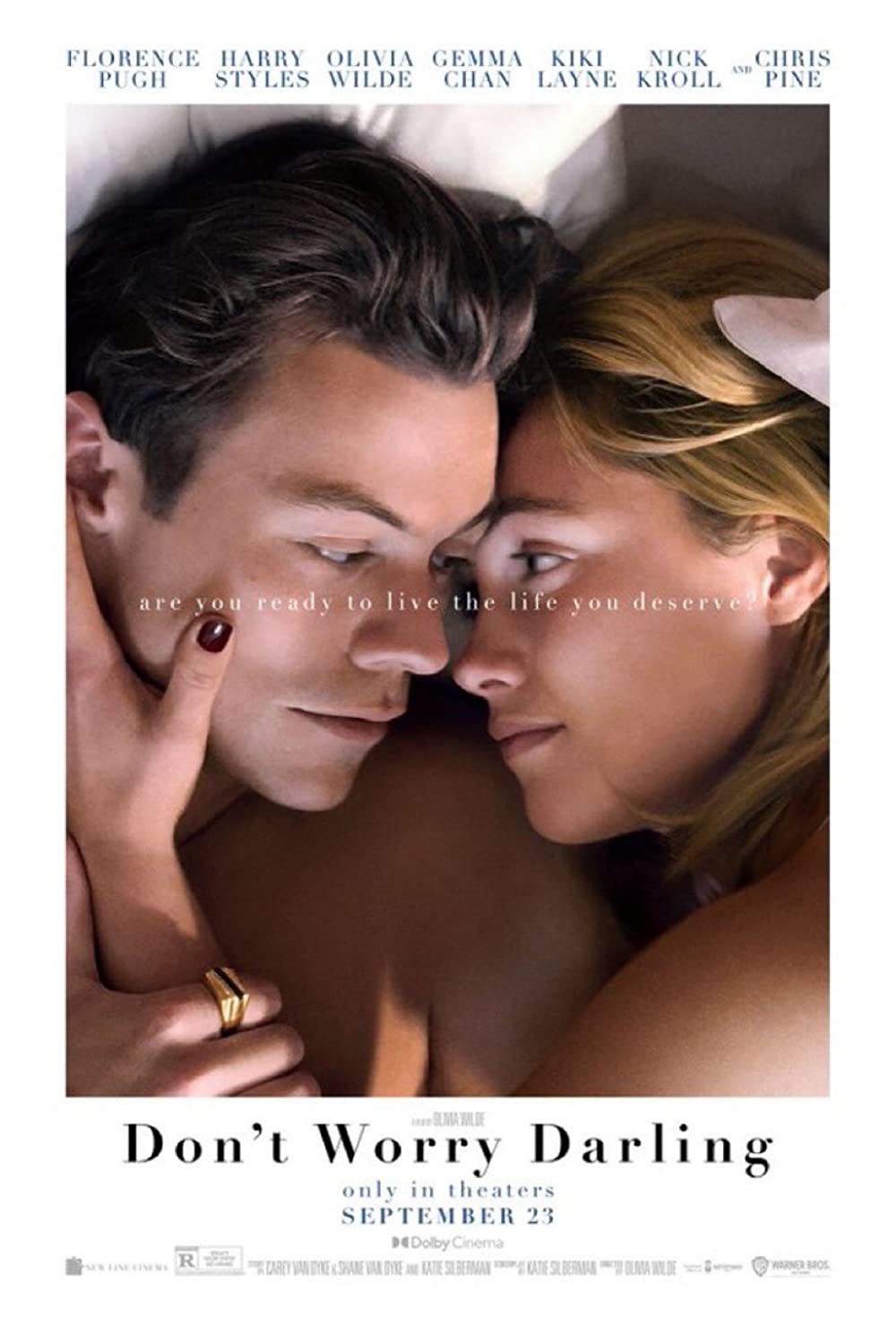
What is the Victory Project? This is the question the newly released psychological thriller “Don’t Worry Darling,” ambitiously poses but fails to answer—at least not coherently.
By all accounts, the film was set to be a blockbuster. The lead actors, Harry Styles and Florence Pugh, are young, attractive, and immensely popular. It was also Olivia Wilde’s second directorial feature following her acclaimed debut, “Booksmart,” and critics were eager to see more from the young director. Perhaps most importantly, the movie’s production was mired in scandal. An affair between Wilde and Styles, Pugh’s notable absence from the press tour, and public conflict between Wilde and Shia LeBeouf all began generating headlines months before the film’s release (not to mention the alleged spitting incident at the film’s premiere).
The story is set in the idyllic, newly-developed neighborhood of Victory—an intensely mid-century, palm-tree-heavy oasis in the middle of an otherwise barren desert. As an intentional throwback to the ’50s, the neighborhood’s houses are occupied by young attractive couples who observe traditional gender roles. The wives wear tea-length swing dresses and pack their husbands’ lunches before the men leave for work in their Chevy Bel-Airs. Alice, the film’s protagonist, is one of those wives who fills her days with cooking, cleaning, shopping, taking ballet classes, drinking with her next-door neighbor and best friend, Bunny, and waiting for her husband, Jack, to return home. Everything appears perfect, and everyone seems happy in this sexed-up caricature of mid-century America. However, something sinister lurks beneath the picturesque veneer.
The men of Victory go to work each day for the “Victory Project,” an ideological endeavor that spawned the town of Victory itself. The mission of the “Victory Project,” which is led by Alice’s charismatic neighbor, Frank, is distinctly opaque. Alice and her fellow wives know nothing of their husbands’ work save for daily earthquake-like disturbances that they casually brush off. The mystery of the “Victory Project” becomes explicitly menacing when Alice is suddenly plagued by disturbing visions and experiences that grow increasingly macabre as the story progresses.
Like its female characters, the film is beautiful but hollow. The costumes, set, and cinematography are gorgeous. Florence Pugh’s performance is incredible. But the plot is inconsistently paced, possesses a dubious theme, and entirely lacks feasibility.
Styles’ performance is disappointing on its own and downright tragic compared to Pugh’s. He doesn’t move his face enough, but somehow still gives the impression that he’s trying too hard. He never truly becomes Jack and never sheds his off-screen identity. He’s Harry Styles for the entirety of the movie. When Pugh was onscreen, I became immersed in the story of Alice’s life in Victory, only to be wrenched back to reality by the startling and inexplicable presence of a British rock star. I had to Google his character’s name to write this review.
“Don’t Worry Darling” has a problem with pace. It pours all of its energy into the first half hour of its runtime, introducing expositional information and establishing its fundamental conflict. The beginning is ambitious and prompts so many questions that the audience wonders how Wilde will pull it all together.
The short answer is that she doesn’t.
The middle of the movie drags on, reusing the same “unsettling” plot points repeatedly. Alice’s vision of smiling synchronized swimmers slowly necrotizing is far less impactful the third time around. Wilde tells us at the beginning of the movie that something is wrong in Victory and then spends the next hour and a half trying to convince us that something is wrong in Victory. The big reveal, during which the “Victory Project” is finally explained, is crammed uncomfortably into the last 30 minutes of the film. After an hour of nothing, the climax and falling action are suddenly dumped on the audience.
The film’s feminist motifs are neither subtle nor thoughtful. There is no nuanced or thought-provoking commentary on sexual politics. The message is loud and uninteresting, moralistic and unfocused, puritanical and crude. Sure, it’s a scathing social criticism— but of what is unclear. Men in general? Jordan Peterson (who was purported to be the inspiration for the antagonist)? The ’50s? I genuinely don’t know.
The film’s bumbling attempt to convey a feminist message is hostile to men and condescending toward women. It’s hardly an enlightening social commentary. Half-hearted gestures toward some immaterial and unnamed misogynistic force fail to establish an enemy to fight against.
Most disappointingly, the story simply doesn’t make sense. The big “twist” doesn’t explain the odd happenings we’ve spent so much time observing. While the dystopian events might effectively establish the movie’s tone, it fails in terms of plot. The twist is also absurd. The reveal was so jarring and silly that my friends and I laughed out loud when we went to see it in the theater.
“Don’t Worry Darling” has a lot of potential as an intriguing hybrid of “Mad Men” and “The Village.” It proves to be stylistically rich but substantively bereft. Its conflict is fascinating, but the resolution is logistically and thematically incoherent.
The drama surrounding the movie’s production was ultimately more compelling than the movie itself. If you haven’t seen it yet, don’t worry about missing out.
