
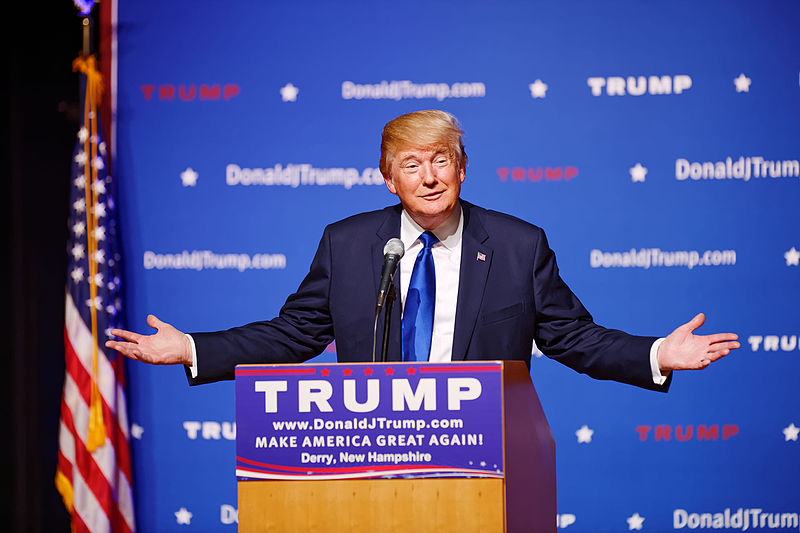
The current era marked by political unrest and division between parties and branches of our government is nothing new to our history. What is different, however, is the president’s understanding of his role in current circumstances.
In his own way, President Trump is getting to the root of what people really want. The American people want security — protection and reassurance that their regime will prevent fraud and abuse by any means necessary, while ensuring that each person could feel fulfilled in their communities and their work. This may seem broad, but America’s definition of security is changing as we speak, which might lead to a change in the role of our government.
A government’s primary role is concerned with security, but every generation has the opportunity to define what the scope of that security is, financially, militarily, morally. The President has tapped into the wellspring of security that continues to attract individuals dissatisfied with business as usual in Washington, D.C.
For example, politicians accept that illegal immigration is a problem, but twiddle their thumbs instead of fixing it.
Trump campaigned as a de-aligning figure, a wrecking ball thrown against the gilded institutions of Washington, D.C. set upon demolishing the previous status quo. He attacks his political opponents mercilessly, ignores expediency for prudence with a long-run approach, exposes corruption, and speaks honestly — even if sometimes incorrectly with false information. And he demonstrates a genuine care for the American people.
But what will be left in his wake?
According to the theory of realignment, history illustrates a political party system which realigns in terms of platform and policy every 36 years, as a result of generational differences and a dramatic change in party allegiance. If this is so, a realignment is soon imminent. I do not think Trump is that realigning figure, nor do I think he sees himself as that. He is leveling all previous standards, paving the way for a realignment.
Following Trump’s presidency, what will be the new defining characteristics of the Right after the previous attempt at fusion between libertarianism and social conservatism in America?
We can only predict what will come in principle, but I believe it is essential to prepare for the future in our limited capability to know. We must ask the right questions in order to identify the New American Right, as Sohrab Ahmari calls it, when it actually arrives. This upcoming philosophy is a fundamental rejection of unrestrained classical liberalism — one without guardrails — which yields a continual fight for endless and aimless individual autonomy.
This new political ideology articulates the connection between true liberty and responsibility. It encourages self-restraint and announces that man ought to be judged as an individual while he is understood as a part of the community. It will understand government as a means of both providing security and encouraging the preservation of a moral society. It understands society’s need for orientation toward that “highest good.” People don’t want liberty for its own sake; they want the protection of liberty to seek fulfillment.
The New American Right will not worship the free market like the conservatives of the past. For them, free enterprise will be a tool, historically-proven to be the best mechanism for promoting human flourishing. It is a means to help build a society, rather than its own end in which the people may conduct themselves with or without good aims.
Those under this banner will likely deeply revere the Founders, bear witness of the desecration of the Constitution, and morally oppose the ethical and cultural disintegration of the United States. They will understand this on account of government’s neglect of immorality, anti-religiosity, and class warfare. Our system of government is designed for a moral people, but morality is not spontaneous. A well-ordered society needs guidance by good leaders and policies.
We are beginning to see actors emerge in this mold, such as Congressman Andy Biggs, R-Ariz., and Congressman Dan Crenshaw, R-Texas. Senator Josh Hawley, R-Missouri, emphasizes the necessity of encouraging morality, and the threat big tech poses to the American polity. These three individuals are more articulate versions of President Trump in some form or fashion, and they will have the chance to rebuild the political sphere after his exit.
If Trump is re-elected, the United States will see a surge in this trend of defiance against aimless individualism. I predict we may see a realignment toward a new ideology that champions the citizen — the person who has duties to the community and for whom the government secures the ability to pursue personal plans ordered toward a higher purpose.
Weston Boardman is a George Washington Fellow and a senior studying economics.
