
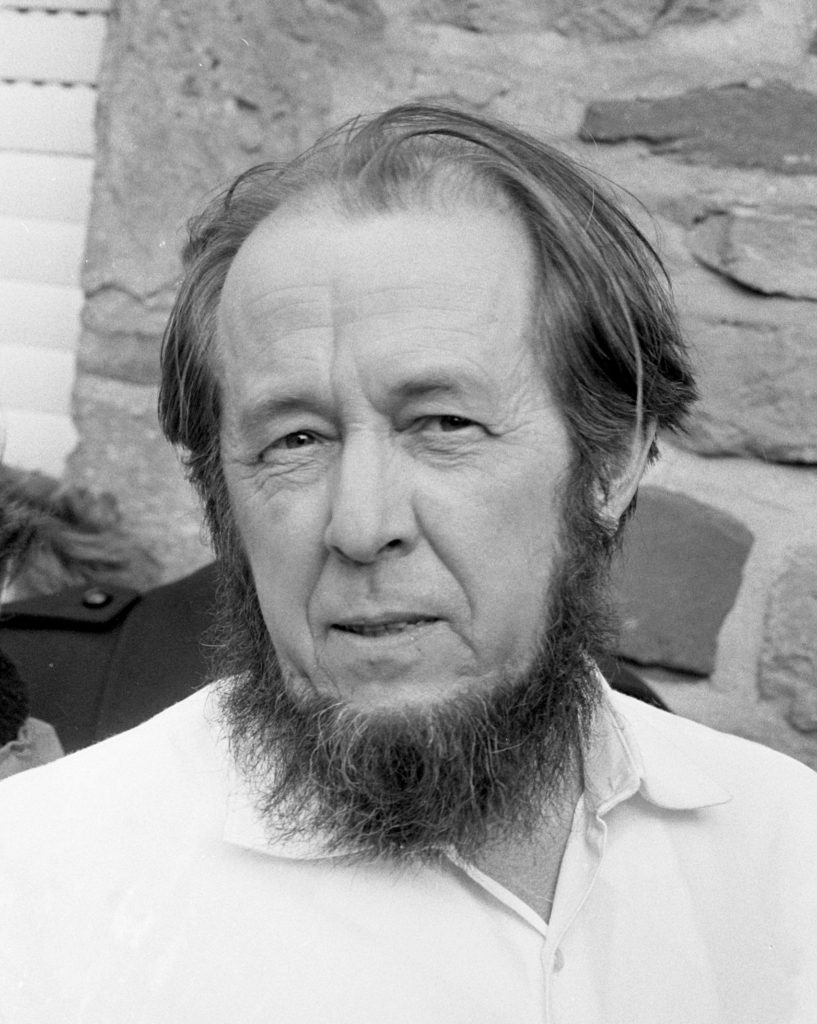
“One word of truth shall outweigh the whole world,” said Soviet dissident Aleksandr Solzhenitsyn. Indeed, the prolific author offered not just one word of truth, but many. With his work “The Gulag Archipelago,” Solzhenitsyn provided what diplomat George Kennan called “the most powerful single indictment of a political regime ever to be leveled in modern times.” For his contributions in exposing the evils of totalitarianism, Solzhenitsyn deserves a place on Hillsdale’s Liberty Walk.
Aleksandr Solzhenitsyn was born in Russia in 1918. His father died before his birth, so he was raised by his widowed mother. She encouraged her son’s education in literature and science and brought him up in the Russian Orthodox Church. But at 14-years-old, Aleksandr left behind the teachings of Jesus Christ for those of Karl Marx. He became a committed scholar of Marxism and mathematics in college and soon after joined the Red Army. Solzhenitsyn commanded an artillery unit during World War II and was twice decorated for his bravery.
During his time in the army, Solzhenitsyn was arrested for criticizing Joseph Stalin in private letters to a friend. The devoted Marxist was sentenced to eight years in a labor camp and three years in exile. Here, he rediscovered religion and began writing . In a Soviet journal in 1961, he published his first short novel “One Day in the Life of Ivan Denisovich,” about a day in the life of a Soviet inmate. His work was thereafter censored, so he turned abroad to continue publishing.
In 1970, he won the Nobel Prize for Literature. Solzhenitsyn declined his invitation to receive the award in Stockholm because he feared the Soviets would not allow him to return home. So, he submitted his Nobel address in written form. Here, Solzhenitsyn admitted: “I was convinced I should never see a single line of mine in print in my lifetime” — but still he wrote nonetheless. In this address, he reflected on Dostoevsky’s powerful line: Beauty will save the world. Falsehood, violence, ugliness — all will come crumbling down when confronted by truth, Solzhenitsyn argued. He urged his fellow writers to action: “I believe that we are able to help the world in its white-hot hour. Not by making the excuse of possessing no weapons, and not by giving ourselves over to a frivolous life – but by going to war!”
And, go to war he did. Three years later, in 1973, he published his masterpiece: “The Gulag Archipelago,” named for the Soviet network of labor camps that stretched like islands from the “Bering Strait almost to the Bosporus,” exposing the atrocities of the Soviet regime to the world. Solzhenitsyn’s writings reminded the world that people are not purely material beings, soulless and godless, to be molded and perfected like clay. Instead, man is a spiritual creature, longing for truth and a destination higher than this world. “The Gulag Archipelago” is a powerful testimony to this simple truth: Man is meant to be free. After the publication of this three-volume work, Solzhenitsyn was arrested and exiled. He retreated to a barbed-wire enclosed home in a remote mountain village in Vermont until 1994.
Solzhenitsyn confronted the monstrous ideologies of the East, but he found little comfort in his new home in the West. In 1978, Harvard University invited him to give its commencement address and he delivered a speech that ended in controversy. Rather than praising the Western way of life, he offered a warning: “A decline in courage may be the most striking feature which an outside observer notices in the West in our days.” Solzhenitsyn warned America’s intellectual class of a liberty divorced from virtue, a softness induced by luxury. He criticized the “spiritual exhaustion,” “psychological weakness,” and “loss of willpower” that has come to characterize American society. Rights abound, but duties have vanished. What is good has been substituted for what is legal. Material luxuries have replaced spiritual fulfillment. Misery abounds.
Why the tyranny of the East? And why the misery of the West? Solzhenitsyn provided an answer in a 1983 speech: “Men have forgotten God; that’s why all this has happened.” In this way, the problems facing the East and the West are not two but one. They mirror each other, both depriving man of the divine, both premised on the idea that man’s final destination is this world, and that, in Marx’s own formulation, “man is the highest being for man.”
After expressing these sentiments at Harvard, Solzhenitsyn was ostracized from academia. “When I called out ‘Live not by lies!’ in the United States, I was told to go take a hike,” he reflected in 1978. “It turns out, democracy expects to be flattered.” So he returned to Russia in 1994, where he lived out the rest of his days and died in 2008 at the age of 89.
His prescience was unmatched, his prose unequaled. He longed to preserve those same things that Hillsdale College seeks to preserve today: “That ancient trinity,” as he called it, “of Goodness, Truth, and Beauty.”
For his courageous defense of unpopular truths, Aleksandr Solzhenitsyn was excluded from other campuses. For that very same reason, we should welcome him to ours.
Garrison Grisedale is a senior studying Politics.
