
Anyone who has taken one of Professor of History Ken Calvert’s classes knows about his love of the overhead projector.
Instead of the digital projectors wired into the ceiling of each classroom, Calvert prefers a boxy contraption illuminated by an incandescent light bulb that looks like it belongs in a “Looney Toons” episode. But Calvert is proud to be a Luddite.
“The ‘old -fashioned’ overhead projector is easy to use, rarely breaks down — although sometimes it needs a new bulb — it never needs to be restarted or to have an IT person help figure out how to work the thing,” he said. “I think the overhead projector has more smarts than the smartboard.”
Calvert is not alone in his affection for the technologies of the past. Sophomore Jonah Davey typically types the drafts for all of his papers on a typewriter. Davey said doing so helps him distill his thoughts and write more efficiently, in a way that neither handwriting nor typing on a computer would allow.
“It’s a low-tech device that functions for me as an accelerated form of handwriting,” Davey said.
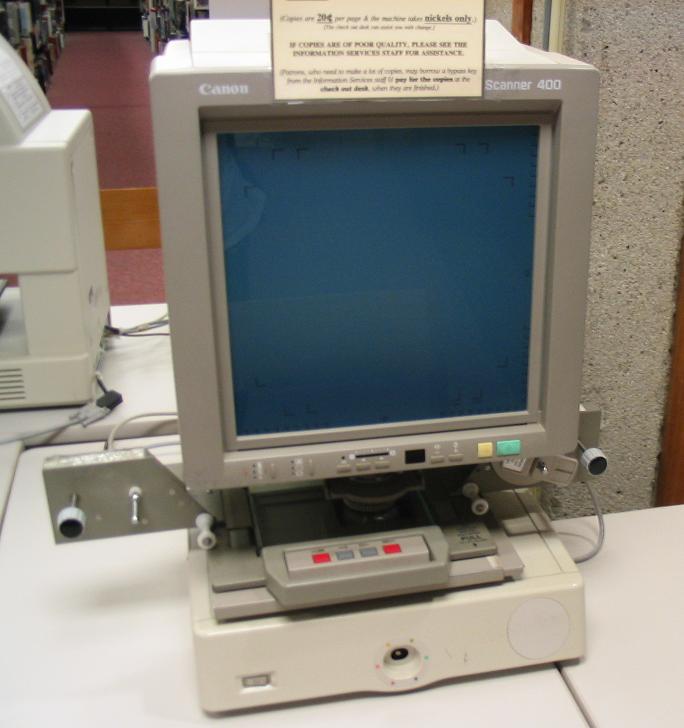
Even the college itself still adheres to the past. Although now rarely in use, Mossey library has two microfiche readers as well as a microfilm reader.
According to Public Service Librarian Linda Moore, the college is in the process of slowly phasing out microfiche.
For example, the college used to have a number of books in its microfiche cabinet, but once these were purchased online, the physical copies were discarded. Additionally, the college has purchased a scanner that allows microfiche users to make individual copies of microfilms.
“If someone decides a microfilm is important, it becomes available online,” Moore said.
As new technologies quickly overtake older ones, the library tends to accumulate multiple copies of the same thing. Moore said this has happened most notably with the New York Times. The college owns hard copies, microfiche versions, and the online version of the NYT archives.
“It’s America’s paper, so to speak,” Moore said.
According to Moore, another problem with the constant onslaught of new technology is the hard decision of whether to replace existing catalogs or create new ones.
This becomes most evident in the library’s transition from VHS tapes to DVDs for the film collection. Some things in the VHS library are irreplaceable, and as the library transitions from DVDs to Blu-ray discs, the same is becoming true.
“Keeping up with the technology as it evolves can be a real issue for the library,” Moore said.
Even more pressing, however, is the issue of when to finally let an old technology go. For instance, the library no longer stocks vinyl records because it no longer has record players.
“One of the philosophies of the library is that if we are going to collect it, we need to have the equipment,” Moore said. “People were stealing record needles — which are expensive — so we never replaced them and got rid of our record player.”
Some technologies, however, are so old that they never will leave. Moore pointed over to the table near the copy machines.
“Paper cutters are not cutting edge, so to speak,” Moore said.
