
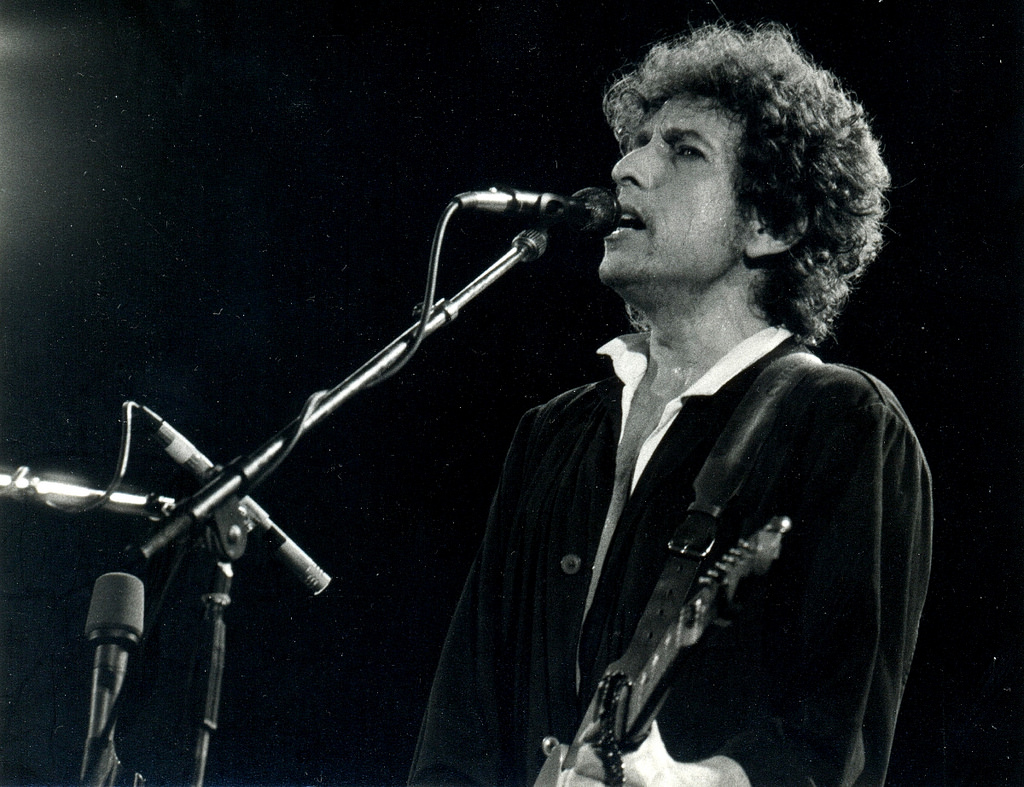
Bob Dylan just won a Nobel Prize in literature. It’s exactly the kind of lifetime achievement award such an endlessly inventive and prolific artist as Dylan deserves.
Of course, everyone is mad about it.
In The New York Times, Anna North laments that the selection committee passed over “writers who have made significant innovations in the form” and underrepresented “writers from the developing world” in favor of a man already famous for his work.
North is correct that Dylan doesn’t need the distinction of a Nobel win. But she overstates the award’s ability to launch previously obscure writers into the public eye — just ask Svetlana Alexievich, Tomas Tranströmer, or Mo Yan.
These, of course, are three other recent laureates for the Literature prize. Hadn’t you heard?
North’s other critiques fall just as flat. “Significant innovations in the form”? Dylan’s unique, complex narratives inspired a generation of poets and songwriters. “Writers from the developing world”? Have you ever been to Duluth?
It’s hard to fault writers like North too much; they’re fighting an uphill battle. Dylan’s mastery of his form and cultural influence are nearly impossible to overstate. His songs — elemental blasts of deep human feeling — electrified a music scene dominated by the superficial and the trite. It was Dylan who inspired the Beatles to leave their teenybopping “She Loves You” days behind to pen masterpieces like “Yesterday,” “Come Together,” and “A Day in the Life.”
“The way that Elvis freed your body, Bob freed your mind,” Bruce Springsteen said in 1988. “He showed us that just because music was innately physical, it did not mean that it was anti-intellect. He broke through the limitations of what a recording artist could achieve.”
Just as importantly, Dylan muscled the culture of the heartland back into a pop landscape overwhelmingly populated, as now, by urban elites. Dylan’s early catalog is full of clever jabs at his industry’s snobbery. “Unlike most of the folk songs nowadays that are being written uptown in Tin Pan Alley,” Dylan comments over the opening chords of 1963’s “Bob Dylan’s Blues,” “This — this is a song, this wasn’t written up there… This was written somewhere down in the United States.”
Springsteen again: “Bob Dylan is the father of my country.”
Difficult as it is to fault Dylan on the merits, critiques of Dylan’s Nobel necessarily all boil down to an argument of qualification. As a singer, the argument runs, Dylan is not actually engaged in the project of literature, which connotes the written word. Stripped of their musical regalia, Dylan’s lyrics fall flat — or at least fall short of deserving a Nobel.
There would be something to this argument, were it not that literature has always been about more than the bare word. Poetry, while good in print, derives its particular pleasure from the rhythm of spoken sound, the sibilants and glottals that form rushing air. More, the proper execution of a state play requires costumes, sets, even music — but no one would deny that a play can be literature. Certainly the Nobel Committee has not: piles of playwrights have won the prize, from Samuel Beckett to George Bernard Shaw.
But even this answer misses the point. The most important question here isn’t just what literature is, it’s what literature is for.
The creation of literature is not simply a technical exercise of virtuosic wordsmithing. In the truest sense, literature is for its readers — for their delight and edification. Prizes in literature shouldn’t just say “Good job: You had the best words!” Rather, they should reflect literature’s purpose: to help us make sense of our broken world; to help us redeem the time, because the days are evil. Dylan, singing about politics and society, about sin and faith and hope and love, did and does that better than anyone.
He sings with tenderness, as in 1966’s “Sad-Eyed Lady of the Lowlands”: “With your silhouette when the sunlight dims / Into your eyes where the moonlight swims, / and your matchbook songs and your gypsy hymns, / Who among them would try to impress you?”
He sings with bitterness, as in 1965’s “Positively 4th Street”: “When you know as well as me you’d rather see me paralyzed, / Why don’t you just come out once and scream it?”
He sings with resignation and determination, as in 1975’s “Buckets of Rain”: “Life is sad, life is a bust; / All you can do is do what you must. / You do what you must do, and you do it well — / I do it for you, honey baby, can’t you tell?”
Bob Dylan, in short, sings about is what it is to be alive.
As usual, of course, Dylan himself slips by his critics with a shrug. He’s always been the last person to call his own work “genius” — he has protested throughout his career that he is nothing but an entertainer, and clearly thinks many of his own fans take him too seriously.
In that respect, he’s fighting an uphill battle, too.
