
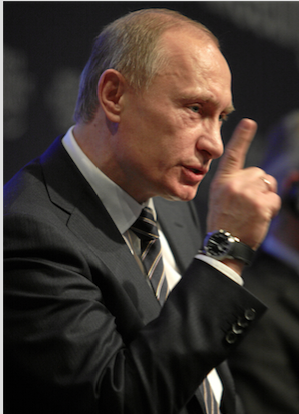
Amid all the recent drama over the Republican nominee’s burgeoning man-crush on Russian President Vladimir Putin, the actual threat of Russia is being overlooked.
Russia occupies 20 percent of the Republic of Georgia, has completely annexed the Crimea peninsula, continues to unofficially support insurgency in Eastern Ukraine, and has propped up the Assad Regime in Syria, which has used chemical weapons on its own people. And Russia shows no signs of slowing down.
Putin has created a Russia in which he is unchallenged at home, all-powerful in his region, and among the most powerful voices abroad. Putin believes in what some of his predecessors termed “Greater Russia” in that he thinks of the former Soviet Republics as merely extensions of the Russian cultural sphere: “We are not just close neighbors,” Putin said after annexing Crimea, “we are essentially, as I have said more than once, a single people.”
Ted Bromund, a senior researcher at the Heritage Foundation wrote in February, “I have met with a number of Eastern European and Baltic diplomats and politicians. All are convinced Russia will invade Latvia, Lithuania and Estonia.” They should fear. Putin has conducted a number of snap military exercises in the Baltic, and the state-owned Gazprom gas company has the ability to throttle most of Eastern Europe’s supply of the crucial natural resource. And, as his occupations of Georgia and Ukraine prove, Putin is not afraid to expand his borders – and the West is afraid to push back.
Meanwhile, Russia is flexing its muscle more and more on the international stage. After the recent cease-fire in Syria disintegrated and United States Secretary of State John Kerry nearly accused Russia of war crimes, Putin reacted strongly. The Kremlin revoked several nuclear accords, deployed anti-aircraft weapons to Syria, dispatched 5000 paratroopers to participate in joint exercises in Egypt, and even suggested that they might reopen military bases in Vietnam and Cuba. A reporter on a state-run news program relayed a significant threat: “boorish behavior toward Russia has a nuclear dimension.” Russia completely changed the calculus in Syria, and is now dictating the terms of the battle, with no fear of Western retaliation.
Russia is putting up a strong face abroad in part because of its weakness at home. As the Economist pointed out, “The economy is failing. … Living standards have fallen for the past two years and are falling still. The average salary in January 2014 was $850 a month; a year later it was $450.” The Heritage Foundation is more blunt: “Democratic freedoms are in retreat, corruption is endemic, and the future is bleak.”
In November 2013, Putin’s approval rating, according to the independent Moscow-based Levada Center, fell to 61 percent – the lowest since 2000. Less than a year later, after his annexation of Crimea and the staging of the Sochi Olympics, Putin’s approval rating was up to 88 percent. Putin’s position at home is strong, but his strength at home seems dependent, at least in part, on his strength and power abroad.
When Mitt Romney called Russia our “number one geopolitical foe,” in 2012, he was widely mocked by his political opponents. President Obama called it a 1980’s foreign policy. Hillary Clinton said that “it’s somewhat dated to be looking backward” toward the cold war and its foreign policy. As Secretary of State, it should be mentioned, Clinton brought a “reset” button to Russia that mistakenly read “overcharged” instead. Meanwhile, Philip Breedlove, the Supreme Allied Commander and commander of U.S. European Command, is arguing that Russia poses “a long-term existential threat” to America and her allies.
Our current president’s policy – put in place in part by Secretary Clinton – has done nothing to stop Putin’s aggression, and trying to be friendly with Putin is like trying to befriend a wolf: you might not fail, but you can never feel safe, either. The next president must be strong against Russian aggression on the international stage and focus on hitting Russia’s economy. Our next president should use strong economic sanctions to chastise Russia’s abuses of international law, because Russia’s weaknesses are not external – where most Western pressure to date has been applied – but internal.
Thackston is a senior studying politics.
