
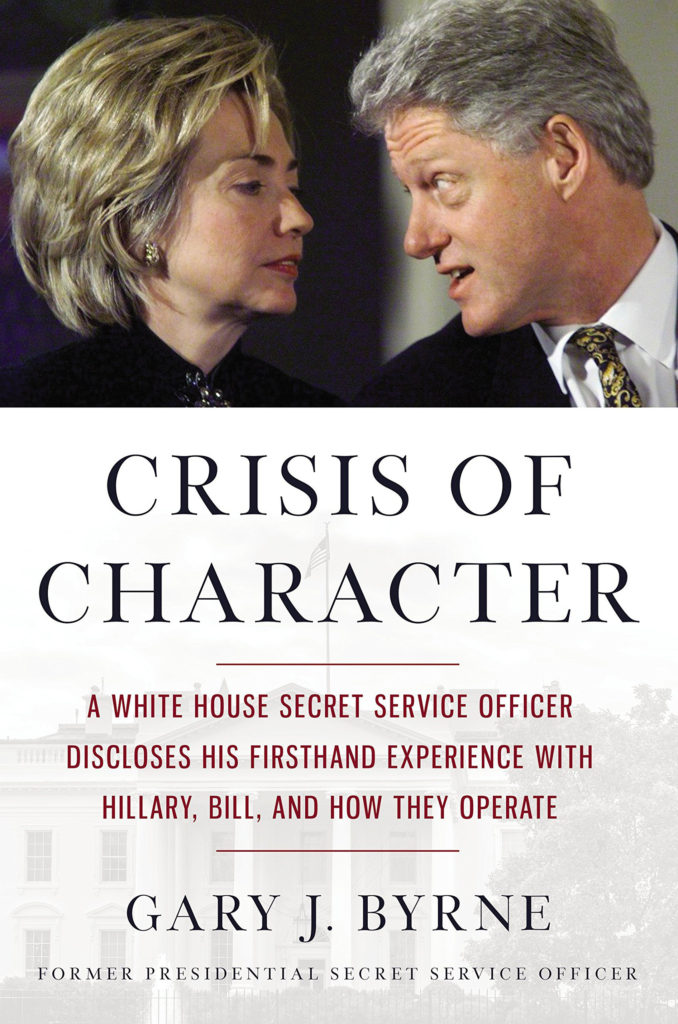
From Whitewater, to Lewinsky, to Benghazi, and finally to Emailgate, Bill and Hillary Clinton have been embroiled in national scandals for almost 30 years. Former United States Secret Service officer Gary Byrne unleashes on the Clintons in “Crisis of Character,” a tell-all book published by the Hachette Book Group in June 2016, making the moral and practical case against electing Hillary Clinton president.
The book follows Byrne’s career protecting the first family and the White House as a uniformed officer in the Secret Service, and later looking to prevent terrorism as an United States air marshal. Byrne focuses on the Clintons’ fixation on protecting their public image and lust for money and influence and the resulting disregard for national security and others’ personal welfare.
Byrne uses his firsthand experience dealing with the Clintons to support a glaring and harsh description of the presidential power couple. Byrne portrays Bill as a lax leader better suited as a bartender than president, and a serial womanizer who cares more about his next “appointment” with Monica Lewinsky than about national security. Byrne says Hillary is merciless and known for her incredible temper, yet always manages a smile in front of company and the media.
“Crisis of Character” begins with a fight between the Clintons in the White House that results in a vase smashed against a wall and a black-eyed president. Byrne immediately launches into the conflict of conscience of the Secret Service following the incident.
Protecting the president of the United States is a profound honor that Byrne would give his life for, but the USSS cannot defend a president from the threat of the first lady, Byrne says. The Clintons’ behavior showed contempt for the responsibilities of anyone underneath them, even the jobs of men and women tasked with their protection. Later, Byrne outlines how Bill Clinton’s actions forced him to destroy evidence of an affair to protect the president, something Byrne could have been punished for if he was caught.
As a uniformed officer, other former Secret Service officers have claimed Byrne would not have held a high enough level of clearance to get as close to the Clintons as he claims. But Byrne refutes that he was promoted as an agent in president George H. W. Bush’s administration to the level of clearance needed.
While Byrne’s critics rely on attacking his character, none of them challenge the validity of his portrayal of events. While doubt can exist whether Byrne witnessed the events personally or reconstructed them through gossip, the events themselves largely haven’t been questioned, excluding when Byrne allegedly caught the president kissing Eleanor Mondale in the White House Map Room. Mondale denied ever being involved with Clinton until her death in 2011.
A major portion of the book is devoted to detailing Byrne’s experience in the Clinton White House during the Lewinsky scandal. He explains how far Bill Clinton went to have the affair, even suggesting Clinton gave Lewinsky access to a private White House line reserved for top military brass. Granting this access was more than just an abuse of power by the president; Lewinsky became an immediate security risk. According to Byrne, any competent interrogator could have manipulated her into giving up the phone line’s code.
Throughout the investigation into the Lewinsky affair, Bill Clinton misdirected and scapegoated, wasting money and manpower in the cover up. Byrne blames the Clintons for the excessive waste and “an all-time low” in morale.
The investigation took an exhausting toll on the hundreds of people involved. Byrne went a week on just three hours of sleep. Work in the White House stopped completely as the administration was forced into evading and stonewalling the FBI from revealing an embarrassing lapse in judgement by the president at best, a serious threat to national security at worst as unqualified people were allowed access to restricted places.
The Clintons acted in selfish and erratic ways that broke the morale of Secret Service and White House staff, leading to a lack of pride and honor in fulfilling responsibilities. The poor leadership led to systemic problems within the administration and the USSS in particular, resulting in 300 officers leaving the Secret Service by 2003, according to Byrne.
The Clintons’ first priority in public is always protecting their image, in stark contrast with their security detail’s mission of protecting them. When traveling, the administration would insist on Secret Service agents dressing in plain clothes to appear more approachable. According to Byrne, the practice only made agents look less threatening, negating their ability to deter potential attackers through intimidation. It placed the lives of the Clintons and their security detail at needless greater risk.
The mentality of valuing appearances over efficiency extended to the military, where requests for vehicles and support were denied because “We don’t want to look too militant,” as Byrne heard one official say.
“Crisis of Character” raises important moral questions about the type of leadership the Clintons exhibit and how the United States will handle a Hillary Clinton presidency. Byrne also fears the risk Hillary poses to national security with details continuing to come out concerning her private email server.
The validity of Byrne’s critiques of the Clintons rely heavily on his own integrity. He often hides the names of other agents he talks to or uses vague references when quoting administration officials. Though the book reads like a gossip column at times, Byrne’s main contentions — that the Clintons suffer from a powerful “rules don’t apply to me” attitude the possible threats to the stability of the administration and security of the country — are supported by the litany of Clinton scandals that have made national news for the past three decades.
Byrne fears Hillary will repeat and exacerbate the chaos of Bill’s presidency. The difference today, Byrne claims, is that “If we board that time machine for a return trip — it’s our fault.”
