
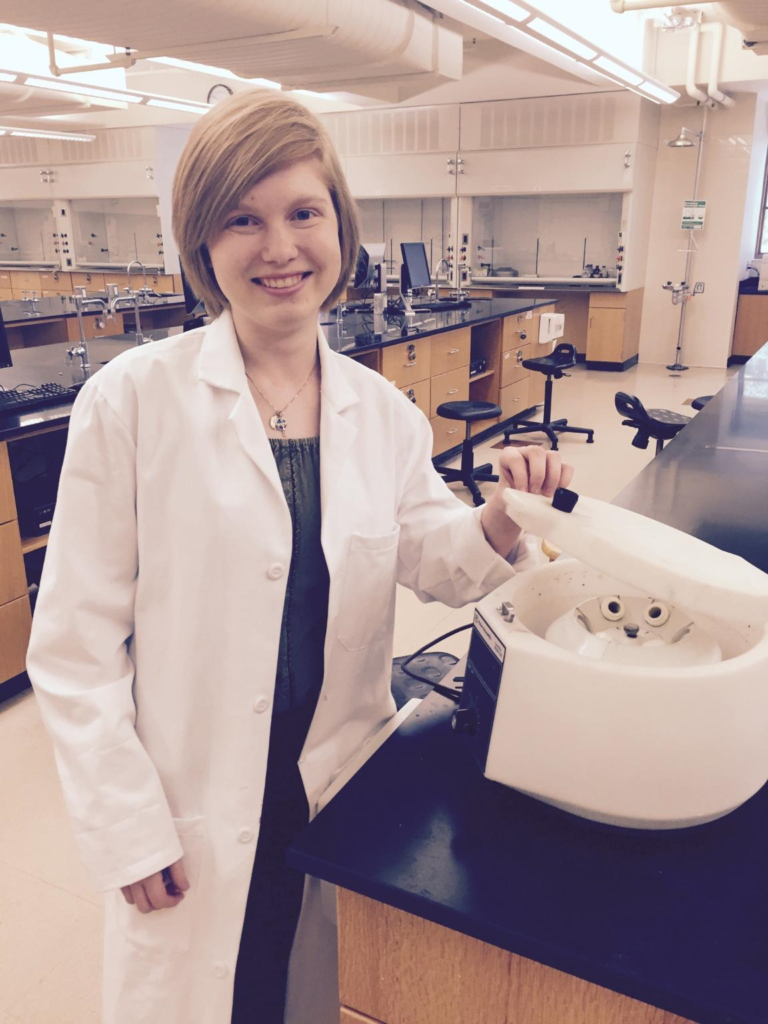
Successful surgeons have mastered the art of chopsticks.
Junior Emily Nelson discovered this from the two months she spent at the University of Texas Health Science Center in the cardiothoracic department this summer. When Nelson’s small fingers struggled to manipulate a needle driver in her suturing lessons, her Texas host family recommended she practice eating with chopsticks to simulate the finger coordination.
Nelson’s chopstick skills became so good one day her supervisor stepped back to allow Nelson to put a stitch on the heart of a bypass patient.
Dr. John H. Calhoon supervised Nelson. He is professor and chair of cardiothoracic surgery at the UT Health Science Center and the President’s Council Chair for Excellence in Surgery.
Nelson is the first Hillsdale student to intern for Calhoon, and he’d like to offer that opportunity every summer.
“Emily did a beautiful job of working for us; she was energetic and involved. When she applies for medical school I’d love if she’d consider us—Emily would be our first draft choice,” Calhoon said.
After being approached by college President Larry Arnn in fall 2014 regarding internships for Hillsdale students, Calhoon contacted Chris Hamilton, associate professor of chemistry and adviser of the Pre-Professional Society, in search of a student who had experience with electronic medical records and who could write.
“Emily caught Dr. Calhoon’s attention by saying that she loved watching surgeries,” Hamilton said.
Nelson proved to be a perfect fit.
As a freshman, she spent three weeks training to be a medical scribe at the Hillsdale Community Health Center.
In her interview, Calhoon asked if she still had a grasp of the medical language.
Nelson replied frankly.
“With that kind of stuff, it’s either use it or lose it, but I still got my flashcards!” she said.
In addition to troubleshooting their electronic medical record system to be more patient and physician friendly, Calhoon had a research project for Nelson. He asked her to write a ‘then and now’ comparison piece between the American founding and the early pioneers of cardiac surgery to the progressive trends in politics which medicine has also experienced through the rise of administration.
“Emily’s work is good enough to be in the Imprimis in my opinion. The content is outstanding,” Calhoon said.
Nelson typically spent her evenings in the medical library researching and writing after a long day of following resident medical students as they visited patients or in the operating room standing at the surgeon’s side.
Even as the daughter of a practicing anesthesiologist and having already shadowed physicians, Nelson had never experienced medicine this personally before.
“My experience in the hospital and with surgery in particular has been similar to, ‘Here’s a stool, so maybe you can see,’” Nelson said. “But on day three in the hospital, Dr. C had just wrapped up his part of an operation and pulling off his apron, asks me, ‘Do you want to learn how to scrub in?’ From that day on I was standing across from or right next to the surgeon.”
Only toward the end of her two months did Nelson make headway on modifying the electronic medical records system when inspiration struck as she stared at the Microsoft Word panel.
“I thought, ‘this is really intuitive.’ I started looking up apps and examining social media for how they made things user-friendly,” Nelson said.
In her 2,500 word report, Nelson suggested several improvements, including making a customizable home screen modeled after Pinterest, where doctors can prioritize different things for every patient.
Calhoon is currently looking into publishing Nelson’s work on the electronic medical records, and working for Calhoon has only increased Nelson’s desire to enter medical school following graduation.
Although she has not decided on a particular area in medicine yet, as she told one of the nurses in Texas, surgery is definitely “on the table.”
