
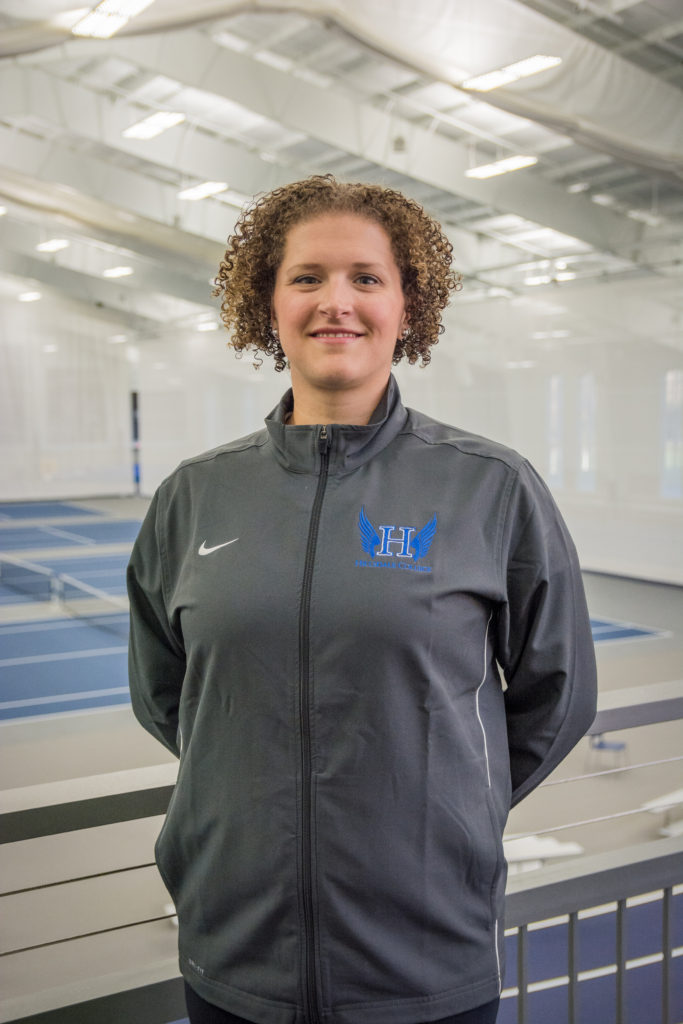
Janine Kuestner joined the Hillsdale track and field family at a perfect time. Since her arrival in September, the team has achieved the most success in its program’s long history with second-place finishes at the NCAA Division II cross-country nationals and at the indoor NCAA D-II nationals.
“I feel really lucky and blessed to be here at this time,” Kuestner said. “It’s been really exciting.”
But Kuestner did not take the most traditional career path in becoming a throws coach at Hillsdale.
Kuestner thought her own collegiate track and field career was over upon graduation in 2003. But fast-forward eight years, and she was on a roster again.
“I had the best year of my life athletically,” Kuestner said of 2011.
Kuestner only competed three of her four collegiate years at the University of Tennessee, having redshirted her sophomore year because of an injury. After coach and scholarship changes at the university during her senior year, she tried to transfer to continue throwing. Her transfer release, however, was denied and she decided to graduate in 2003 with a season of eligibility in the NCAA unused.
While teaching high school in New York City and volunteer assistant coaching at a D-III school where she was earning her master’s degree in Education, Kuestner reviewed the NCAA rules book and realized she could throw for another year in D-III. She took the opportunity to throw at Ohio’s Ashland University, training under head coach Jud Logan, a four-time Olympian in the hammer throw.
“I was the oldest person by about six years,” she laughed, but the experience earned her a new personal record and introduced her to her husband and coaching career.
After Ashland, Kuestner began coaching at Walsh University where she stayed for two years forming her coaching philosophy.
“Transitioning to coaching was a lot different than I had expected. Before, I thought it was all about what you say in practice — all the technical aspects of the throws— and that is a really big part, but designing a year -long or four-year-long training regime is so important. There’s so much more to it than just knowing the event and giving the appropriate cues. My approach is to try to understand each athlete individually to the best of my ability and design a program for them to maximize their potential.”
Kuestner met the Hillsdale coaching staff at the USTFCCCA national convention last December. When Jeff Forino, Hillsdale’s previous head coach, left for a position at Dartmouth, newly appointed Andrew Towne reached out to Kuestner.
“She was my first call,” Towne said. “You always keep a look out at other coaches, and she was getting something out of her kids that she probably shouldn’t have and that no one expected.”
Towne said he was interested in Kuestner because she had a great mentor at Ashland, but she wasn’t a “copycat coach.”
“A lot of them come out copying, but she has her own blueprint for coaching, that and a very friendly attitude,” Towne said.
Kuestner, however, wasn’t looking to leave Walsh at the time.
“For every job you weigh the negatives and positives, and for me, at that time, the positives outweighed the negatives,” Kuestner said. “But Hillsdale really fit with me — the academic strength of the school and the Christian foundation of the school is really important to me, and I think we have one of the best coaching staffs in the country here. I really appreciate Coach Towne’s leadership.”
Kuestner is now looking to steamroll the Chargers’ indoor success into the outdoor season where throwers have more opportunities.
“When you come to college to throw, you’re really coming for outdoor,” senior captain Heather Lantis explained.
In indoor track only two throw competitions are included: the shotput and the weight throw. For the outdoor season javelin, discus, and hammer are added to the lineup.
“I think our group is stronger outdoor, I’m hoping to get a couple of my kids to nationals this year,” Kuestner said. “They’re all right at or better than their PR’s from last year. They’re ready to cash in on all the hard work they’ve been putting in.”
Lantis said Kuestner has been a “refreshing addition to the coaching staff.”
“She’s made a strong effort to have us be more united,” Lantis said. “It’s easy to have practice times all over the place, but she tries to line them up so you’re always practicing with a teammate. There’s a lot more consistency in having a team atmosphere even though it’s an individualized sport and I think that’s benefitted all of us.”
Junior Nathaniel Nobbs who placed first in his event the Bob Kahn Invite last weekend said that Kuestner has helped him improve his technique.
“Javelin is one of the most technique-heavy events, and with her help I have been able to identify the areas I need to work on and then fix them through a lot of work,” Nobbs said.
In addition to this season’s goals, Kuester said her main goal is to be a “positive influence” in her athletes’ lives.
“They come in as high school kids, they’re still very young and you see them mature over the course of a season and years and by the time they leave they’re adults ready to take on the world. I feel really lucky to have a hand in that process,” Kuestner said. “As a coach, you see more of them than their professors, and you’ll most likely have more conversations with them than their roommates or friends. I don’t take that responsibility lightly.”
Lantis and Nobbs confirmed that Kuestner is reaching her coaching goals.
“Coach K is just an awesome person. She keeps things in perspective for us yet gives us confidence that we can achieve marks we may not have at first,” Nobbs said. “She is always ready to laugh and to laugh heartily. You can just tell that she enjoys all of her athletes.
Lantis said Kuestner has been a great mentor for her this year and that “she is a wonderful role model for all of the women on the team.”
