
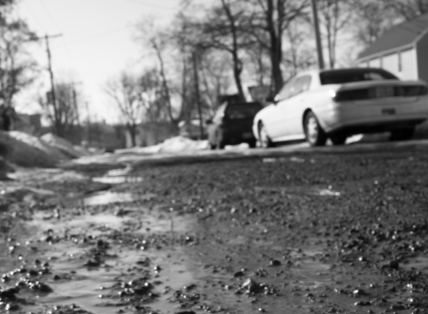
The Hillsdale City Council with help from community members, created a list of 24 roadfunding options. The potential solutions include ways to cut waste in the budget, privatize cityrun projects, and generate revenue, such as the income tax.
All ideas are included on the list, regardless of their viability. City Manager Linda Brown said some, like selling roads, may be illegal and will need to be approved by the City Attorney.
Although some options are unpopular, city council hasn’t discounted anything yet because the money is greatly needed.
Unlike county roads which cost between $500,000$600,000, city roads cost almost twice as much.
“For us to do one mile, it’s a million dollars,” Brown said. “That’s because we have curb, we have gutter, we have storm water, we have sanitary and water mains, and all those things that run under the street. When you have to replace all of that, it’s extremely expensive.”
One method city leadership has discussed is grant money, but Brown says only six streets are eligible for this funding.
“We’ve tapped into every opportunity for grant money, but it’s so restricted,” Brown said. “Because we have what’s called a small, urban boundary, and unless that street connects to that boundary, it’s not eligible for funding.”
Once council agrees on a plan, the city will move forward with budgeting and road work using the guidance of a Pavement Surface Evaluation Rating completed in June 2013.
The PASER study evaluated the 60.899 miles of Hillsdale streets on a scale of 110, with 1 meaning “total reconstruction” and streets ranked an 8, 9, or 10 having “no maintenance required.”
More than 37 miles of Hillsdale streets ranked as a 4 or below, and excluding the 10.04 miles of road not rated, Hillsdale’s weighted average PASER rating was 3.8, meaning Hillsdale’s streets are in “poor to fair condition” overall.
According to City Finance Director Bonnie Tew, many other cities’ streets are in the same condition, and the economy is largely to blame for the lack of action thus far.
“We are at the 1992 level of revenue from the state right now,” Tew said. “It’s a triple whammy because our property taxes have declined for the last five or six years, revenue sharings have gone down, and as the industries left, our top employers became tax exempt.”
State Rep. Ken Kurtz also addressed the economic issues holding back road funding at the Feb. 3 Hillsdale City Council meeting. Kurtz said that with the uptick in the economy, he believes fixing streets should be one of the main priorities throughout the state of Michigan.
“If there are dollars, we need to appropriate a good bit of that back into our infrastructure,” Kurtz said.
Every dollar invested in preventative maintenance now will save $4 to $6 in future reconstruction costs, according to a recent publication of Asset Management Guide for Local Agencies in Michigan by Cambridge Systematics, Inc., and the Michigan Department of Transportation.
If the streetrepair process doesn’t start soon, costs will only continue to rise, and Hillsdale isn’t the only one facing this bleak future if action isn’t taken soon.
“We are not unique in the state of Michigan or across this country with deteriorating
infrastructure and reduced revenues,” Tew said. “While some think we’ve mismanaged things for many years and didn’t do what we needed to do, we really did do what we could.”
