
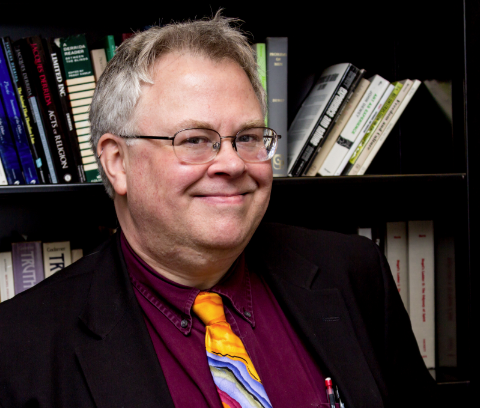
Philosophy and Culture Professor Peter Blum has compiled many of his essays dealing with philosophy, religion and sociology into a book called “For a Church to Come: Experiments in Postmodern Theory and Anabaptist Thought” which will be available on March 5.
The book focuses on the controversial idea that postmodern thought can be compatible with Christian beliefs, specifically those held by Mennonites, a specific branch of Anabaptists.
“It is an effort to try to show how I think a bunch of theorists, a bunch of heavy-weight academics that are big names in recent social theory and philosophy, that sometimes are understood as being kind of anti-Christian or not compatible with Christianity, and I’m experimenting with them being more compatible than some people think,” Blum said.
Although some of Blum’s essays have appeared as chapters in many books, this will be the first book that is entirely his own.
“The book is very important to him, and I know he’s really excited about it,” said lecturer Abigail Sudds. “He’s been working on it for a long time.”
Sudds, who graduated from Hillsdale in 2007, is Blum’s daughter. Sudds has taught sociology at Hillsdale as an adjunct instructor for the past four semesters.
Jim Stephens, professor of philosophy and religion, who has worked with Blum for about 15 years, is also excited about the book.
“It’s not easy at a place like Hillsdale with our teaching schedule to get a book published, so when a colleague manages to, in addition to all the classes, they deserve accolades,” Stephens said. “Its going to be a really fun, interesting book, and I’m going to get my hands on it as soon as I can, sit down and read it, then walk thirty feet down the hall to his office, stick my head in and tell him ‘he’s wrong! But let’s talk about it and I’ll get the coffee.’”
The fact that the book is a culmination of three subjects — philosophy, sociology, and religion — is rather uncommon, but so is the fact that Blum has a strong background in all three of these subjects.
“It’s often the case that people who are in the different fields that I’m interested in look askance at each other,” Blum said. “People in philosophy are a little bit leery of people in sociology, and people in sociology are a little leery of them, so everyone’s leery of me,” he said with a laugh.
Blum’s entire adult life and his education in religion, philosophy and sociology, has influenced the book.
Blum was first introduced to the Mennonite faith at the private high school that he attended. After graduating from high school, he studied at Goshen College in Indiana, which is also Mennonite. It was during this time that he realized a fondness for sociology in addition to philosophy, which was what he had originally intended on majoring in.
Blum graduated from Goshen in 1984 with an interdisciplinary major in philosophy, religion, and sociology. From there, he studied at the Associated Mennonite Biblical Seminary in Elkhart, Ind. where he took courses in theology, ethics, and Biblical studies.
After leaving the seminary, he attended Notre Dame University and it was during this time, Blum said, that he met John Howard Yoder, one of the most important and influential Mennonite thinkers of the 20th century.
Yoder was teaching at Notre Dame and although Blum was never one of Yoder’s students, he conversed with him frequently.
“One of the ways to identify what is going on in the book religiously, or theologically, is that it is really strongly influenced by the thought of John Howard Yoder,” Blum said.
After earning his master’s degree in philosophy in 1988, Blum stayed at Notre Dame to work towards a graduate degree in sociology.
“The story of my graduate school experience says a lot about what I’m interested in,” Blum said. “You’re kind of expected to specialize when you get a doctorate and I didn’t do that very well.”
While at Notre Dame, Blum began teaching as an adjunct instructor of philosophy at Indiana College.
In 1992, during his last year at Notre Dame, Blum found a teaching opportunity at Hillsdale.
“I was looking at a job bulletin and all of the job listings wanted people who studied crime and statistics. I do neither, but right in the middle of that bulletin, was this one ad for a place that I hadn’t heard of before — Hillsdale College — and it was like the ad was written for me,” Blum said.
Blum said that the College was looking for someone to teach sociology, but they really liked that he had a strong background in philosophy and religion as well.
“I was interested in teaching in a liberal arts setting and not just doing research in one specific area of study, so Hillsdale’s been a very good fit,” Blum said.
After graduating from Notre Dame in 1993, Blum began teaching as an assistant professor of sociology at Hillsdale College.
“I was originally a part of the psychology and sociology department. I was the sociologist, but in the past ten years, I’ve done a lot of teaching across the boundaries — teaching in the religion and philosophy department as well — so I was moved to the philosophy and religion department,” Blum said.
In 2007, when Blum became a full professor at Hillsdale, he was asked to create the Sociology and Social Thought Program.
Blum is, and has always been, the only full-time professor in the program. However, there are currently three adjunct instructors who teach in the program as well, one of which is Sudds.
“It’s crazy, he’s basically a one man department,” said senior Drew Holub, president of the Sociology Club. “There aren’t many sociology majors, so it’s very close knit and everyone knows him really well.”
As the faculty advisor, Blum is heavily involved with the Sociology Club. He host’s the club’s biggest event, their annual Halloween party, at his house every year.
Holub, who says Blum was a main force in helping him decide to be a sociology major, encourages student to take Blum’s classes.
“I’d recommend taking his classes 100 percent to anyone. He always finds a way to make the topic he’s teaching interesting and when he’s excited about it, it’s easy to get excited with him,” Holub said. “He’s very helpful, and he has a great sense of humor. When I go into his office, more often than not, I’ll come out laughing.”
Blum said that he really enjoys being a professor.
“Watching cartoon light bulbs over students’ heads go off, seeing that expression that says that they hadn’t thought about it that way, that awe moment — that’s one of the main things that makes it worth it,” Blum said.
Holub said that he, along with other sociology students, is excited for Blum’s book to come out.
“I feel like I would almost have to [read his book] being that I’ve become so close to him because I see him all the time, and he’s extremely knowledgeable about the topic so I know that whatever time I put into it, I’ll get something out of it,” Holub said. “Because he’s such a good professor I know that it’s going to be a quality work.”
