
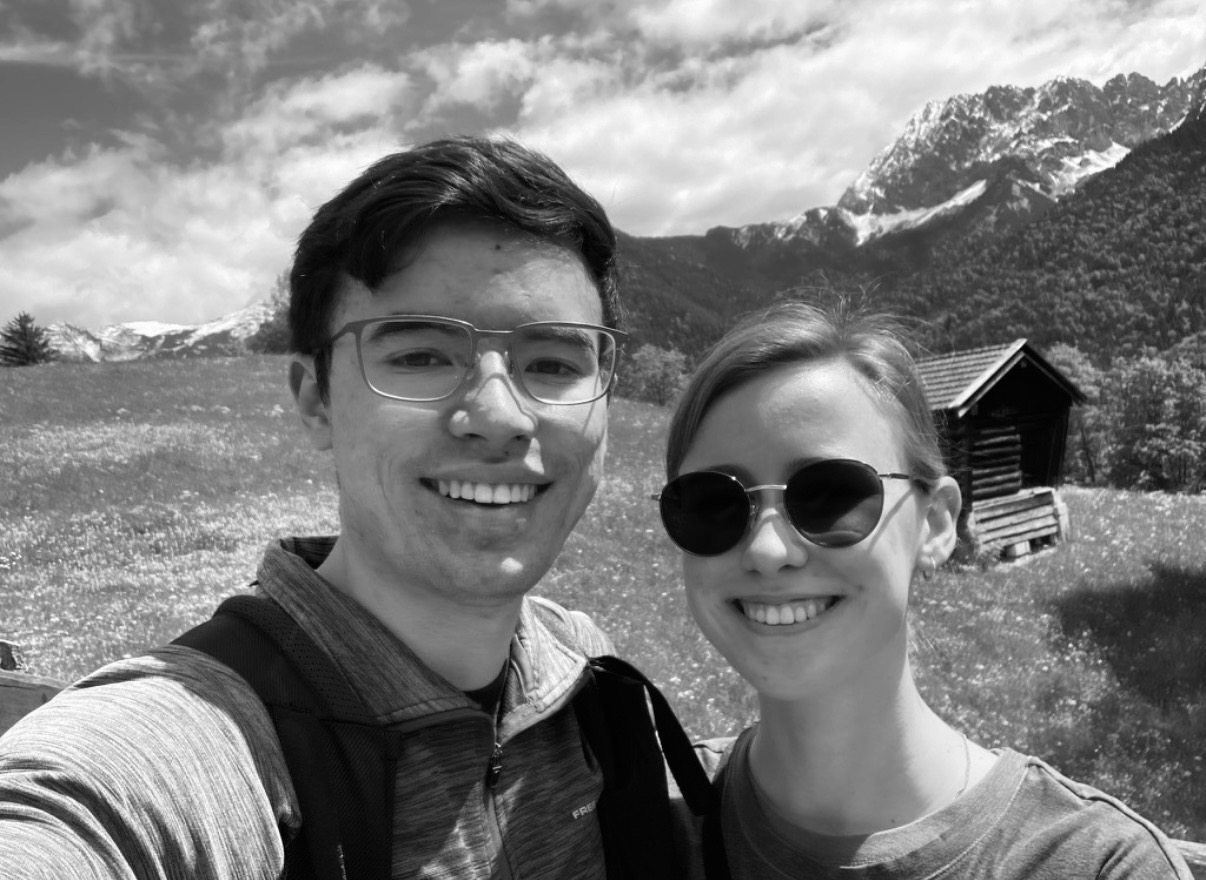
Chen and his wife, Ellenor, on a hike outside of Mittenwald, Germany. Courtesy | Zachary Chen
Zachary Chen is a senior pursuing a double major in Latin and Greek and a minor in German. He is involved with the classics honorary Eta Sigma Phi and the German honorary Delta Phi Alpha. Zachary is the president of the Lutheran Society and is a Choral Scholar. Zachary married Ellenor Chen (formerly Scarbrough) in May.
What is your hottest take?
Confessional Lutheranism is Catholicism with a capital C.
What fictional character do you find most relatable?
I’m probably Bill from “Bill and Ted’s Excellent Adventure.” Either that or Patroclus from the “Iliad.”
What is the key to success at Hillsdale?
Work hard and wonder at what you read. It’s either easy to skimp out on your reading and then get overwhelmed by cramming for stuff. But I think diligence and a constant attitude of wonder at the greatness of what you’re studying goes a long way towards academic success.
If you could have a lifetime supply or anything, what would you pick?
Oxford Classical Texts. If I could own a critical edition of every fragment and complete work of literature from say, 800 B.C. to A.D. 35, that would be great.
Who are your top three authors?
Homer, Virgil, and Dante. Luther is a close fourth.
Who is a figure from antiquity you’d like to get dinner with?
Bishop Ambrose of Milan. He was a reader himself. I would want to go over his library with him and just listen to him talk about books.
What is something you think a lot of people don’t understand about learning languages?
People tend to see it as either very impressive to know a lot of languages or very difficult to learn new ones. And the truth is that if you are consistent in practicing and reading, and you have a lot of desire to read literature from a particular language, it’s not terribly hard to pick it up. It just goes back to the question of how to succeed at Hillsdale — daily diligence and consistency.
What is your current hyperfixation?
Torquato Tasso’s “Jerusalem Liberated.” This is actually coming out of a Dr. Gaetano class. “Jerusalem Liberated” is a 16th-century Italian epic poem that incorporates both medieval romance and classical epic in the context of post-Reformation debates and the political threats.
What is a question you wish people asked you more often?
What’s the most beautiful thing you’ve read or seen today, apart from your wife?
Why are you studying so many languages?
I also study Italian here, and the reason for the modern languages was originally because of Latin and Greek. I started with Latin, and then I knew in high school, “OK, I’ve got to learn Greek to fully appreciate Latin literature,” and then building on to that, when I got here, I was like, “Oh, in order to read the great scholars of the 20th century and before, you need Italian and German.” This is the problem with learning languages, is that as you go along, you find out that there’s more stuff you need to read, and there’s things, say like Goethe or Torquato Tasso, that you just need to acquire yourself. I guess originally it was all for the sake of Latin literature, but now it’s expanded my horizon of what I’m interested in.
What is the most valuable piece of advice you have been given?
I can’t remember who told me this. I think it was someone in high school, or I read it in a book in high school, and it’s just an attitude that I think a number of different people instilled in me. But it was, “Do not be afraid of the truth because all truth is God’s truth.” It obviously has religious implications, but I think you can pursue it through the sciences into poetry. It becomes a very interesting principle for reading and interpreting texts, because if you are willing to carry through the logical operation of pursuing the truth and to actually exercise a reason and not sort of be constrained to what you want to see somewhere, it’s very freeing.
What makes you smile daily?
My wife.
Any relationship advice you care to share?
For men, strive to be humble and noble. You’re going to fail, and for some reason, your wife will love you anyway. I don’t have anything for the women.
How did you become Lutheran?
I grew up Reformed Baptist, and I was friends with a lot of Roman Catholics, and conversations with them, and reading the scriptures as I got older, and learning more about church history convinced me that God works efficaciously through the sacraments, and that they offer grace universally. That universal grace can actually be particularized to me, and it actually has real effects, for me here and now. I wound up not becoming Roman Catholic, because I don’t fully agree with many of the doctrines of the present day Roman Church. But in searching for Catholic Christianity, capital Cs both like that, led me to Lutheranism.
