
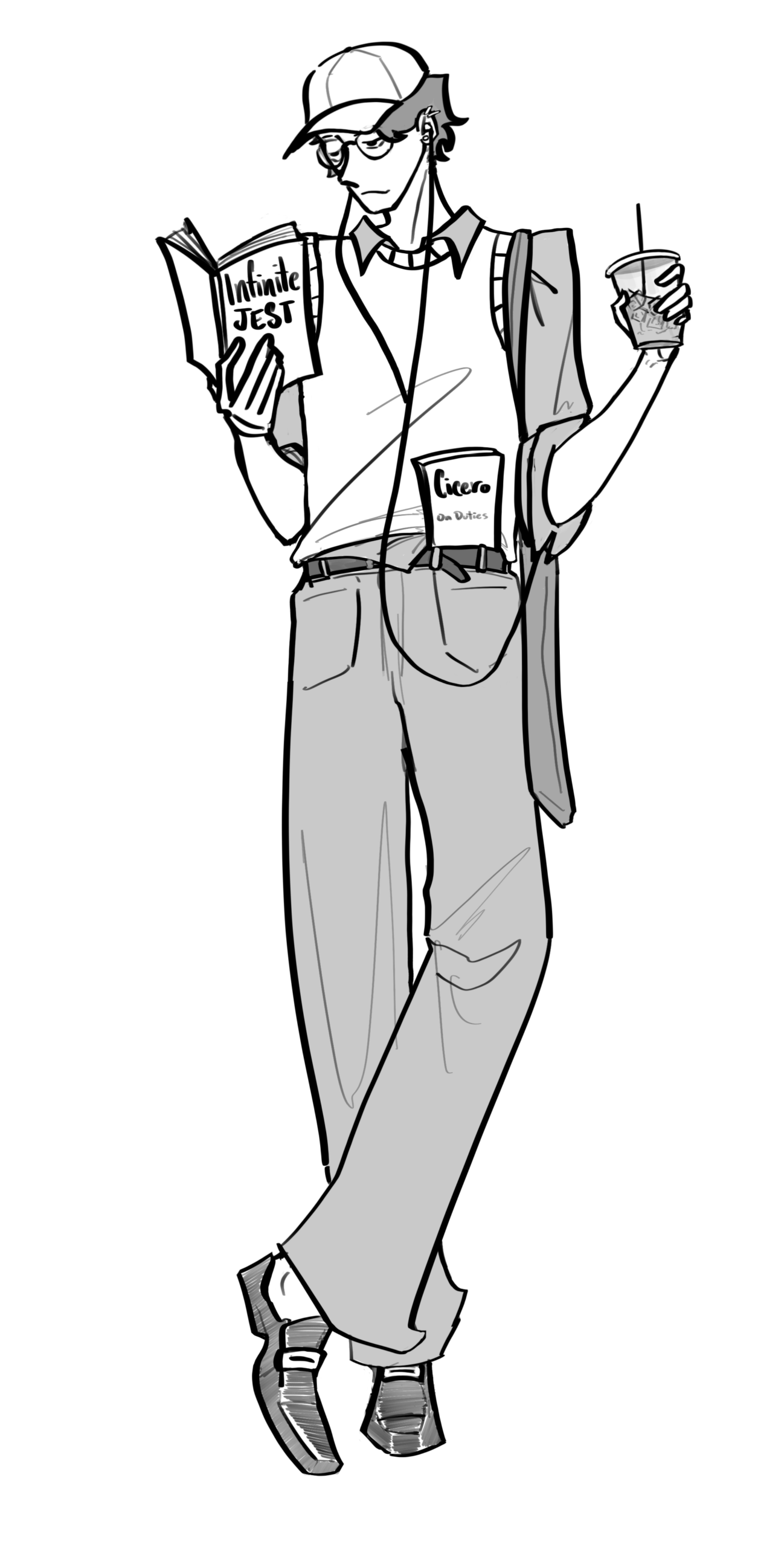
Young men have become too nonchalant.
The Merriam-Webster dictionary defines “nonchalant” as the quality of “having an air of easy unconcern or indifference.” Nonchalance is just an act — it doesn’t mean you don’t care about the world. It’s pretending not to care about the things you love and hate.
Being nonchalant numbs and disrupts the reality of being human. When we disregard our emotions we live on autopilot. Experiencing emotions is natural, and part of being human. They’re not just points of weakness. They are necessary to love.
Jokes about nonchalance are everywhere on Instagram and TikTok. People in every one of my circles say some of my actions are “too much,” calling me “very ’chalant.” Friends encourage one another to be more nonchalant by quietly telling one another to “calm down” or “be quiet” about things that warrant a much different reaction.
Encouraging the sterile emotional response of young people when excitement is appropriately called for causes them to embrace a detrimental nonchalant attitude. Friends encourage one another to act less on what they feel because of the fear of being too much and thus unrelatable or disagreeable to the group.
But, organically reacting to the joys and sorrows of life is a good and natural part of what it means to be human.
It’s bad for the human psyche to numb itself to emotion. As the psychologists Edward Deci and Richard Ryan explain in their article about “Self-Determination” theory, human beings need to feel that they have autonomy, are competent, and can relate to one another in order to be fulfilled, and thus happy. The last of these, “relatedness” as a psychological factor, demonstrates why people are being nonchalant: they fear not being able to fit in.
People deeply desire to feel that they belong and to know they are loved. But sometimes people abandon themselves in pursuit of acceptance. Rather than being honest about what they love, people act as if they are above caring about anything, in hopes that others will like them more for having no opinions.
YouGov conducted a study in April 2025 on the recent demoralization of young men that surveyed 2,000 U.S. men between the ages of 18 and 29 with diverse beliefs. According to the Institute for Family Studies, this study indicated that “young men care about their status, want to contribute, and are distressed by the gap between their current circumstances and what they really desire for their life.”
As young men across the U.S. wrestle with their role and purpose, they need to feel that they can relate to another and fall back on their community.
The YouGov survey asked young men to agree or disagree with how much the following statement resonated with them: “All in all, I am inclined to think that I am a failure.” A staggering 46% of the men ages 18-23 agreed they felt this way to an extent, while only 32% of men ages 18-29 disagreed.
Although it might be more comfortable to act nonchalant, young men need to be free to express themselves to find lasting community and identity.
We cannot be loved if we show only a fabricated and carefully limited version of ourselves. Being nonchalant is denying the reality of your emotions, and by extension who you really are. When someone represses his emotions to fit in, he limits who he is and prevents what he truly wants — to be known and loved.
If young men do not give one another the opportunity to see who the other is, to love him for who he is, flaws and all, they will never form the connections they need. True connection requires a departure from the cultural movement of nonchalance.
People in my generation are isolated because they aren’t authentic — they’re too nonchalant.
The remedy isn’t to close ourselves off. It’s to open ourselves up to others despite the fears that may come with that endeavor. We need messy, raw, and real relationships. Don’t hold back a laugh or a smile when you see something that makes you happy, and don’t be afraid to cry in front of a friend. The things that give you joy and unrest deserve to be experienced alongside real friends.
Monica Smies is a sophomore studying philosophy.
Illustrated by
Annie O’Connor.
