
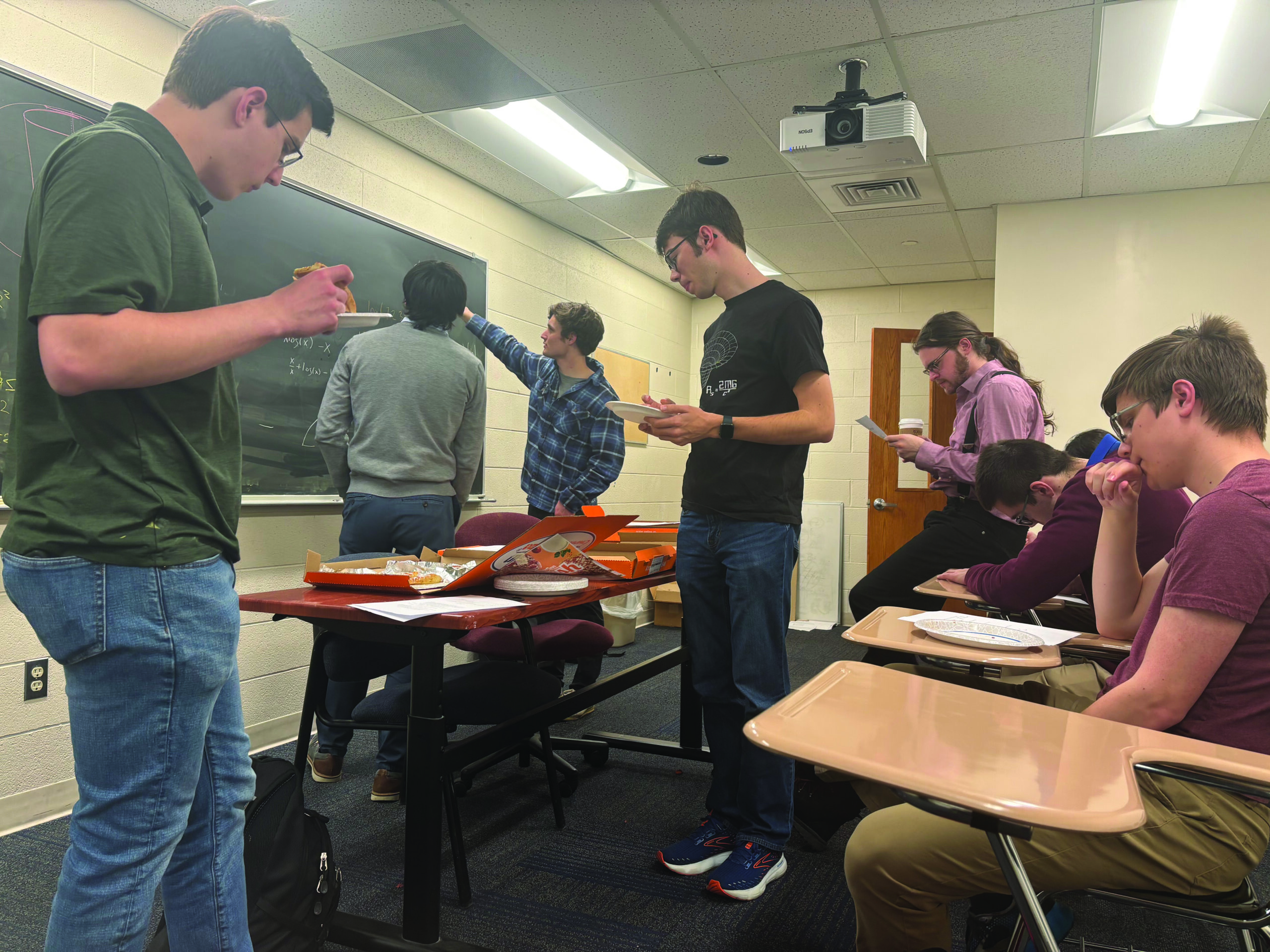
The Hillsdale math club eats pizza and solves math problems. Jillian Parks | Collegian
“Has this always been here?”
Sophomore Andrew Schmidt asked the group of us gathered outside Associate Professor of Mathematics David Gaebler’s office at 6 a.m. on April 12. He was referring to a geometric piece of art, about 2.5 feet in diameter, hanging from the ceiling.
“It predates me, and I got here in 2013,” Gaebler said.
Schmidt laughed and admitted that noticing things and spatial awareness weren’t exactly on his list of strengths.
While the claim could be true for obscure decor, Schmidt uses the power of observation and visualization every day as a math major and the leader of the math team.
He broke the school record for the William Lowell Putnam Mathematical Competition in his freshman year. He took college-upperclassmen-level problem-solving courses in high school. He leads the Hillsdale Problem Solving Seminar, colloquially known as the math club, through archived competition questions every Thursday in the basement of Dow Science.
Sometimes, during math club, when people are split into groups or pairs, working on a few different problems simultaneously, a flurry of math terms, numbers, and contributions blend into a cacophony of discovery.
“By changing the point on L1, we get a different plane with . . . the natural log of . . . a constant factor and solve for . . . a double angle over two . . . but what if it’s parallel?”
Excitement enlivens each of their faces as their voices rise in volume and quicken beyond their usual conversational pace. It’s the kind of contagious passion that makes you wish you remembered more than just the quadratic formula from your 12 years of public school math education.
Last Saturday, Schmidt split six participating members of the math team into two groups of three in preparation for the annual Lower Michigan Mathematics Competition set to take place in Saginaw later that morning.
Only five of the competitors made it to the Dow Science that morning, though.
Sophomore Matthew Tolbert trudged down the hill from Whitley Residence toward the bus, where we picked him up a full 30 minutes past the scheduled departure time — and still ahead of the sunrise. The math team, Gaebler — the team’s faculty adviser — and the assigned reporter were already packed into a cozy 15-seater van, ready for the three-hour bus ride.
Tolbert apologized for being late and slung a plastic Mossey Library bag filled with books into the space next to the passenger seat. It was the only desirable seat left, unless he wanted to be stuck in the very back or one of the middle seats.
“I have to work on my theology paper,” he explained to the bus.
Everyone laughed — not just because it was a joke, but because they all understood. These were liberal arts students who knew what it meant to hold brain space for polynomials alongside Plato and arithmetic sequences alongside Aristotle. Balancing rigorous math with deep dives into philosophy and theology is part of the deal at Hillsdale — and, surprisingly, part of the joy.
Sophomore Benjamin Bassett said he chose Hillsdale for its liberal arts focus, hoping it would make him a more well-rounded mathematician.
“Math is awesome, and I love it, but there’s a lot more than math,” Bassett said. “It’s nice to go home after a math competition and read Shakespeare or play piano, because while they might not be directly applicable to a career in math, having appreciation and limited knowledge in a lot of fields is very human.”
The others seem to agree, at least in practice. Among them are interests in the audio-visual, the musical, the computational, the linguistic, the theatrical, and more. From the front to the back Gaebler, Tolbert, freshman Levi Dittman, senior Seamus Welton, myself, alumna Emily Rose Willis ’24, sophomore Benjamin Bassett, senior Jonah Murray, and Schmidt, the van was filled with people who embodied that balance.
Even with all of these diverse interests, the group decided to talk about math on the bus ride. I dozed in and out of listening, watching the limbs of the dead trees pass by through the window. The conversation inside the bus took a similar shape, starting with foundational ideas and words and branching off into more complex off-shoots and theoretical ideas, including an in-depth reading of a Reddit thread with a poorly done proof of Fermat’s Last Theorem.
Fermat’s Last Theorem says that no whole numbers can solve the equation x^n + y^n = z^n for any value of n greater than two, if x, y, and z are all positive whole numbers. Pierre de Fermat wrote this in the 1600s, but it wasn’t proven true until 1994 — 300 years worth of attempts at proof.
Upon arrival at Saginaw Valley State University, each team had three hours to complete 10 math problems: some that required basic algebra and others offering extra credit for not relying on calculus. The problems are difficult, so the teams often divide and conquer. Tolbert takes over counting problems. Murray gets trigonometry and analysis questions. Schmidt is partial to number theory.
Rose and Gaebler both worked on the problems in the professor waiting room during the three-hour time slot, occasionally collaborating with educators from other colleges. Gaebler walked me through a few of the problems, which were likely well explained and lucid aside from the fact that I couldn’t even remember the difference between a natural number and an integer.
Solving up until the very last minute, Murray and Tolbert reported writing in parallel to finish their final proof as the clock counted down. Schmidt, Tolbert, and Murray’s team finished all 10 problems, unfortunately discovering upon reunion that they missed problem two on account of 27 being a factor of 2025.
Welton, Bassett, and Dittman hypothesized solid answers for about four of the problems. Both teams agreed problem seven was the trickiest this year.
As more and more teams trickled into the room, the energy of sharing, comparing, and corroborating energized the space. Excited half sentences and nodding in agreement accompanied a lot of “right, right, right!” as the competitors remembered the excitement of finding the answer all over again. It was that familiar cacophony I heard in Thursday math club, but it was all 14 teams, continuing through lunch and into the review session where students from different schools worked through their solutions to the test problems in front of the group.
Hillsdale students presented four of the 10 problems, with Tolbert doing two of those. Kalamazoo College, the reigning champions from 2011–2018 and 2023–2024, demonstrated three of the 10 problems. The remaining problems were each taken up by a different school.
Benjamin Whitsett and Matthew Quirk from Kalamazoo stopped to talk with the Hillsdale team after both schools dominated the solution session. In a semi-competitive, semi-friendly way, the two teams discussed the problems they solved and the problems they didn’t. The competition results won’t be announced until the test author and grader go through the tests, awarding points for processes as well as correct answers.
“Hopefully, we can see each other outside of a competition setting sometime,” Whitsett said as the groups parted ways.
The Hillsdale team agreed, said goodbye, and piled back into the bus. The same trees and branching conversations characterized our bus ride home, but the adrenaline wore off, and the 6 a.m. call time caught up to a few of us.
That morning, outside of Gaebler’s office at 6 a.m., the team had discussed an intriguing idea in mathematics: the Goldbach Conjecture. It states that every even number greater than two can be made by adding two prime numbers together. Though it’s been checked for trillions of even numbers using computers, no one has found a solid, step-by-step mathematical proof that has shown it to be true for all even numbers. So it remains a conjecture, not a law.
Mathematics — especially in the realm of problem solving — often begins with conjecture: a willingness to question, to attempt, to fail, and an intentional pursuit of fully proving ideas of which we are reasonably sure, even if the process takes anywhere from three hours to 300 years.
The governing mathematical laws come to light in time, amidst branching conversation and cacophonies of discovery, causing mathematicians like Gaebler, Schmidt, Tolbert, Murray, Bassett, Welton, Dittman, and Willis to ask:
“Has this always been here?”
