
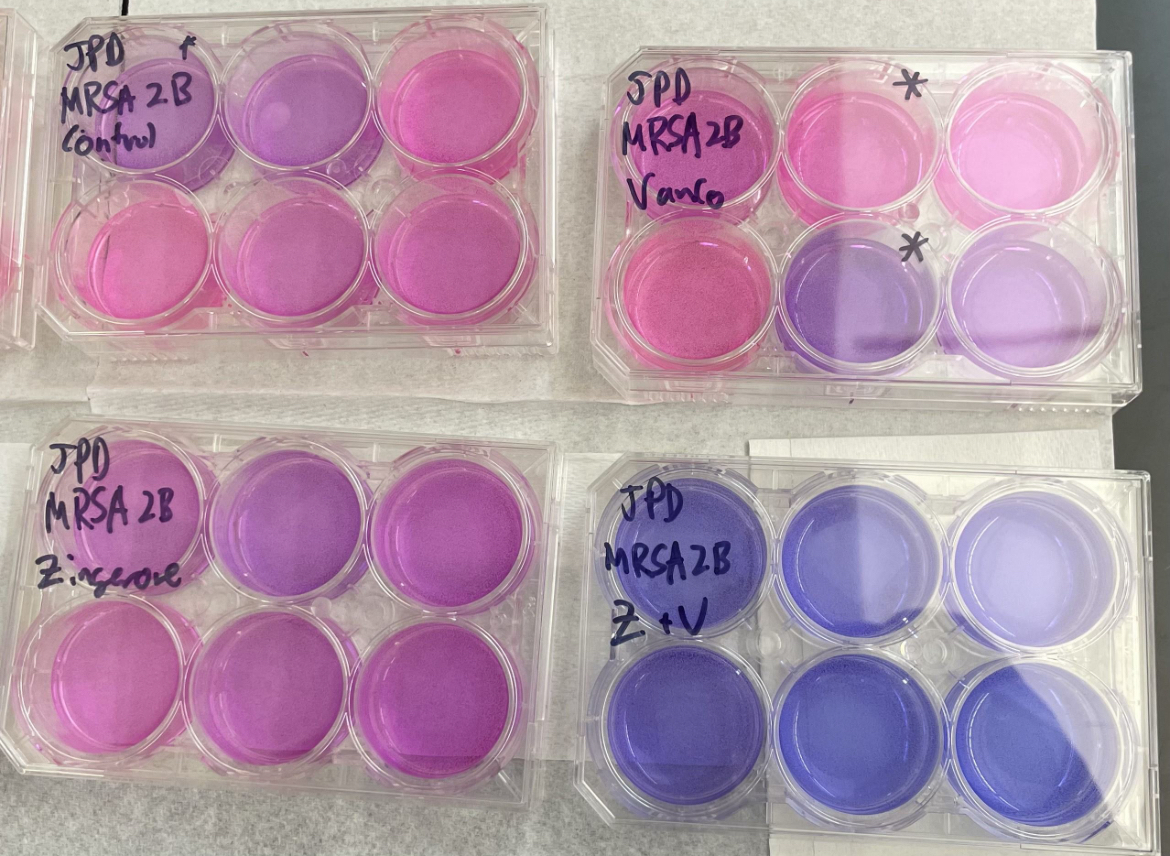
Hillsdale students grow bacteria in Petri dishes. Courtesy | Joseph Doherty
More than a million people die each year from a bacterial strain that resists most forms of treatment. But Andrew Russell and his team of Hillsdale students may soon publish trailblazing research on how a compound in ginger can help to kill it.
“The impact of this research touches everything from medical implants, to oral hygiene, to the brewing industry,” said Russell, an associate professor of biology.
The bacteria Staphylococcus aureus is a common bacteria often found on human skin or inside nostrils. Most of the time, it is harmless. But if the bacteria enters the bloodstream through a cut or opening, it can cause skin infections, bone and joint infections, or even blood poisoning.
S. aureus can become even more dangerous when it transforms into a superbug, a type of bacteria that has developed resistance to most forms of antibiotics, making it very difficult to treat.
Joseph Doherty ’24 said this superbug is capable of causing life-threatening complications.
“It is a very dangerous yet relatively common pathogen in humans due to several antibiotic resistances,” Doherty said.
Russell and his students spent the summer investigating this drug-resistant bacteria strain and how to prevent it from spreading and forming colonies. They focused on studying how a chemical called zingerone works in tandem with antibiotics to affect bacteria formation.
“Zingerone is a naturally-occurring chemical found in ginger and has been shown to inhibit biofilm growth in several other species,” Doherty said.
Russel said his team discovered that zingerone halts the spread of bacteria by cutting off communications between cells.
“Years ago, my lab showed that a chemical compound called zingerone is able to prevent these bacterial communities (called biofilms) from forming, without killing the bacteria directly,” Russell said. “Our recent experiments were aimed at determining how zingerone does this. In other words, what is its molecular mechanism? Our results suggest that zingerone works by blocking chemical communication between bacterial cells.”
Doherty said two compounds, zingerone and an antibiotic called vancomycin, worked best together to treat S. aureus infections.
“In our study, we found that established bacterial biofilms were not impacted by vancomycin or zingerone alone, but when used in combination, the biofilm survival was statistically and significantly reduced,” Doherty said.
Senior Logan VanEnkevort said their research had never been done before.
“The results were what we hypothesized, however it’s still surprising that this worked simply because this is relatively novel research that does not have a whole lot of precursors,” VanEnkevort said.
Senior Morgan Piwonka said she is still experimenting.
“I’m currently trying to see if I can get some more data using a confocal microscope. With this microscope I can take multiple images of the biofilm and then stack them together producing a 3D image of the biofilm,” Piwonka said.
Doherty said the hypotheses they made corresponded well to the results.
“These results were what we were hoping for so they were very exciting, because they aligned with our hypothesis,” Doherty said.
Doherty, who is currently attending Lincoln Memorial University-DeBusk College of Osteopathic Medicine in Harrogate, TN, said the research he conducted at Hillsdale will be useful for his future career.
“I would love to continue this research while I am here,” Doherty said. “I am working on a publication that will hopefully occur within the next year.”
VanEnkevort also said his research may find its way into some scientific literature. Some of the students are publishing their work, which will help their careers.
“I believe Dr. Russell is working on combining my work with Hillsdale graduate Sam Zemis’s work on biofilms to try to publish,” VanEnkevort said. “If all goes well, hopefully this work will end up in a science magazine.”