
Most people will never run a marathon, let alone an ultramarathon — Charles Steele, assistant professor of economics, just ran his 63rd.
Steele signed up to run his first Le Grizz 50-mile ultramarathon in 1983 because it “seemed like a good idea.”
“I had never run a marathon before, so I was running a serious training program. I was in really good shape for a marathon, but they canceled it,” Steele said. “I had read somewhere in a book that anyone well-trained for a marathon could run up to 100 kilometers or 62 miles. I thought, well, Le Grizz is only 50. I didn’t know any better.”
Steele is part of a community of Hillsdale students, professors, and faculty members who run these extreme distance competitions. For these ultrarunners, the question isn’t “Why run 50 miles?” but rather “Why not?”
The Le Grizz occurs annually on the second Saturday in October in Montana, just outside of Glacier National Park. Steele has completed the race 23 times and won multiple awards over the years.
He received the “Ten Bears” Award in 2010 for completing the ultramarathon 10 times. In 2021, after his 20th finish, he received the “Chief Ten Bears” Award, named after an Indian chief.
“There’s a guy from the Blackfoot Indian Reservation in Western Montana who would come over and do a ceremony with the people who have done it 20 times and induct you into the group of Chief Ten Bears,” Steele said. “I think there’s about 20 of us.” As part of the induction, each person is given a Blackfoot Indian name. Steele is named “Po-nah-tat-sii,” meaning “slow deer.”
“He apparently meditates on this,” Steele said. “He comes up with a name. He finds out something about you.”
In 2013, amid a federal government shutdown, the U.S. Forest Service restricted access to roads included in the Le Grizz route. If ultrarunners followed the traditional route, the Forest Service threatened retaliation.
“People live up there permanently, so it’s open all the time,” Steele said. “It’s not like the road was closed. We were told you can’t run on it because of the government shutdown. And if you run on it, we’ll yank your permit. You’ll never be allowed to run there again.”
Le Grizz organizers and participants were forced to find an alternate route for the race. Steele, however, was frustrated with the restrictions and was honored with Le Grizz’s first-ever “Government Shutdown” award.
“I was the one who had the best complaints about how awful the federal government is. So I got the government shutdown award,” Steele said. “It might just be the finest award I’ve ever won.”
Though he’s run thousands of miles, Steele can’t imagine getting bored while running, which is perhaps why he plans to run thousands more.
“I can get bored doing a lot of things, but not this,” he said. “You just enjoy it.”
Steele does not listen to music while he runs but says he thinks about many different things, from economics lectures and wolverines to paper writing and grizzly bears.
“When I say that, though, I usually have music playing in my head. I do right now,” Steele said. “The other thing about running in the mountains and running in these places is you want to be able to hear what’s around you, like if you suddenly hear some really big animal crashing through the woods — I wanna hear that.”
It is possible to encounter grizzly bears while running Le Grizz, and Steele has crossed paths with a few.
“There are times when I’ve been running solo, so I brought bear spray and a .44 Magnum. If the bear spray doesn’t work, the .44 is there, so you can shoot yourself,” Steele quipped.
The longest ultramarathon Steele has run was more than 100 miles long.
“It was in Texas, so of course they made it 101,” he said.
Steele also frequents the Beaverhead 50K Trail Run along the continental divide in Idaho, which he inspired Hillsdale sophomore T.J. Korotzer to tackle this summer.
“I love that part of the country, so it seemed like a perfect fit,” Korotzer said. “The scenery was beautiful, although I did spend an inordinate amount of time looking at the ground so I wouldn’t trip.”
Korotzer ran about five miles of the race alongside a man whose sisters attended Hillsdale College.
“We had a connection,” Korotzer said. “Whenever we saw each other at the aid stations, we would give each other words of encouragement.”
Korotzer — a Marine Corps veteran — is no stranger to intense physical training.
“I had done two half marathons while I was in the Marines, but this was a different beast due to the sheer amount of time I spent on the trail,” he said.
Korotzer said he was surprised by how calm he felt during the race.
“The world got a lot smaller, and I had a tremendous amount of focus,” he said. “My goal was very clear — finish the race.”
Brent Cline, associate professor of English, didn’t start running until he was in his thirties. Cline is yet another Hillsdalian who has conquered Beaverhead.
“I had no intention of running an ultramarathon,” Cline said. “I was in Idaho with a buddy of mine, and he said, ‘There’s a race happening there tomorrow morning,’ as he pointed to the top of a mountain. I found out that the Beaverhead ultra began where Meriwether Lewis first came over into Idaho. I love Lewis and Clark, so I decided, ‘OK, I’ll run that.’”
Cline trained over the next year for the 35-mile race that has an average altitude of 8,600 feet.
“You can’t recreate that training in Michigan, so you don’t bother trying,” he said.
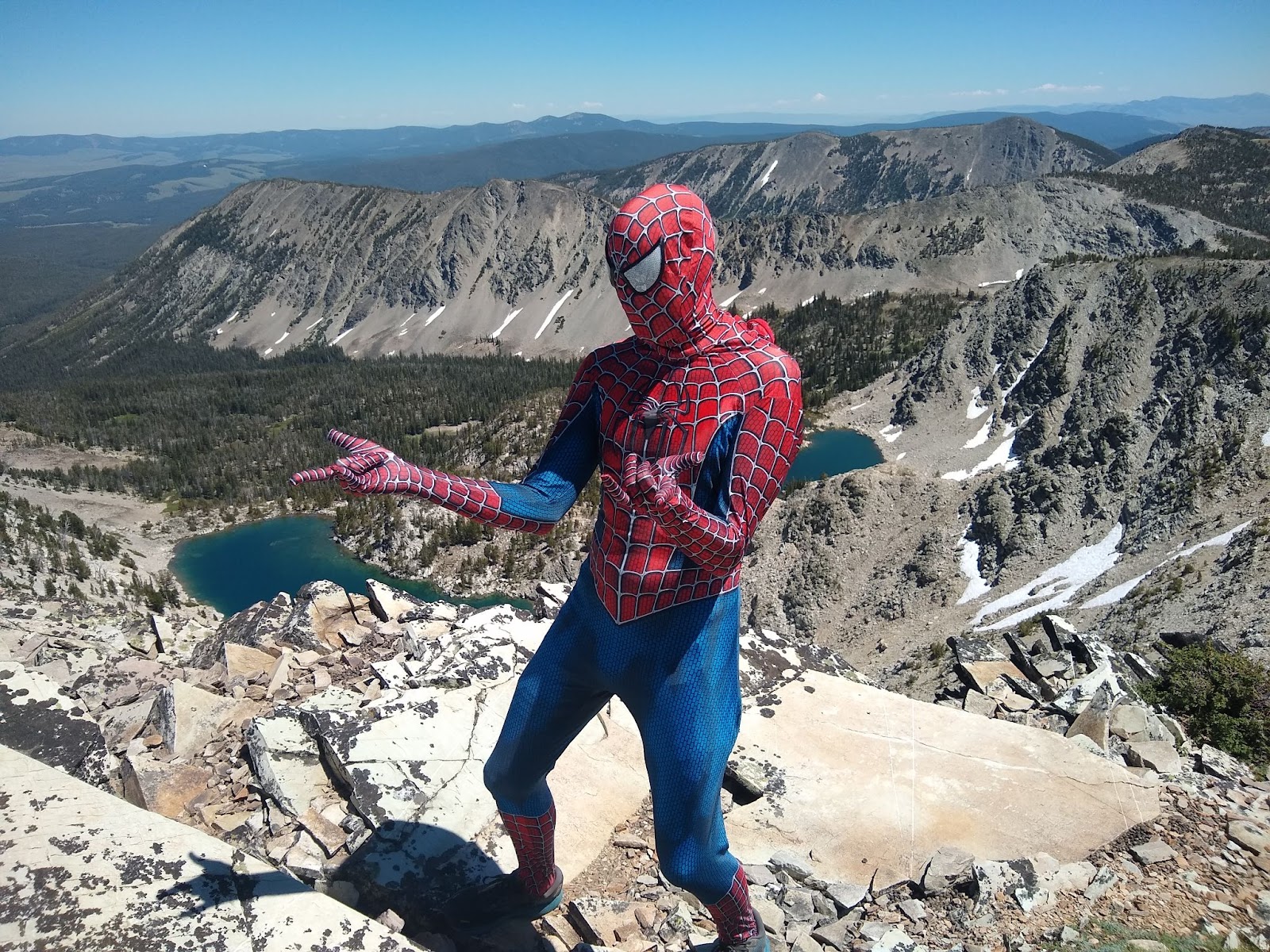
His friend once said that Cline was the “least zealous ultrarunner” he had ever met, which Cline regarded as a compliment, although he did don a Spiderman costume the last time he ran Beaverhead.
Other Hillsdale ultrarunners completed their first race here in Michigan.
After running off and on for four years and wanting to try an ultramarathon for about as long, George Roche Sports Complex custodian Andrew Hollenbaugh ran his first ultra in August 2024 — the North Country Trail 50K in Manistee National Forest in Michigan.
“From the start of the race to the end of the race, there was nothing but support and love,” he said.
Hollenbaugh said he relaxes while running, letting his mind go completely blank and tuning out daily stress. He sometimes listens to audiobooks and podcasts, though he will put on music when he needs more motivation.
“My race had plenty of conversation with some amazing people running along the way,” he said.
According to Hollenbaugh, ultrarunner personality types vary with some unifying elements.
“Overall, ultrarunning attracts adventure seekers, outdoor lovers, and people who just want to find peace in their minds while pushing their limits,” Hollenbaugh said.
Steele drew a similar connection between ultrarunner optimism and testing the limits.
“If you’re trying to do something, and it’s really questionable as to whether you can do it or not, talk to an ultrarunner. The ultrarunner is not the person who will say you can’t do that,” Steele said. “They’re the ones who say, ‘Maybe you can.’ That’s the mentality.”
According to Steele, running shorter distances is more competitive, with people more focused on beating each other. Even way back in the pack of an ultra, it’s more of a question of how to help each other get through it.
“We’re all doing something really hard,” Steele said.
These ultrarunners believe the distance covered, and sometimes who they run alongside, is more important than a record-breaking time.
“No one cares about your time. The slower you go, the more fun you have,” Cline said.